


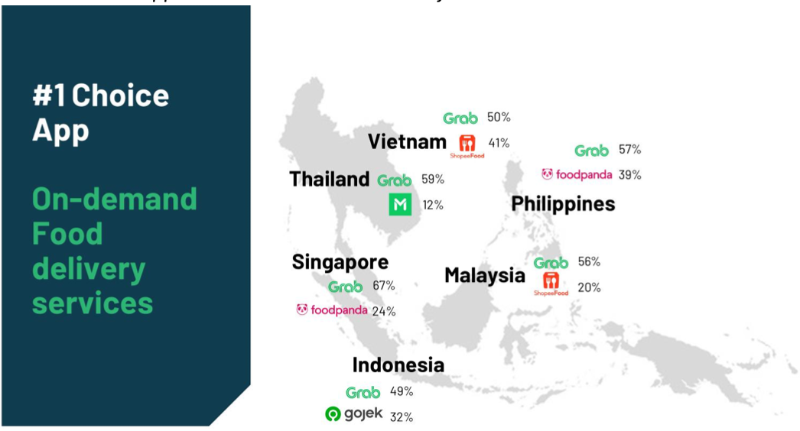
A recent study by Ipsos Indonesia on consumer perceptions and satisfaction across Southeast Asia found that Vietnam has become a highly dynamic market for major food delivery and ride-hailing categories, with established players such as Grab, ShopeeFood, Be, and Xanh SM competing for market share.
The market’s rapid expansion is expected to continue in the coming years. According to the e-Conomy SEA 2025 report by Google, Temasek, and Bain & Company, Vietnam’s online food delivery market is projected to reach $9 billion by 2030. Meanwhile, research by AgileTech estimates that the country’s ride-hailing market could grow to $2.56 billion by 2030.
This strong growth trajectory has created a complex competitive environment in which consumer perception and brand differentiation are becoming critical success factors. Ipsos data showed that users across Southeast Asia access food delivery services an average of 13 times per month, while ride-hailing applications are used approximately 21 times per month.
However, the market’s rapid growth is also intensifying competition. Ipsos noted that Vietnam’s on-demand landscape is being shaped by two key factors: a highly concentrated market structure and the accelerated pace of digital adoption following the Covid-19 pandemic. Under such conditions, brand perception and consumer preference are becoming increasingly important competitive advantages.
According to Ipsos Indonesia’s research, Grab has maintained a strong leadership position across Southeast Asia, including Vietnam. The platform is also perceived as the most trusted brand in both on-demand food delivery and ride-hailing services, with a trust score of 45 per cent, compared with Shopee at 42 per cent, Xanh SM at 33 per cent, and Be at 25 per cent.
However, this growth has also intensified competition among established players in Vietnam. In the ride-hailing segment, Grab maintained its position as the top-choice application, outperforming Xanh SM and Be. In the on-demand food delivery segment, Grab also emerged as the leading platform after edging out ShopeeFood in a closely contested market.
In the food delivery segment, 50 per cent of respondents identified Grab as their first-choice application, placing it ahead of competitors in the market. According to Ipsos, consumer preference in this category is largely influenced by brand recognition and service convenience. The analysis highlighted several factors contributing to Grab’s performance, including a simple user experience, stronger order-tracking capabilities, perceived data security advantages over ShopeeFood, and a balance between service quality and affordability. Grab also outperformed ShopeeFood and Be in terms of price perception.
Meanwhile, in the ride-hailing segment, 68 per cent of respondents identified Grab as their preferred application, outperforming other market players, including Xanh SM and Be. Ipsos found that becoming the top choice means becoming the “go-to” app that users open instinctively because they trust it as the right option for booking a ride. Grab’s performance in on-demand transportation also exceeded its performance in the on-demand food delivery segment.
Grab’s leadership reflects several strengths, including its broad range of services, simple and user-friendly interface, strong brand recognition, service quality, and cost and time efficiency. According to Ipsos, several key factors underpin Grab’s strong performance.
First, Grab outperforms Xanh SM and Be through its wider range of transportation services.
Second, the app’s simplicity and ease of use play an important role in driving user preference, with Grab outperforming its competitors in this area as well.
Third, peace of mind when using the application remains a critical factor for transportation users, similar to the on-demand food delivery sector. In this regard, Grab performs strongly in terms of data security and overall user experience.
In addition, Grab stands out in delivering service quality at an appropriate price point, achieving a balance between affordability and service standards in the ride-hailing segment.
The platform also leads in terms of brand popularity, outperforming competitors not only in functionality, application usage, and pricing, but also in overall consumer recognition. Furthermore, Grab has successfully established itself as the market leader in consumer perception of time and cost efficiency.
The survey was conducted by Ipsos Indonesia in August 2025 through an online study involving 3,500 respondents aged between 21 and 45 across six Southeast Asian countries, including 500 participants from Vietnam.
The findings suggest that competition in Vietnam’s on-demand market is increasingly shifting beyond pricing strategies towards broader factors such as user experience, trust, and service quality.








 Google translate