


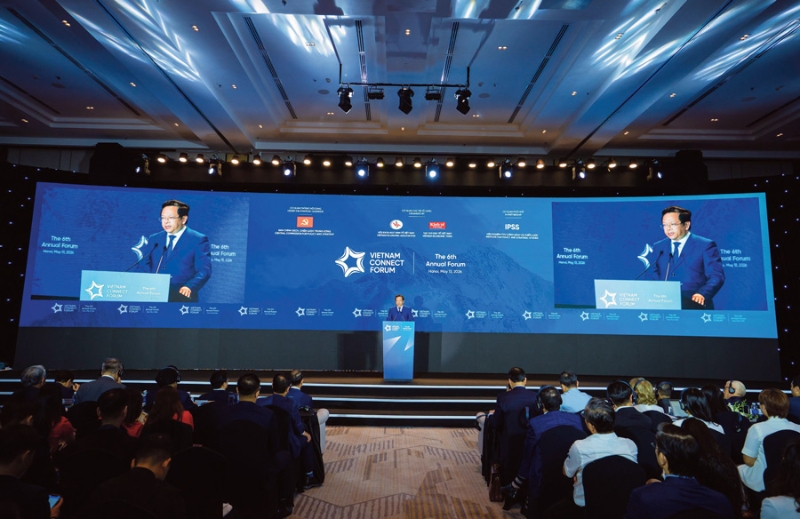
To adapt to a changing landscape, Vietnam must fundamentally rethink its traditional approach to the FDI sector. Rather than focusing narrowly on the concept of “attracting FDI,” the capital source should be viewed as an inseparable and organic component of the country’s broader growth model.
This transition requires a comprehensive roadmap for reform, spanning investment attraction policies, industrial development strategies, infrastructure planning, and the creation of a sustainable business ecosystem. Foreign-invested enterprises (FIEs) should no longer be regarded merely as a source of capital but as key stakeholders that can strengthen national capabilities and elevate industrial competitiveness. The overarching objective is to build an independent, resilient, and strategically-autonomous economy that remains deeply integrated into global economic flows.
Attracting new-generation FDI
To achieve its double-digit economic growth targets, Vietnam faces an enormous capital requirement, estimated at VND38,500 trillion ($1.48 trillion). While the public sector is expected to contribute approximately VND8,300-8,500 trillion ($319.2-326.9 billion), the bulk of the remaining funding, more than VND30,000 trillion ($1.15 trillion), must come from the private sector, investment funds, and foreign enterprises.
Against this backdrop, improving institutions to capture the next wave of “new-generation FDI” has become a top priority. A key shift in thinking is that Vietnam must pay closer attention not only to direct investment inflows but also to foreign indirect investment (FII). This is expected to become a core focus of an upcoming Politburo resolution on the foreign-invested economy, which will have a broader scope than previous frameworks.
To attract new-generation FDI and strengthen links between FIEs and domestic enterprises, Vietnam must fundamentally renew its mindset, vision, and policy objectives. The country’s new strategy can be distilled into four “golden keywords.”
The first is “holistic integration.” In the past, Vietnam tended to simply emphasize the concept of “attracting FDI.” Today, FDI must instead be treated as a core component of the country’s growth and development model. This requires a comprehensive overhaul of policies, from investment attraction and industrial development to infrastructure and ecosystem building.
Rather than evaluating performance through fragmented reports focused solely on disbursed capital figures, FDI should be integrated into the broader national growth model. Policies must be interconnected, linking investment promotion with industrial development, infrastructure, and ecosystem support.
This perspective also requires coherence across Vietnam’s various policy resolutions, including Resolution No. 10 (2017) and Resolution No. 68 (2025) on private economic development, Resolution No. 12 (2025) on restructuring State-owned enterprises, Resolution No. 79 (2025) on State economic development, and Resolution No. 50 (2019) on FDI. A forthcoming resolution on the foreign-invested economy will broaden the scope further to include both FDI and FII, reflecting a more unified strategic framework.
Within this framework, State-owned enterprises (SOEs) should remain central in areas tied to national defense and security - sectors where private enterprises may not be well-positioned to operate. Meanwhile, FIEs should be seen not only as capital providers but also as partners that enhance Vietnam’s national competitiveness and industrial capabilities.
The second keyword is “ecosystem.” This approach goes beyond incentives and infrastructure to include a shift in governance mindset. Public institutions must transition from a “management” role to an “enabling” role that facilitates business growth.
Building an ecosystem also means paying greater attention to nurturing and upgrading existing FIEs, rather than focusing exclusively on attracting new projects. In this context, localization should no longer be measured merely as a percentage ratio but by the extent to which Vietnamese businesses participate meaningfully in value chains.
The third keyword is “co-creation.” FDI attraction should no longer focus solely on capital inflows or job creation - traditional metrics that previously dominated policymaking. Instead, FDI should help transfer management expertise, strengthen economic capabilities, and improve Vietnam’s global standing.
And the fourth keyword is “global orientation.” Economic links should not be limited to Vietnam’s domestic market of 100 million people, but should aim outwards to capture higher value from global markets.
Synchronizing policies
Turning this philosophy into reality will require coordinated policy implementation. A new resolution on the foreign-invested economy is expected soon, but broad policy alignment across sectors will be equally important.
At the macro level, Vietnam needs synchronized reforms in land, investment, planning, construction, tax, data, AI, science and technology, and finance policies. Notably, the National Assembly is expected to undertake a comprehensive revision of the Land Law in late 2026, addressing issues such as lease durations, land classification, pricing, and administrative procedures.
Vietnam must also adopt a more ambitious approach to sandbox frameworks in emerging sectors. The current model, in which ministries propose isolated sandbox mechanisms on a case-by-case basis, has often resulted in prolonged delays, with some frameworks taking more than three years to materialize.
Sectoral strategies will also require updates. The Ministry of Industry and Trade is preparing a range of industrial policies to support reindustrialization, including a Law on Key Industries. Vietnam is also reviewing industrial strategies, launching Go Global programs, and seeking to reduce logistics costs, which currently account for roughly 18 per cent of GDP; a relatively high level.
The financial, banking, and monetary sectors will likewise require reforms, including new support packages for priority industries. In energy, breakthrough policies will be needed to unlock offshore wind and renewable energy development, supported by stronger marine spatial planning frameworks.
At the local level, fiscal mechanisms should be reformed to give localities greater flexibility in supporting businesses. Some localities possess substantial financial resources but face regulatory barriers that prevent the effective use of funds, including for workforce training initiatives.
Vietnam also needs a comprehensive review of investment incentives. At present, incentives are spread too broadly, with roughly 78 per cent of second-tier manufacturing sub-sectors receiving preferential treatment. Going forward, incentives should be more targeted, focusing on priority sectors, regions, and enterprise categories. Rather than relying mainly on input-based tax incentives, policies should increasingly be tied to measurable outcomes and firm commitments.
The country should also establish a national program for priority industries, enabling the government to negotiate directly with major corporations and investors instead of leaving decisions entirely to local authorities.
Capital mobilization will remain central. Vietnam must streamline administrative procedures and strengthen the business environment to better attract FDI inflows. Greater attention should also be paid to cross-border capital flows, particularly through international financial institutions and investment funds, given that Official Development Assistance (ODA) often comes with high costs and significant conditions.
Additional recommendations for attracting next-generation FDI include improving Power Purchase Agreements (PPAs), expanding guarantee mechanisms, securing lower-cost financing, and fostering the development of investment fund industries such as index funds and trusts through more supportive tax policies. If Vietnam aims to remain competitive internationally, it must align more closely with, and in some areas exceed, global standards.
Strengthening domestic capacity
Alongside reforms targeting foreign investors, support policies for domestic enterprises, particularly small and medium-sized enterprises (SMEs), must be implemented more effectively before, during, and after FDI attraction efforts. Revising SME support legislation is considered essential.
Local governments should also use budget resources more flexibly to support workforce training and foster stronger collaboration between local authorities, educational institutions, and businesses. Successful models from provinces such as Bac Ninh and Bac Giang could provide valuable lessons for replication.
For FIEs, Vietnam should encourage reinvestment by offering stronger incentives for second-phase or expansion projects, including easier land-use rights transfers and preferential treatment for retained earnings reinvested domestically.
Ultimately, the success or failure of this strategy will depend on implementation discipline. Even the best policy direction will struggle to deliver results if institutional reforms are slow, inconsistent, or unstable. Vietnam must avoid fragmented local implementation and instead reduce compliance costs in a meaningful way.
The country remains committed to viewing FIEs as an integral part of its long-term development strategy. With trust, policy consistency, and mutual understanding, Vietnam can unlock new spaces for sustainable growth.




 Google translate