


Recent discussions in Hanoi highlighted Russia’s efforts to promote SMR technology in Vietnam, positioning next-generation nuclear energy as a stable and low-carbon power source capable of supporting economic growth, energy security and industrial development.
Interest in SMRs has been growing as Vietnam is looking for stable, low-carbon electricity sources capable of supporting its long-term economic and industrial expansion.
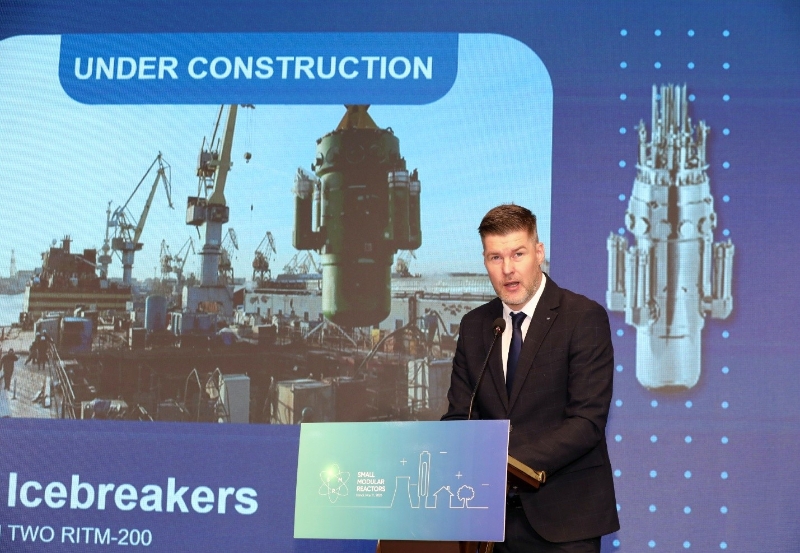
At the international seminar “Small Modular Reactors (SMRs): Strategic Solution for Vietnam’s Energy Security”, jointly organized by Vietnam Economic Times/VnEconomy and Vietnam Atomic Energy Institute in Hanoi earlier this month, Mr. Dmitry Raspopin, Director of Rosatom’s country office in Vietnam, shared insights into Rosatom’s SMR development strategy and the global outlook for next-generation nuclear technologies.
According to Mr. Raspopin, the intergovernmental agreement signed between Vietnam and Russia in March 2026 created an important foundation for a new phase of bilateral cooperation in nuclear energy.
Vietnam, he noted, is emerging not only as a rapidly growing energy market but also as an increasingly important technology and industrial hub in Southeast Asia. This transformation is expected to significantly increase demand for reliable 24/7 electricity supply - particularly for industries such as AI, cloud computing, semiconductors and large-scale data centers.
“Renewable energy without baseload generation cannot fully guarantee the required level of reliability,” the Rosatom representative said.
SMRs are increasingly being viewed as a possible option for countries seeking to expand electricity generation capacity while also reducing carbon emissions and maintaining grid stability.
From nuclear icebreakers to powering the AI era
One of the most notable points in Rosatom’s presentation was its positioning of SMRs not merely as an energy technology, but as foundational infrastructure for the digital economy.
According to Rosatom, AI, data centers, semiconductors and cloud computing all share one common requirement: absolutely stable, uninterrupted electricity supply that is not dependent on weather conditions. This is where SMRs are believed to have advantages over many other energy sources.
Rosatom explained that its SMR technology was developed from reactor systems originally designed for Russia’s nuclear-powered icebreaker fleet - currently the only nuclear icebreaker fleet in the world.
Drawing on more than 400 reactor-years of operational experience in harsh Arctic environments, Rosatom developed the RITM-200 reactor series, which is now used for icebreakers, land-based SMRs and floating nuclear power plants.
The standard land-based SMR configuration includes two RITM-200N reactors with a combined capacity of 110 MW, a fuel cycle of up to six years and a design lifetime of 60 years.
Rosatom considers this particularly suitable for countries with developing power systems or regions that do not yet require massive power generation capacity but still demand high reliability.
Unlike conventional nuclear power projects, which are often associated with multi-billion-dollar investments and lengthy construction timelines, SMRs are being promoted as a more flexible solution with lower capital costs and shorter construction periods.
Importantly, SMRs can be deployed near industrial zones, data centers or coastal areas where electricity demand is growing rapidly but transmission infrastructure remains limited.
Floating “nuclear batteries” and global expansion plans
Rosatom is currently one of the world’s leading exporters of nuclear power technology. Of the 25 nuclear export projects currently under construction worldwide, 22 are being implemented by Rosatom.
The group’s international portfolio now includes 35 large nuclear power units and six SMR units across 11 countries, ranging from China, India and Bangladesh to Hungary, Egypt, Uzbekistan and Kazakhstan.
One of the projects highlighted by Rosatom was the Akademik Lomonosov floating nuclear power plant in Pevek, Russia - currently the world’s only commercially operating floating nuclear power plant.
The facility uses two KLT-40S reactors with a total electrical output of 77 MW. Since entering operation in 2020, it has generated around one billion kWh of electricity by early 2025. According to Rosatom, the plant is expected to meet approximately 84% of local electricity demand from 2026 onward.
Building on that experience, Rosatom is now developing a new generation of “floating nuclear batteries” for international markets. These floating power units are designed as non-self-propelled barges equipped with two RITM-200M reactors and two steam turbines, delivering around 100 MW of electricity.
According to Rosatom, the model is particularly suitable for coastal regions, remote islands, mining areas, locations with weak grid infrastructure and emerging industrial hubs with high electricity demand but limited access to stable power supply.
Another notable aspect is that Rosatom is not only offering technology, but also moving toward long-term power purchase agreement (PPA) models in which the company would operate the facilities throughout their lifecycle.
This reflects a broader shift within the nuclear industry - from selling equipment to providing energy services.
More than electricity: Infrastructure for long-term growth
SMRs are increasingly being viewed not only as an additional power source, but also as a potential catalyst for economic growth and the development of high-tech industries.
According to the figures presented at the conference, a single SMR project could create around 700 jobs during construction and more than 300 permanent jobs during commercial operation. Nuclear projects are also expected to help local businesses integrate more deeply into global industrial supply chains.
As electricity demand continues to rise sharply due to the expansion of AI, data centers and the digital economy, SMRs are increasingly being discussed as a potential tool for supporting decarbonization efforts in developing economies.
Nuclear energy is also regarded as one of the lowest life-cycle greenhouse gas emission sources among large-scale power generation technologies today.
For Vietnam, SMRs are still at an early stage of policy discussion and technology cooperation. However, as power demand is projected to continue rising rapidly in the coming years - especially from high-tech industries and digital infrastructure - next-generation nuclear technologies such as SMRs are beginning to attract greater attention as a possible long-term option for national energy security.




 Google translate