


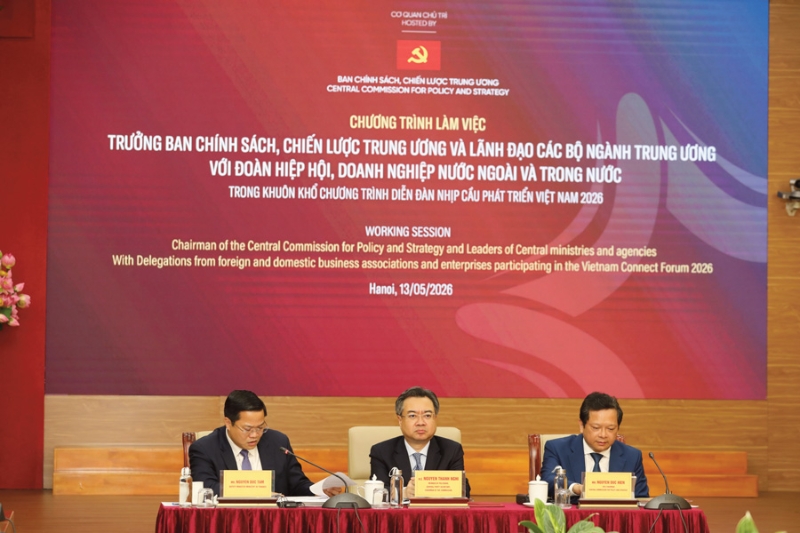
During a working session with Mr. Nguyen Thanh Nghi, Politburo Member, Secretary of the Party Central Committee, and Chairman of the Central Commission for Policy and Strategy, and leaders from ministries and agencies on May 13, representatives from foreign business associations said the country’s next phase of development will depend increasingly on execution, particularly in areas such as administrative reform, policy consistency, workforce readiness, infrastructure, and higher-value investment. They also offered recommendations on improving Vietnam’s business environment.
Addressing the business environment
Among the issues raised, administrative reform and policy consistency emerged as the most immediate concerns, with several representatives arguing that “ease of doing business” will increasingly shape Vietnam’s competitiveness in attracting long-term investment.
Mr. Bruno Jaspaert, Chairman of the European Chamber of Commerce in Vietnam (EuroCham), argued that Vietnam’s future competitiveness no longer lies in offering cheaper electricity or stronger tax incentives, both of which are already relatively attractive within Southeast Asia. Rather, he said, the country should focus on improving the ease of doing business.
Citing EuroCham’s Business Confidence Index, Mr. Jaspaert noted that administrative procedures have consistently remained the top concern among European businesses for the past eight years. Though legal reforms have moved in a positive direction, implementation at the local level remains uneven, he said, with companies in some cases waiting years for refunds as substantial capital remains tied up.
Mr. Ko Tae Yeon, Chairman of the Korean Chamber of Business in Vietnam (KOCHAM), added that lengthy VAT settlement procedures have created cash flow difficulties for many manufacturers, despite VAT being an indirect tax intended to be reimbursed.
Beyond taxation, business associations repeatedly highlighted inconsistencies in regulatory interpretation between localities as a major challenge for long-term investment planning. According to Mr. Jaspaert, practices permitted in one locality may become difficult or impossible in another due to different interpretations of the same legal framework.
Mr. Ko likewise said South Korean investors frequently encounter confusion when policies are applied differently across agencies and localities, making it difficult for businesses to operate with certainty.
Representatives from the Singaporean and US business communities shared similar concerns, while acknowledging progress in recent legal reforms. Mr. Seck Yee Chung, Vice President of the Singapore Chamber of Commerce Vietnam (SingCham), welcomed efforts to improve transparency through revisions to investment regulations, including special investment procedures designed to accelerate project approvals. However, he noted that uncertainties remain regarding project eligibility, technical standards, and implementation. Sub-licenses, particularly for foreign-invested enterprises (FIEs), also continue to take considerable time despite improvements in primary investment approvals, he added.
Meanwhile, Ms. Virginia Foote, Chairwoman of the American Chamber of Commerce in Vietnam (AmCham), said administrative burdens remain relatively high, particularly regarding land lease renewals and differences in how local authorities interpret tax, investment, and land regulations.
Still, she acknowledged growing openness from ministries during consultations on decrees and circulars, describing engagement between authorities and business associations as an important part of improving implementation.
Mr. Denzel Eades, Chairman of the British Chamber of Commerce Vietnam (BritCham), added that predictability, transparency, and consistency in policy execution are essential for attracting long-term foreign capital. “FDI is deployed in a competitive context,” he said, and certainty in the investment environment is often what determines whether international investors commit for the long term.
Building the next growth engine
Beyond administrative reform, foreign business representatives said Vietnam’s next phase of development should focus not only on attracting investment, but also on strengthening domestic capabilities through technology transfer, workforce development, and deeper integration between FIEs and local enterprises. Several representatives argued that the long-term value of FDI should increasingly be measured not only by capital inflows but also by its contribution to Vietnam’s industrial ecosystem.
Mr. Jaspaert emphasized that Vietnam should prioritize building stronger domestic supply chains and encourage investors to contribute technology, expertise, and local sourcing capacity alongside financial investment. “The best ambassadors for attracting more FDI are the investors already here,” he said, adding that Vietnam should ask not only how much capital investors bring but also what technology, skills, and local supplier development they can contribute.
He noted that stronger local ecosystems would make Vietnam more resilient during periods of global disruption, while technology transfer would help generate longer-term value embedded in patents, know-how, and human capital.
Localization was also a major concern for South Korean businesses. According to Mr. Ko, Vietnam’s local sourcing ratio remains relatively low, at around 20 per cent, compared with roughly 40 per cent in several other Asian economies. To help Vietnamese firms better integrate into global value chains, he said the government could provide more practical financial support for domestic enterprises seeking to meet international quality and technology standards.
At the same time, several speakers stressed that workforce readiness will be equally important in absorbing higher-quality investment and technological upgrading. Mr. Ko said stronger collaboration between schools and enterprises is needed to better align education with labor market needs, particularly in engineering and technical fields.
Mr. Jaspaert similarly described education as a form of national infrastructure and one of Vietnam’s strongest long-term competitive advantages. He suggested the country aim to build the strongest education system in Southeast Asia, emphasizing accessibility and affordability.
Additionally, Mr. Seck said Vietnam should move beyond distinctions between FIEs and domestic enterprises and instead focus on building a stronger business ecosystem where local companies can participate more actively in global supply chains. In his view, the government’s role is to create the right environment for businesses to thrive. “Build the stadium, build the pitch, establish the rules, appoint the referees, and businesses will be the players on the field,” he said.
Ms. Foote told the gathering while many international companies are impressed by Vietnamese talent, gaps remain between education outcomes and industry requirements, particularly in engineering, technical, and management capabilities. Strengthening links between education institutions and employers, especially universities and technical training systems, would help Vietnam attract faster and higher-value investment, she said.
Human capital development was also highlighted by Mr. Eades, who pointed to opportunities for deeper international education partnerships, including collaboration between Vietnamese and UK universities to support talent development and cross-border learning.
Energy and infrastructure as enablers
As Vietnam seeks to move up the value chain and attract higher-quality investment, business associations said energy security and infrastructure development will play an increasingly important role in sustaining growth. Several foreign chambers pointed to rising investor demand for renewable energy access, warning that implementation delays and policy uncertainty could constrain Vietnam’s competitiveness in the years ahead.
Ms. Foote said access to reliable and renewable energy has become increasingly important for international investors, particularly those from the US, Europe, and Japan, where environmental requirements are becoming more prominent in investment decisions.
While Vietnam’s offshore energy potential remains significant, she said progress in opening the sector to broader investment has moved too slowly. Energy companies, she added, remain interested in partnering with Vietnamese counterparts to develop offshore wind, solar, onshore wind, and biomass projects. However, she emphasized that the National Power Development Plan VIII (PDP8) will need faster implementation to unlock meaningful investment.
Mr. Eades echoed similar concerns, arguing that energy transition should be viewed not only as an environmental objective but also as an economic and energy security priority. Under PDP8, he noted, Vietnam will require more than $25 billion in annual investment across power projects and grid infrastructure, raising questions over how capital can be mobilized and deployed efficiently.
For investors, one of the biggest priorities is a clear route to market and certainty over project timelines, particularly regarding when projects can realistically achieve commercial operation, he said. He also stressed the importance of creating financing frameworks capable of supporting large-scale infrastructure projects, particularly through non-recourse project finance, which could help attract deeper pools of international capital for LNG and offshore wind developments.
Grid infrastructure was another recurring concern. According to Mr. Eades, clearer mechanisms are needed to allow greater private sector participation in transmission and grid development, alongside continued progress on the Direct Power Purchase Agreement (DPPA) mechanism and regulatory frameworks for battery energy storage.
South Korean businesses similarly highlighted uncertainty in renewable energy investment. Mr. Ko said many investors remain hesitant to commit capital due to unclear implementation frameworks, suggesting Vietnam consider regulatory sandbox mechanisms that would allow policies to be tested and adjusted more quickly.
Beyond energy, infrastructure connectivity and urban planning were also identified as critical factors in supporting future investment. Mr. Seck pointed to improvements in transport connectivity in northern Vietnam but said stronger links between airports, industrial parks, and seaports, particularly in the south, remain necessary to facilitate the efficient movement of people and goods.
He also stressed the importance of township planning alongside industrial development, arguing that attracting talent to industrial parks will require more comprehensive ecosystems, including housing, healthcare, and supporting services. “We cannot have cities or provinces that are simply large factory zones,” he said.
For sectors such as data centers and other high-tech industries, he continued, greater clarity around zoning, land use planning, and long-term development frameworks will also be increasingly important for investor confidence.
Unlocking capital
Alongside improvements to the business environment and infrastructure, business associations said Vietnam will need deeper pools of capital and stronger market institutions to support its long-term growth ambitions.
Mr. Eades said international capital will play a critical role in helping Vietnam achieve double-digit growth and its goal of becoming a high-income economy by 2045, noting that domestic capital markets alone are unlikely to be sufficient. “The priority now is for that strategic direction to be supported by an enabling environment that allows foreign capital to be deployed and to flow,” he said.
In an increasingly competitive global investment landscape, predictability and transparency remain key considerations for investors deciding where to allocate long-term capital, he went on. He also expressed support for Vietnam’s International Financial Center initiative, describing it as an opportunity not only to attract additional capital but also to introduce more sophisticated financial products and innovation into the economy.





 Google translate