


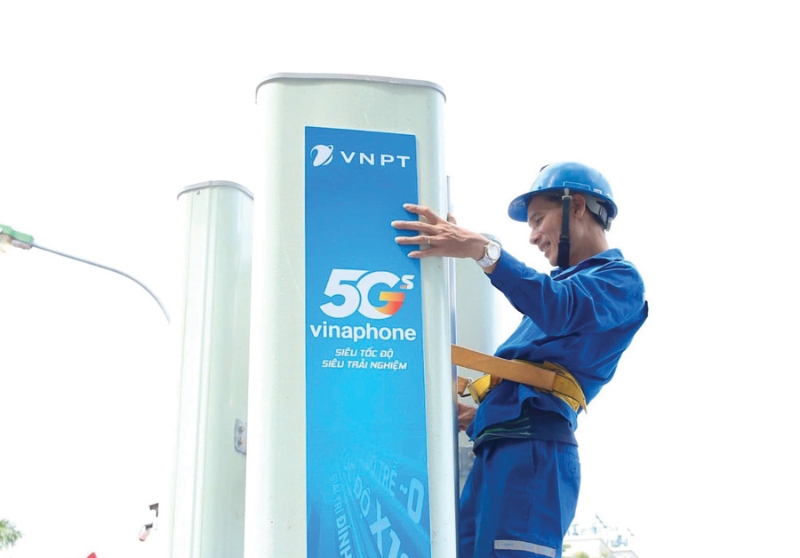
Investment in 5G is an investment in national digital infrastructure, establishing the groundwork for new business models and innovative digital solutions while enabling deeper and more sophisticated growth in the digital economy. As 5G networks continue to expand in the age of AI, Vietnam must prioritize building robust and resilient infrastructure to position itself as a standout digital economy in the region.
Major rollout plan
Just over a year since the launch of 5G services, Vietnam has made remarkable progress in expanding its network infrastructure. As of February, nearly 40,000 base stations had been deployed nationwide, covering approximately 90 per cent of the population and reaching close to 23 million subscribers.
These figures were was shared by Mr. Nguyen Phong Nha, Deputy Director General of the Vietnam Telecommunications Authority (VNTA) at the Ministry of Information and Communications (MoIC), during the “5G, Subsea Cables and Satellite Telecom” discussion session held within the recent EU-Vietnam Global Gateway Business and Investment Forum.
Vietnam’s broader telecommunications landscape also reflects strong momentum. The country currently has five mobile network operators and six mobile virtual network operators (MVNOs), serving a total of 120 million mobile broadband subscribers. Average download speeds have reached 188 Mb/s, ranking Vietnam 14th globally.
In fixed broadband, it has around 25 million FTTH (fiber-to-the-home) subscribers, with average download speeds of 288 Mb/s, placing it ninth in the world. Fiber-optic penetration has also expanded rapidly, with some 85 per cent of households now connected to fiber networks.
Emphasizing the potential of 5G in Vietnam, Ms. Rita Mokbel, CEO of Ericsson Vietnam, highlighted its relevance as the country strengthens its position as a regional manufacturing hub. “We clearly see the benefits of combining AI with manufacturing here in Vietnam,” she said. “5G is enabling Industry 4.0, where machines, people, robots, and sensors are all connected in real time, and AI helps deliver continuous performance.”
She also pointed out that this convergence is already reshaping factory operations, making them more responsive and efficient. “Robots can be controlled remotely, and issues are detected in real time,” she added. “Ericsson is already seeing these benefits in our 5G smart factory in the US, and we hope to bring all the advantages of 5G to manufacturers and factories around Vietnam.”
From the perspective of local telecom operators, Mr. Nguyen Quoc Khanh, Deputy Chief Technology Officer at the Vietnam Posts and Telecommunications Group (VNPT), noted that the transition to 5G, combined with cloud-based technologies, edge computing, and data processing, will significantly expand the number of digital touchpoints across the network.
“As we move toward 5G, cloud-based technologies, together with edge computing and data processing, will create countless new touchpoints,” he said. “Ensuring security for infrastructure, customers, and end users therefore becomes critically important.” VNPT is actively adopting advanced security approaches to address these challenges. “We are moving toward a Zero Trust model and embedding security from the design stage,” he explained.
Meanwhile, Viettel is taking a comprehensive approach to risk management in building its telecom infrastructure, integrating security considerations across the entire network lifecycle. The group applies risk governance frameworks throughout all stages, from policy formulation and network design to procurement, deployment, and especially operations.
Further elaborating on this approach, Mr. Ha Minh Tuan, Director of the Technical Division at the Viettel Group, emphasized that procurement serves as a clear example of how security is embedded across the network lifecycle. “Security, safety, origin, traceability, and quality standards are mandatory criteria, and they are institutionalized in contracts,” he explained. “We need to master our own technologies to ensure national security. Currently, around half of Viettel’s core network is operated using equipment that we have researched and manufactured ourselves. Viettel is also targeting 99 per cent population coverage for both 4G and 5G this year.”
Building a secure backbone
Vietnam’s accelerating investment in physical infrastructure, from subsea cables to cross-border connectivity, has become a decisive enabler for the next phase of its digital transformation. More than a story of capacity expansion, this upgrade is creating the structural foundation required to absorb and scale advanced technologies from Europe, particularly in 5G and AI.
At the center of this transition is the rollout of 5G, widely seen as the backbone for future digital services. Yet, as Ms. Mokbel pointed out, the value created by 5G is inseparable from the responsibilities it entails. “This creates enormous value, but at the same time a greater responsibility in sensitive data protection and national security, especially when those capabilities are used in defense, emergency services, and aerospace,” she said.
This underscores a critical shift in how infrastructure is being conceptualized. No longer confined to speed and coverage, next-generation networks must now be designed with embedded security from the outset, particularly as they begin to support mission-critical applications across sectors.
As Vietnam positions itself to integrate more deeply with European technology ecosystems, the alignment between infrastructure development and security architecture becomes essential, not only for domestic stability but also for cross-border interoperability. For Vietnam, early alignment with these security frameworks could offer a strategic advantage, positioning the country as a reliable partner in future digital ecosystems.
At the operational level, global technology providers are already embedding themselves within Vietnam’s telecom landscape. Ericsson, for instance, has been working closely with local operators to translate strategic ambitions into concrete implementation. “In Vietnam, we are very proud to work with our customers, the leading communication service providers, and we have formed four different secure 5G taskforces in the country,” Ms. Mokbel said.
A similar emphasis on infrastructure readiness and regional connectivity came from Mr. Hiro Miura, Head of Mobile Networks for Southeast Asia at Nokia, who pointed to the proactive role of Vietnamese telecom operators in shaping the region’s digital landscape. “I really admire Viettel for their initiative in the Asia-Pacific on subsea cabling,” he said. “So I have great respect for Viettel in doing that, and also for the VNPT cross-border network, which already connects five different countries.”
These investments in physical infrastructure are not merely technical achievements; they represent strategic moves to position Vietnam as a regional connectivity hub. By strengthening both domestic and international links, operators such as Viettel and VNPT are laying the groundwork for more advanced digital services, including AI-driven applications that rely on high-speed, low-latency networks.
Crucially, these developments are unfolding at a time when the global AI cycle is entering a new phase of expansion. As Mr. Miura observed, the scale of investment required is only set to grow. “The AI cycle has just started, and it will continue, and investment will only increase, based on what we believe,” he emphasized.
This anticipated surge in demand places additional pressure on network infrastructure, not only to handle greater data volumes but also to support increasingly complex workloads. In this context, the convergence of 5G and AI becomes a defining feature of the next-generation digital economy.
However, the implications go beyond centralized systems. A key emerging trend is the decentralization of computing power, with AI capabilities being deployed closer to end users through edge computing. This shift has the potential to transform how digital services are delivered, making them faster, more responsive, and more accessible. “We will be bringing AI to the people, not only in the data center but at the edge cloud,” Mr. Miura said.
For Vietnam, this evolution aligns closely with broader development goals, including the expansion of digital services to underserved areas and the enhancement of industrial productivity. It also reinforces the importance of building infrastructure that is not only robust, but also flexible enough to accommodate new technological paradigms.
Ultimately, the convergence of physical infrastructure upgrades, 5G deployment, and AI integration points to a single underlying principle: that the strength of a digital economy depends on the integrity of its networks.
In this sense, Vietnam’s current trajectory reflects more than a technological transition. It is a strategic recalibration, one that seeks to balance rapid digital adoption with the demands of security, resilience, and international integration. As European technology providers continue to engage with the market, the country’s ability to align infrastructure development with global standards may well determine its position in the emerging digital order.
We clearly see the benefits of combining AI with manufacturing here in Vietnam. 5G is enabling Industry 4.0, where machines, people, robots, and sensors are all connected in real time, and AI helps deliver continuous performance.







 Google translate