Given that the global scale of the Real-World Asset (RWA) tokenization market remains modest, Vietnam has significant opportunities to anticipate the development wave and attract international capital flows.
Despite unpredictable fluctuations around the world and the trend of cash flows shifting back to developed economies, foreign indirect investment (FII) has not yet left Vietnam’s stock market.
The Ministry of Finance (MoF) has said that collecting information on businesses using trading apps on mobile phones to support investment in financial products is quite difficult. Investors need to carefully research information about mobilizing organizations and ask partners to provide legal documents before making an investment, such as establishment and operational licenses, business lines, and so on. MoF suggested that investors research information on securities companies, fund management companies, and securities investment funds on the website of the State Securities Commission (SSC).
The Central Institute for Economic Management (CIEM) has said the lack of a legal foundation for fintech and the circular economy raises concerns about risks and negative consequences. It is therefore necessary for Vietnam to accelerate the testing of a sandbox mechanism in the banking sector.
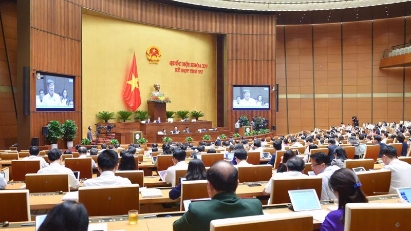
At a discussion session on October 28, many National Assembly (NA) deputies said it is necessary to adopt solutions to restore Vietnam’s corporate bond and securities markets as soon as possible, to ease the pressure on credit. In particular, the government needs to closely monitor interest rates at banks, so that sectors carrying out production and business can access credit at an appropriate cost.
The VND interest rate on the interbank market fell on October 28 for all terms, while the USD/VND exchange rate was also down sharply. Analysts believe the falls reveal that changes in monetary policy management over recent times have been partly effective.
The State Bank of Vietnam (SBV) has reported that average growth in green credit in the 2017-2021 period was more than 25 per cent each year. As of June 30, outstanding loans for green projects stood at more than VND474 trillion ($19 billion), up 7.08 per cent year-on-year but accounting for only 4.1 per cent the total in the economy. At the “Green credit, green banking towards sustainable development in Vietnam” workshop held by the SBV in cooperation with relevant units on October 27, a central bank representative pointed out many obstacles in granting green credit, such as a lack of medium and long-term capital and high market risks.