


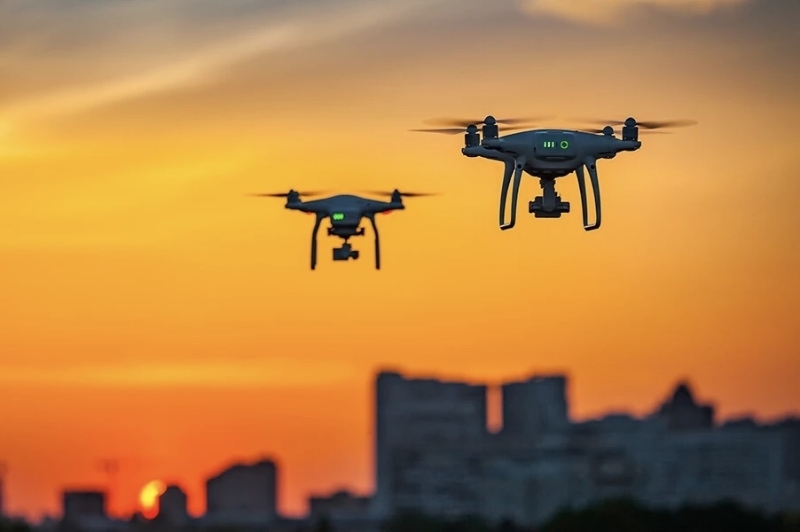
By effectively combining four key strengths—software and AI engineering, the East Asian electronic supply chain, low-cost manufacturing capabilities, and a vast application market—Vietnam is fully capable of becoming a global center for drone development and production.
This message was shared by Minister of Science and Technology Nguyen Manh Hung during a recent working session with Real-time Robotics, a Vietnamese company specializing in robotics and unmanned aerial vehicles (UAVs).
Minister Hung noted that the drone industry is unique in that it does not rely heavily on heavy industry. Instead, it is driven by AI, software, and system integration—areas where Vietnam holds several distinct advantages. Specifically, he highlighted four critical factors:
First, software and AI capabilities. Modern drones are no longer just "small airplanes." Their most vital components are navigation, computer vision, autonomy, and AI control. In other words, software defines the value. Vietnam possesses a massive force of software engineers, a rapidly growing AI sector, and low research and development (R&D) costs. In the modern drone era, software accounts for the largest share of a product's value.
Second, Vietnam’s position in the regional electronic supply chain. Drones require chips, cameras, sensors, motors, and batteries. All of these components are readily available within the East Asian supply chain, including China, Taiwan (China), South Korea, and Japan. Vietnam is situated at the heart of this network, providing a significant logistics advantage for drone manufacturing.
Third, low-cost manufacturing advantages. Drones are categorized as light electronics and light mechanics, produced using modular methods. These types of products are highly compatible with Vietnam’s manufacturing ecosystem and its skilled technical workforce. This is a product category where Vietnam can be globally competitive in terms of production costs.
Fourth, vast domestic demand. Crucially, Vietnam has a wide range of practical applications for drones, such as in agriculture, power grid inspections, forest and maritime surveillance, and logistics. A strong domestic market is essential for businesses to scale rapidly. Many nations have failed in the robotics industry simply because they lacked a robust home market.







 Google translate