


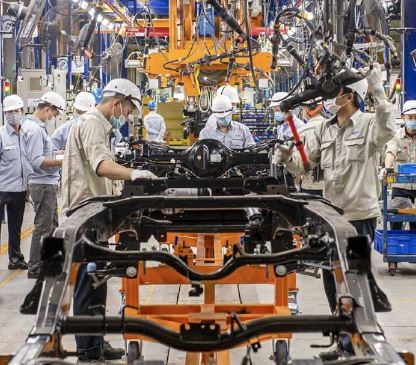
Vietnam continues to lead ASEAN in the readiness of Japanese businesses to expand their investment, according to the 2025 Survey on the Business Conditions of Japanese Companies Investing Overseas released by the Japan External Trade Organization (JETRO) on January 26.
Mr. Haruhiko Ozasa, Chief Representative of JETRO in Hanoi, said the survey results show that 56.9 per cent of Japanese businesses in Vietnam said they plan to expand their operations, thus maintaining the Number 1 position in the region for two consecutive years. “This also confirms the enduring attractiveness of the investment environment in Vietnam,” he added.
Positive signs
The survey found that the percentage of Japanese businesses planning to expand operations in the short term - the next one to two years - in Vietnam is higher than the ASEAN average of 46.8 per cent and the Asia-Oceania average of 45 per cent.
Of the Japanese businesses in Vietnam, 38.2 per cent plan to maintain their current business status, 4.2 per cent want to downsize, and only 0.7 per cent intend to relocate or withdraw to a third country.
Mr. Ozasa pointed out two trends in the expansion of Japanese businesses in Vietnam. First, there is a focus on the domestic market. This trend is evident and concentrated in sectors with high domestic market potential. For example, in the non-manufacturing sector, prominent industries include restaurants, retail, trade, and wholesale. Similarly, in the manufacturing sector, the food industry has the highest rate of investment expansion, to meet the needs of the Vietnamese market.
The second trend is investment in providing services to Japanese businesses already investing and operating in Vietnam. Typical sectors include trade, wholesale, and finance and insurance. “Japanese businesses investing in Vietnam will benefit from the services of their fellow Japanese companies,” Mr. Ozasa emphasized. “This facilitates their business environment and enriches Vietnam’s support industries.”
Notably, businesses in both the manufacturing and non-manufacturing sectors cited expanding domestic market demand and increased exports as reasons for expanding their operations over the next one to two years.
Data from the survey shows that, in Vietnam, 35 per cent of Japanese businesses export to the US. Regarding the impact of tariff measures, 33.8 per cent these responded that the impact was significantly negative, primarily due to declining demand in the US market. Meanwhile, 38.1 per cent of businesses responded that the impact was unclear at the present time.
However, the total value of exports to the US by Japanese businesses in Vietnam accounted for only 7.7 per cent of their total exports. Mr. Ozasa said that the impact of US tariffs at present is not too significant for Japanese businesses. “Some key solutions include adjusting prices, increasing the localization rate, and diversifying markets,” he added. “However, in the future, tariffs on transit goods and tariffs on certain items will have a strong impact on business and investment, so further observation is needed.”
Another noteworthy point from the survey is that the percentage of businesses expecting to be profitable in 2025 reached 67.5 per cent, an increase of 3.4 points compared to the previous year and the highest level since 2009. Notably, this rate has increased for two consecutive years and, for the first time in five years since 2020, has surpassed the ASEAN average of 65.3 per cent, indicating that the business operations of Japanese companies in Vietnam are clearly recovering and maintaining stable growth.
Regarding profit prospects in 2026 compared to 2025, 47.6 per cent of businesses forecast that business conditions will “improve.” The advantages of Vietnam’s investment environment continue to be highly valued by the Japanese business community. The most prominent factors are market size and growth potential (68.4 per cent), low labor costs (55.2 per cent), and a stable socio-political situation (53.2 per cent). These factors demonstrate the increasingly strong confidence of Japanese businesses in Vietnam’s investment environment.
Facing the challenges
Besides the positive points, the JETRO survey also identifies the challenges that Japanese businesses in Vietnam are facing. Among the risks to the investment environment, administrative procedures are still considered complex. The risk assessment level related to complex administrative procedures (licensing, approval, etc.) has increased sharply since 2019 and rose by a further 5.1 points last year compared to 2024.
The licensing process is another complexity; when the legal system changes, past events may be applied retrospectively and evaluated under current regulations. When transporting products containing certain regulated chemicals, businesses have submitted applications for new permits but have yet to receive approval after more than a year. Procedures and requirements for obtaining work permits for foreigners are frequently revised, causing businesses to spend time and money updating information and handling compliance.
In addition, 58.7 per cent of businesses believe that the legal system is incomplete and lacks transparency in its operation. Specifically, there is a lack of guidance on customs clearance regulations, while penalties are applied quickly. Furthermore, regulations vary between localities. Regarding VAT refunds, many businesses have reported issues such as refund applications not being accepted or refunds being delayed.
Market competition with other countries is also a major challenge. In Vietnam, the most frequently cited major competitors are domestic businesses, followed by Japanese, Chinese, and South Korean companies.
In addition, there are concerns about regulations affecting internal combustion engine vehicles, such as policies restricting motorcycles in Hanoi. These are believed to favor certain businesses, be unfair, and negatively affect the competitive environment. Climate change is also cited as a concern.
Given these challenges, Mr. Ozasa believes that the most important task for Vietnam is to establish and maintain an attractive investment environment to attract Japanese businesses in particular and foreign businesses in general.
Vietnam benefits from a stable political and social environment, he continued, so building an investment climate that ensures predictability for businesses is extremely important. “In the context of a volatile global situation, with unpredictable future changes, businesses find it difficult to make important investment decisions,” he added. “I hope that the Vietnamese Government will listen to and work alongside businesses to develop appropriate policies and build a favorable and sustainable investment environment.”

 Google translate