



As the European Union's Carbon Border Adjustment Mechanism (CBAM) enters its financial enforcement phase, carbon emissions are becoming a direct business cost rather than simply a compliance issue. With CBAM certificates priced at €75.36 ($85.94) per ton of CO₂, companies exporting to Europe are increasingly being judged not only on production costs but also on their ability to measure and reduce carbon emissions.
According to experts, the new framework fundamentally changes how exporters compete, adding carbon alongside raw materials, labor, logistics, and capital as a core determinant of profitability.
Speaking at a recent seminar on CBAM readiness, Ms. Hoang Thi Kim Cuong, Deputy Technical Director and Greenhouse Gas Specialist at Vinacontrol Group, said the regulation is creating a clear distinction between companies that manage carbon data effectively and those that do not.
"In the CBAM era, the real divide is no longer between exporters and non-exporters. It is between enterprises that can verify their carbon performance - and those that allow external regulators to price their uncertainty."
Carbon becomes the "fifth cost dimension"
For decades, manufacturers competed primarily by lowering production costs through cheaper labor, improved logistics, and more efficient sourcing. CBAM introduces a new variable into that equation by assigning a direct financial value to carbon emissions.
According to Vinacontrol, this shift is giving rise to two distinct business models.
Model A transforms emissions data into a financial control instrument. By establishing early measurement, maintaining consistent oversight, and reducing carbon intensity before regulatory levies take effect, the enterprise safeguards its operating margins and secures a structural advantage with global buyers.
Model B relies on deferred action. Lacking verifiable metrics or a practical decarbonization roadmap, its financial exposure is dictated by foreign regulatory assumptions, punitive default values, and buyer-side risk premiums. Under this model, carbon shifts from an environmental line item to a direct threat to corporate solvency.
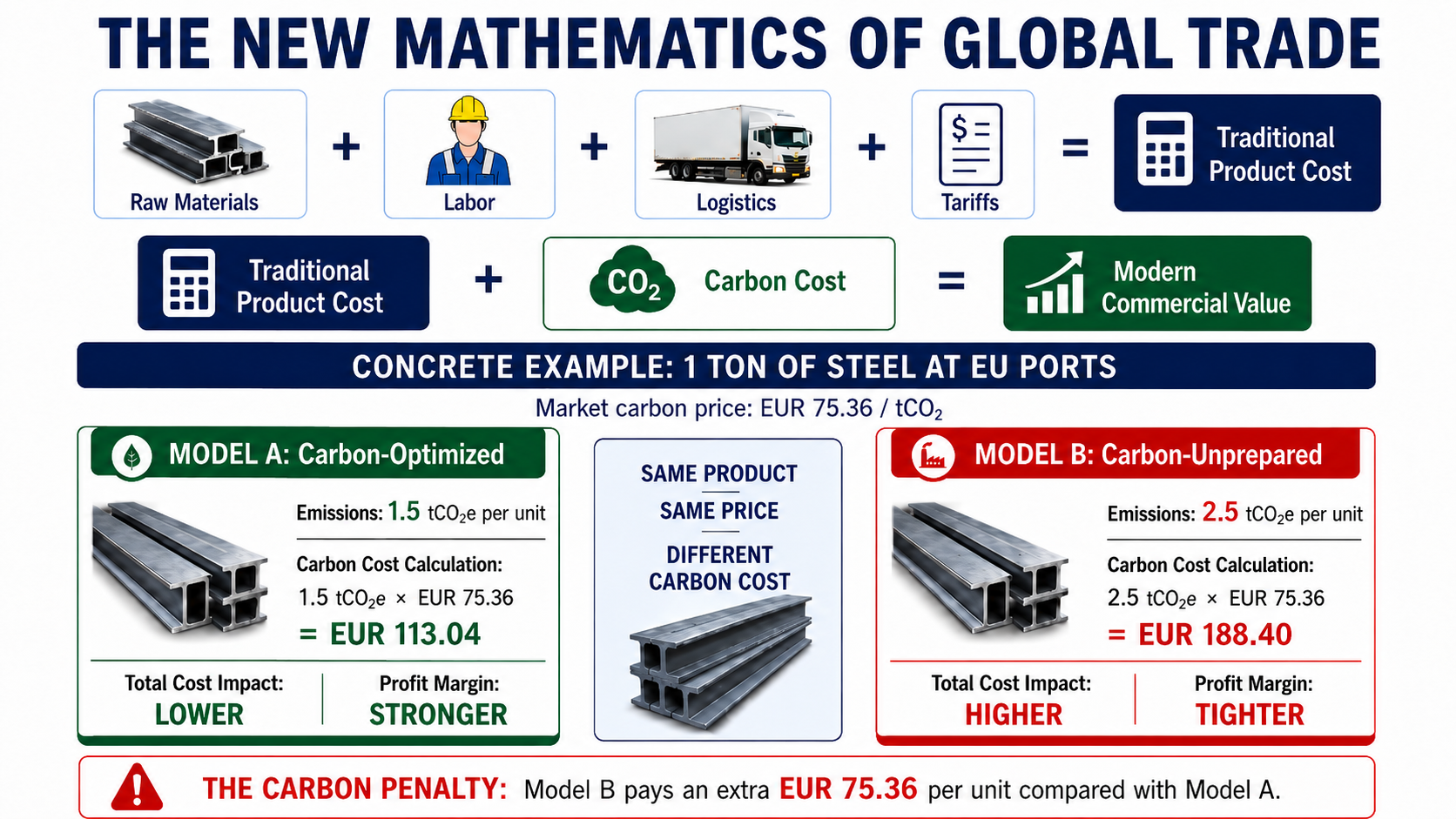
* Financial figures cited in the case study are illustrative estimates based on typical scenarios. Actual outcomes may vary depending on production scale, industry sector, and individual facility conditions.
Common misconceptions leave exporters exposed
Many companies remain vulnerable not because they ignore CBAM intentionally, but because they misunderstand how the regulation will be implemented.
One common assumption is that CBAM affects only direct exporters. However, the European Parliament is already considering expanding the mechanism to more than 180 downstream products by 2028, including automotive components, industrial machinery, and electrical equipment. As a result, suppliers further up the value chain may also be required to provide verified emissions data.
Another misconception is that companies have until 2027 to prepare. While the first financial declaration will be submitted in September 2027, businesses must report emissions covering the entire 2026 reporting year. Companies that delay establishing monitoring systems may find themselves unable to reconstruct historical emissions data when buyers request it.
Vinacontrol also notes that many businesses assume existing greenhouse gas inventories satisfy CBAM requirements. In reality, conventional Scope 1-3 reporting or ISO 14067 assessments do not meet the EU's installation-level methodology for calculating embedded emissions.
Similarly, purchasing renewable energy certificates such as I-RECs or relying on carbon offsets does not eliminate CBAM obligations. EU rules require measurable reductions in emissions at the production facility rather than paper-based offsets.
From compliance risk to competitive advantage
Vinacontrol highlighted the experience of a Vietnamese steel exporter supplying customers in Germany as an example of how companies can reposition themselves before CBAM takes full effect.
The manufacturer initially believed compliance would largely remain the responsibility of its European customer and that purchasing certificates such as I-RECs would be sufficient. That assumption changed when its German buyer requested fully auditable embedded emissions data covering a designated base year.
Without an established carbon accounting system or facility-level emissions data, the exporter faced potential exposure to default emissions values, with estimated additional CBAM costs of €150-200 ($171.09-228.13) per ton of steel compared with better-prepared competitors.
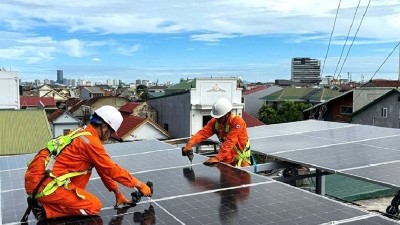
Vinacontrol worked with the company to establish an emissions monitoring framework aligned with CBAM requirements, train internal personnel in carbon accounting, and develop a practical decarbonization roadmap. The program also identified opportunities to improve energy efficiency, optimize thermal performance, and install rooftop solar generation to reduce dependence on fossil fuels.
According to the company, approximately 14 weeks after implementation, the facility reduced emissions intensity by about 18 per cent through energy-efficiency measures and on-site renewable energy integration. Based on Vinacontrol's estimates, this translated into projected annual CBAM cost savings exceeding €85,000 ($96,953.55) compared with relying on default emissions values.

Early preparation can significantly reduce CBAM costs
According to Vinacontrol's estimates, replacing conservative default emissions values with verified facility-level data, together with targeted decarbonization measures, could reduce projected CBAM-related costs by approximately 35-60 per cent. Actual savings will depend on factors including baseline emissions, production technology, energy sources, data quality, and the scope of emissions reduction initiatives.
The company says that combining auditable carbon accounting with practical emissions reduction enables businesses to move beyond regulatory compliance toward long-term management of carbon costs while strengthening their position within international supply chains.
Carbon data emerges as a competitive differentiator
As CBAM reshapes international trade, experts argue that competitive advantage will increasingly depend on companies' ability to generate credible emissions data alongside reducing their carbon footprint.
Rather than separating green businesses from traditional manufacturers, the emerging divide is between companies equipped with reliable carbon data and those that remain unprepared for increasingly stringent market requirements.
Three questions for businesses preparing for CBAM
Companies exporting to Europe may consider the following questions:
- Do you have an installation-level embedded emissions monitoring system, rather than only a consolidated corporate greenhouse gas inventory?
- Which EU customers will require auditable CBAM emissions data before March 2026?
- If default EU emissions values were applied to your exports today, what additional CBAM costs would your business face?
Learn more about Vinacontrol’s emission inventory, verification, and CBAM compliance services: www.vinacontrol.com.vn
Technical consultation: [+84 24 3943 3840/ vinacontrol@vinacontrol.com.vn]



 Google translate