



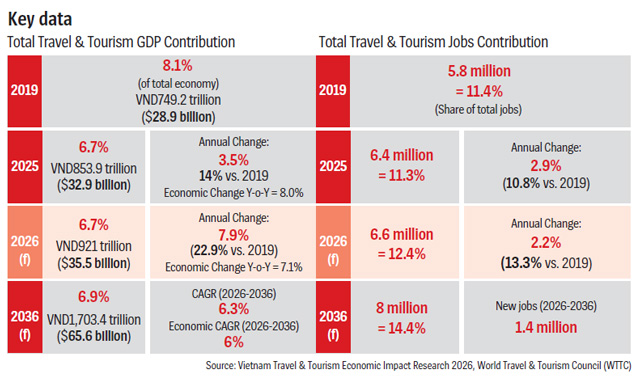
Vietnam’s travel and tourism sector is moving into a new phase of expansion, with its contribution to the economy expected to accelerate this year and continue growing over the following decade. The Vietnam Travel & Tourism Economic Impact Research 2026, published recently by the World Travel & Tourism Council (WTTC), shows that the sector contributed VND853.9 trillion ($32.9 billion) to Vietnam’s GDP in 2025, equivalent to 6.7 per cent of the economy. The contribution is forecast to rise to VND921 trillion ($35.5 billion) this year and reach VND1,700 trillion ($65.5 billion) by 2036, when it is projected to account for 6.9 per cent of GDP.
The WTTC’s measure captures the direct activity of tourism-related businesses as well as the wider effects generated through investment, supply chains, and the spending of people employed directly or indirectly by the sector. In 2025, direct travel and tourism activity accounted for 4.6 per cent of GDP, while the broader contribution reached 6.7 per cent. The direct contribution is forecast to grow by 5.8 per cent annually through 2036, while the total contribution is projected to increase by 6.3 per cent a year.
The numbers point to a sector whose economic footprint extends well beyond hotels and visitor spending to encompass transportation, restaurants, leisure, employment, investment, and domestic suppliers.
Beyond visitors
The report’s methodology is important to understanding the scale of that footprint. The WTTC defines travel and tourism as economic activity related to travelers taking trips outside their usual environment for less than one year. Its research is aligned with the UN Statistics Division-approved 2008 Tourism Satellite Account framework, but goes beyond the direct contribution captured by that methodology to include indirect and induced effects.
The direct contribution covers GDP generated by industries that deal directly with tourists, including hotels, travel agents, airlines, and other passenger transportation services, as well as restaurants and leisure businesses serving tourists. Direct employment similarly refers to jobs within travel and tourism itself.
The total contribution adds the indirect and induced effects. Indirect contribution includes capital investment by travel and tourism industries and spending by other industries on tourism-specific assets, government collective spending that supports tourism activity, and purchases of domestic goods and services used as inputs by tourism businesses. Induced contribution captures the wider economic activity generated when people directly or indirectly employed by travel and tourism spend their income.
This distinction explains why the sector’s total contribution is substantially larger than its direct contribution. It also means that the headline figure should not be read simply as the output of hotels, airlines, or travel agencies, but as representing a wider economic network connected to tourism activity.
The report also separates different types of tourism spending. Visitor exports refer to spending by international tourists inside Vietnam on business and leisure trips, including transport but excluding international spending on education. Domestic travel and tourism spending covers business and leisure travel by Vietnamese residents within the country, while outbound spending by residents abroad is recorded separately.
Internal tourism consumption brings together visitor exports, domestic spending, and government individual spending on services directly linked to visitors. Business and leisure spending are also tracked separately, allowing the research to show where demand is coming from rather than treating tourism as a single category.
Domestic demand
That broader picture shows that Vietnam’s travel and tourism economy is supported by a substantial domestic market alongside international demand. Leisure travel accounted for 80.7 per cent of total internal travel and tourism spending in 2025, compared with 19.3 per cent for business travel. Leisure spending totaled VND653 trillion ($25.1 billion), while business spending amounted to VND156.3 trillion ($6 billion).
The report expects leisure spending to grow by 5.9 per cent annually from 2026 to 2036, reaching VND1,260 trillion ($48.3 billion), while business spending is forecast to rise by 3.7 per cent a year to VND243.2 trillion ($9.4 billion).
Domestic travel accounted for 62.8 per cent of total internal spending in 2025, compared with 37.2 per cent for foreign visitor spending. Domestic spending is forecast to grow by 5.9 per cent annually through 2036, while visitor exports are projected to increase by 4.9 per cent a year.
The figures underline the role of domestic travel as the larger component of tourism demand. They also suggest that the sector’s expansion over the next decade will not depend exclusively on international arrivals. Leisure travel, in particular, is expected to remain the strongest source of spending growth.
International tourism nonetheless provides an important and expanding source of revenue. Vietnam generated VND300.8 trillion ($11.6 billion) in visitor exports in 2025. By 2036, international tourist arrivals are forecast to reach 37.2 million, with visitor exports rising to VND561.8 trillion ($21.6 billion).
The inbound market remains concentrated among several major source economies. China accounted for 25 per cent of arrivals in 2025, followed by South Korea at 20 per cent and Taiwan (China) at 6 per cent. Outbound travel is similarly regional, with China accounting for 29 per cent of departures, followed by Cambodia with 14 per cent, Laos 11 per cent, Japan 9 per cent, and Thailand 8 per cent.
Stronger growth path
The economic importance of travel and tourism is also reflected in employment. The sector directly supported 4.02 million jobs in 2025, equivalent to 7.7 per cent of total employment. By 2036, direct travel and tourism employment is forecast to reach 4.85 million jobs, or 8.8 per cent of all jobs.
Including indirect and induced effects, the sector supported 6.41 million jobs in 2025, representing 12.3 per cent of total employment. That figure is forecast to reach nearly 8 million by 2036, or 14.4 per cent of employment, adding 1.4 million jobs over the decade.
The wider employment measure reflects the same economic connections captured in the GDP figures. Jobs are supported not only by businesses directly serving visitors but also by investment, supply chain activity, and the spending of people whose incomes depend on the sector.
Investment provides another link between current tourism activity and future capacity. Travel and tourism attracted VND274.1 trillion ($10.5 billion) in capital investment in 2025. That figure is projected to reach VND384.9 trillion ($14.8 billion) by 2036.
The report therefore treats tourism investment as part of the sector’s wider economic contribution rather than simply an input into hotels and other tourism facilities. Capital spending can include new accommodation, passenger transport equipment, restaurants, and leisure facilities designed specifically for tourism.
In 2025, Vietnam ranked behind several larger Southeast Asian tourism economies in absolute terms but remained a significant regional market.
The report’s long-term projections place Vietnam among the faster-growing travel and tourism markets, particularly in terms of GDP contribution. The total travel and tourism GDP contribution is forecast to grow by 6.3 per cent annually between 2026 and 2036, compared with a world average of 3.6 per cent. Vietnam ranks 13th globally in this measure. The direct GDP contribution is expected to grow by 5.8 per cent annually; also well above the global average of 3.3 per cent.
Employment is projected to grow more slowly. Direct travel and tourism employment is forecast to increase by 1.6 per cent annually through 2036, while total employment supported by the sector is expected to grow by 2 per cent a year. Visitor exports are projected to rise by 4.9 per cent annually, while travel and tourism investment is forecast to grow by 2.7 per cent.
The near-term outlook is also positive. In 2026, total travel and tourism’s GDP contribution is forecast to grow 7.9 per cent, while the sector is expected to support 6.6 million jobs. International visitor spending is projected at VND347.1 trillion ($13.4 billion) and domestic spending at VND530 trillion ($20.4 billion).
Taken together, the projections describe a sector that has moved beyond recovery and into a longer-term expansion cycle. Its contribution is being shaped by a combination of domestic demand, leisure travel, international visitors, employment, investment, and the economic activity generated through its supply chains.
By 2036, the WTTC expects travel and tourism to support nearly 8 million jobs and contribute VND1,700 trillion ($65.5 billion) to Vietnam’s economy. The trajectory suggests that tourism’s significance will increasingly be measured not simply by the number of visitors arriving in the country but by the breadth of economic activity connected to their travel.




 Google translate