


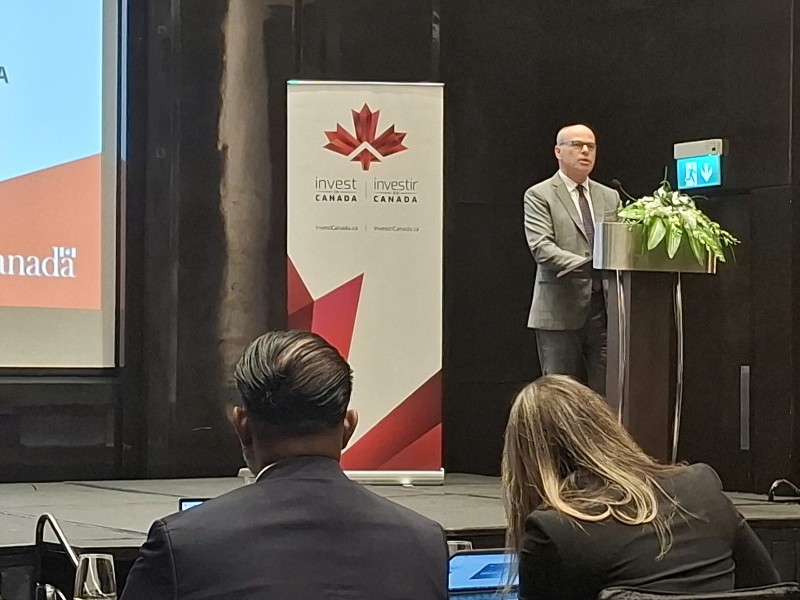
As Vietnamese companies increasingly look for new markets, diversify supply chains and expand globally, Canada is emerging as an attractive destination, thanks to its stable business environment, highly educated workforce, strong innovation capabilities and access to the North American market.
Held on September 8 in Hanoi, the Canada Investment Seminar brought together Vietnamese business leaders and investors with Canadian provincial governments and investment-promotion agencies.
The seminar was followed by the Canada Friendship Networking Reception, which officially marked the launch of CanCham's Hanoi Branch.
The event represents a new step in strengthening B2B links between the two countries, particularly as Vietnam-Canada trade and investment relations increasingly expand into technology-intensive and higher-value sectors.
Four gateways to one north American market
A central message from the seminar was that Canada should not be viewed simply as an investment destination, but also as a platform through which companies can access North America and global markets.
The Canadian province of British Columbia highlighted its position as Canada's Pacific gateway and its strong economic connections with Asia.

The province has approximately 271,000 technology workers and a well-developed ecosystem covering artificial intelligence, digital technology, software, gaming and other high-tech industries. Its Vancouver in particular is home to major international companies including Amazon, Microsoft and Electronic Arts.
Beyond technology, British Columbia offers opportunities in agri-food, seafood, value-added processing, cold storage, packaging and logistics. These sectors are particularly relevant to Vietnamese companies seeking to expand their international operations.
The province also provides support to foreign investors in areas ranging from regulations, permits, taxation and immigration to site selection and connections with universities, industry and government agencies.
Meanwhile, Canada's western province of Saskatchewan presents a different proposition, built around agriculture, energy, fertilizer and critical minerals.
The province accounts for more than 40% of Canada's cultivated farmland and generated approximately C$18 billion in agricultural exports in 2025. Saskatchewan is a major exporter of lentils, peas, canola, oats and wheat.
However, its investment strategy increasingly focuses on moving from commodity exports toward value-added food processing and ingredient manufacturing. This creates opportunities for Vietnamese companies in food processing, agricultural technology, logistics and manufacturing.
Saskatchewan is also rich in uranium, potash, oil and gas and other critical minerals. These resources are supporting new opportunities in energy, food security, clean technology and resource processing.
Ontario and Quebec: Technology and innovation at scale
If British Columbia stands out as Canada's Pacific gateway and Saskatchewan for resources and agriculture, Ontario and Quebec demonstrate another side of the Canadian economy: advanced technology, industry and innovation.
The province of Ontario has more than 26,000 high-tech businesses employing approximately 450,000 technology workers. It produces more than 94,000 STEM graduates every year from its 47 colleges and universities.
Artificial intelligence is one of Ontario's strongest sectors. Toronto, the capital city of the province, is home to the Vector Institute and a large AI ecosystem. Ontario has more than 1,600 AI companies and hosts operations by major international technology companies, including NVIDIA, Qualcomm, AMD, Microsoft, Nokia and Siemens.
Semiconductors are also becoming a strategic priority, alongside quantum technology, cybersecurity and electronics.
Ontario's automotive industry remains a major investment attraction, with Ford, Stellantis, Honda, Toyota, General Motors and a broad network of suppliers operating in the province. As the global automotive industry moves toward electrification, new opportunities are emerging in batteries, critical minerals, advanced materials and recycling.
Clean energy is another competitive advantage. Ontario phased out coal-fired electricity generation in 2013 and now relies heavily on nuclear and hydroelectric power, alongside other sources. The province is continuing to expand nuclear capacity and is advancing a small modular reactor project at Darlington.
Quebec, meanwhile, has developed strong capabilities in AI, aerospace, semiconductors, quantum technology, life sciences and advanced manufacturing.
Montreal, which is located in the southeastern portion of Canada, in the province of Quebec, has become an international AI hub, supported by the Mila research institute. Quebec is also home to IBM's major semiconductor assembly, testing and packaging facility in Bromont.
Aerospace remains one of the province's flagship industries, with companies such as Bombardier, CAE, Bell Textron and Airbus. The sector demonstrates Quebec's ability to attract not only manufacturing projects but also investment in research, advanced engineering and high-value technology.
Invest Québec offers a particularly broad range of support, including co-investment, loans, financial assistance, grants and business connections. This approach reflects the provinces' growing competition for investment projects capable of generating long-term economic value.
From business connections to cross-border value chains
One of the most important messages from the seminar was that Canada's approach to international investment goes beyond financial incentives. The focus is increasingly on long-term partnerships with investors.
From site selection and partner identification to market research, government relations, recruitment, R&D and international expansion, Canadian investment agencies offer a broad range of services.
This could be particularly relevant to Vietnamese companies considering Canada as a long-term investment destination.
Canada can serve as a two-way platform: Vietnamese companies can invest in Canada to access North America while also using Canadian research, technology, manufacturing and logistics capabilities to support their wider international operations.
For Vietnamese companies, the question resulting from the seminar is therefore no longer simply whether Canada is an attractive investment destination. It is increasingly about which province, which sector and which partnership model best fits each company's long-term strategy.
The Canada Friendship Networking Reception following the seminar officially marked the launch of the Hanoi Branch of the Canadian Chamber of Commerce in Vietnam (CanCham).
The expanded presence in northern Vietnam is expected to create an additional direct channel connecting enterprises, investors and business-support organizations from both countries.
The launch is more than an organizational milestone. It could provide a platform for turning the relationships established at the seminar into concrete investment and business projects.
The four provinces presented at the seminar demonstrate the diversity of Canada's economic landscape while sharing a common objective: enabling international businesses to participate more deeply in the Canadian economy.
British Columbia offers a Pacific gateway; Saskatchewan provides resources and agricultural strength; Ontario combines industrial scale with technology; while Quebec brings together innovation, aerospace and advanced technology.
Together, they offer Vietnamese companies multiple gateways into North America.
The most important outcome of the seminar may therefore not be a list of investment incentives, but the possibility of building long-term partnerships. As Vietnam-Canada business connections deepen, Canada could become an increasingly important link in the internationalization and global value-chain strategies of Vietnamese companies.







 Google translate