


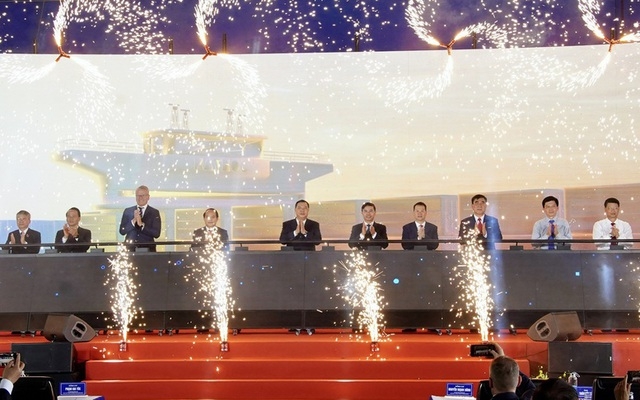
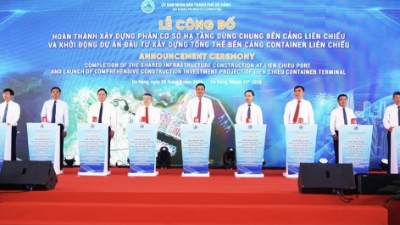
The groundbreaking ceremony of Da Nang-based Lien Chieu Container Terminal took place on April 25, with the attendance of Standing Deputy Prime Minister Pham Gia Tuc and many other senior officials.
With a total investment of approximately VND 45.268 trillion (nearly $1.8 billion), the project involves construction of eight container berths with a total quay length of 2,750 meters, capable of accommodating vessels of up to 18,000 TEU, according to the Government News.
The designed capacity of the port in the central city of Da Nang is 5.7 million TEU per year (equivalent to about 74 million tons annually). After three years of operation, the first phase is expected to reach a throughput of 4 million TEU per year.
The terminal is envisioned to develop into a modern logistics ecosystem, fully integrating functions ranging from barge berths, warehousing systems, inspection and customs clearance, container stuffing and stripping, to an operation control center, with direct connections to the national railway network—thereby forming a multimodal transport chain.
Its operations follow a "green port, smart port" model, applying Internet of Things (IoT) and artificial intelligence (AI) technologies in management, operations, and service delivery.
The terminal also emphasizes automation in operations, the use of clean energy, and environmentally friendly equipment to minimize emissions and comply with both Vietnamese and international environmental standards.
Hateco Group Joint Stock Company, Hateco Seaport Company Limited, and APM Terminals B.V. (Netherlands) was selected as the investor for the project. It represents a combination of the strong domestic capacity of Vietnamese investors and the world-leading port operation experience of international partners.
Addressing the ceremony, Standing Deputy Prime Minister Pham Gia Tuc said, Lien Chieu Container Terminal is not merely an infrastructure project, but also a strategic link in the national and global logistics chain.
This project will help position Vietnam more deeply within the international maritime transport network, he noted.
 Google translate