


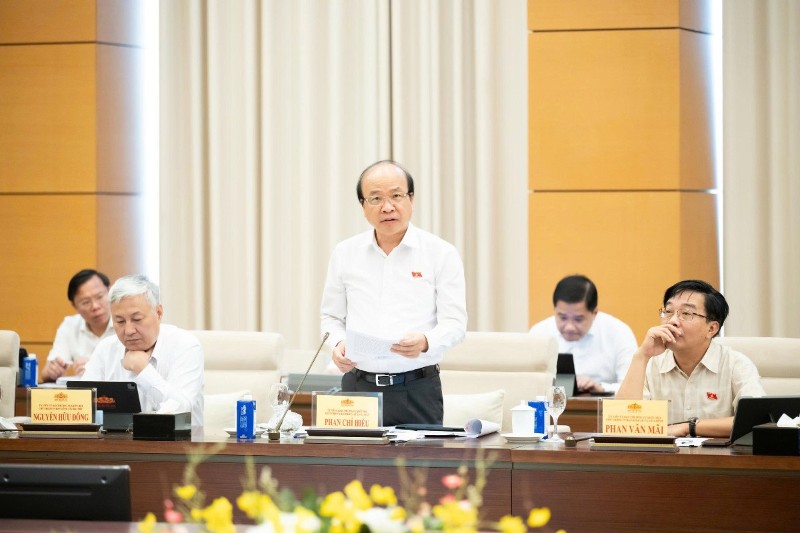
The National Assembly Standing Committee (NASC) continued its deliberations on the draft Law on Urban Development during a session on August 17, with a key focus on the legal framework for the Vietnam International Financial Center (VIFC), specifically the requirement to ensure a unified management platform across both of the center's locations (Ho Chi Minh City and Da Nang).
According to the revised proposal, the local executive body of the VIFC, when exercising certain powers related to the VIFC, must consult with the Ministry of Finance and the State Bank of Vietnam. VIFC members would be permitted to provide financial and support services to domestic organizations—in accordance with their establishment and operating licenses—to facilitate transactions and attract international capital.
However, the discussion highlighted the challenge of designing a unified management mechanism for the entire VIFC. Reporting to the NASC, Chairman of the NA Committee on Legal and Judicial Affairs Phan Chi Hieu noted that while the drafting agency generally agrees with the revisions, further refinements are needed regarding the VIFC’s development mechanism.
NASC members largely concurred with the Government’s explanations, particularly the clarification of the respective scopes of the draft Law on Urban Development and the existing resolutions governing the VIFC.
Nevertheless, members urged a further review of Clause 3, Article 23. The proposed regulation currently stipulates that only the executive body of the VIFC in Ho Chi Minh City issues licenses after obtaining input from the Ministry of Finance and the State Bank of Vietnam. Critics argued that this merely reflects a coordination mechanism between agencies rather than a unified principle for the entire VIFC. They emphasized that licensing standards, risk management, safety supervision, and core market rules must be applied uniformly across both locations of the VIFC.
Regarding cities not yet recognized as "special-class municipalities," deputies noted that they could still apply certain mechanisms and policies if authorized by competent authorities. This clarification addressed concerns regarding the potential application of such mechanisms for Da Nang city.
Furthermore, the NASC requested a clearer distinction between the organizational and operational framework of the VIFC and the policies governing spatial planning, infrastructure, and the connection between the Center and other urban functional zones.
Under this approach, existing resolutions would focus on the organization, operation, and specific incentives of the VIFC, while the Law on Urban Development would focus on space, infrastructure, and urban development conditions. Defining these boundaries is considered essential to avoid the formation of dual, overlapping legal mechanisms regulating a single IFC. The new regulations must ensure policy stability while creating growth space for the Center to become a new economic driver.
Concluding the session, NA Vice Chairman Nguyen Khac Dinh stated that the ultimate goal is to build a legal framework that is unified in management yet flexible enough for efficient operation, thereby creating a foundation to attract global capital and international financial activities into Vietnam.





 Google translate