


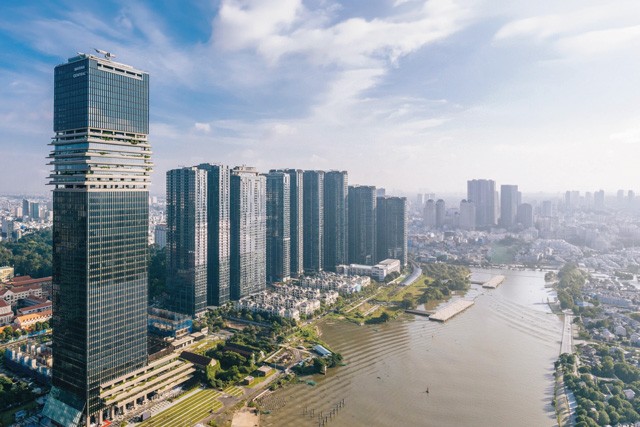
As Vietnam promotes the establishment of an international financial center (IFC) while simultaneously perfecting the legal framework for fintech, AI, digital assets, and derivative markets, cooperation with the UK is expected to expand from sharing policy experience to conducting specific projects in finance, technology, and risk management.
At the UK-Vietnam High-Level Conference, jointly organized by the Embassy of the UK in Vietnam, the British Consulate General in Ho Chi Minh City, and the Ministry of Industry and Trade (MoIT), Mr. Martin Kent, UK Trade Commissioner for Asia Pacific, said that finance is being transformed at extraordinary speed around the world. “Vietnam has already emerged as one of ASEAN’s most dynamic digital economies and is making impressive progress in the digital transformation of its financial sector,” he continued. “The UK is proud to support Vietnam through our partnerships with government, regulators, financial institutions, and businesses. Together, we are helping to build a modern, internationally-connected, and sustainable financial ecosystem.”
Modern financial ecosystem
Deputy Minister of Industry and Trade Phan Thi Thang affirmed that the establishment of the Vietnam International Financial Center (VIFC) is a strategic decision made as the country enters a new phase of development that requires transforming its growth model, boosting productivity, and more effectively mobilizing both domestic and international resources. The VIFC is a unified entity operating in both Ho Chi Minh City and Da Nang, aiming to establish a modern, transparent, and competitive financial ecosystem that aligns with international standards and serves the real economy.
Vietnam, she went on, needs to create space for piloting new models while ensuring cybersecurity, data safety, and consumer protection; preventing money laundering and the financing of terrorism; and maintaining financial stability. “The appropriate approach is not to choose between innovation and regulation but to design a smart regulatory framework that fosters innovation, ensures safe and responsible oversight, and creates genuine value,” she told the conference.
According to Mr. Kent, AI is transforming how financial institutions detect fraud, manage risk, and serve customers. Meanwhile, digital assets are giving rise to new models for capital raising and allocation; open banking and open finance are fostering competitive, customer-centric ecosystems; and cybersecurity is increasingly becoming a cornerstone of financial stability. For Vietnam, these trends are directly linked to the establishment of the VIFC and the imperative to build a financial ecosystem capable of meeting the economy’s evolving needs.
In addition, the VIFC is also linked to the commodities market and derivatives. Vietnam continues to refine the legal framework and policies to develop the commodities trading and derivatives market, the MoIT has said, to ensure transparency, safety, professionalism, and integration. This market is organically linked to the VIFC, where exchanges, clearing houses, banks, insurers, and technology firms can form an ecosystem meeting international standards. However, its scope of service must extend beyond the VIFC to ensure that enterprises across the country in the fields of rubber, metals, energy, animal feed, textiles, and transportation, as well as exporters, can access pricing and risk-hedging instruments.
Promoting international cooperation
Data from the MoIT showed that two-way trade turnover between Vietnam and the UK reached a record high of nearly $9.4 billion in 2025. In the first seven months of 2026, trade volume reached nearly $6 billion, a 14.5 per cent increase year-on-year. By the end of 2025, UK investors had 623 projects in Vietnam with total registered capital of nearly $4.7 billion, concentrated in sectors such as finance, industry, energy, technology, and logistics.
Notably, in 2025, the two countries upgraded their relationship to a Comprehensive Strategic Partnership. This marked not only a diplomatic milestone but also a new framework for action aimed at deepening cooperation across economics, trade, investment, finance, science and technology, the green transition, and digital transformation, thereby delivering tangible results for the people and businesses of both nations.
With this foundation, in order to further promote the financial ecosystem based on innovation, science, and technology, Ms. Thang proposed four priority areas for Vietnam - UK cooperation in the coming period: strengthening dialogue between regulators, financial institutions, and businesses on the regulatory framework for fintech, AI, data, cybersecurity, and controlled testing models; promoting specific cooperation projects at the VIFC and nationwide; developing joint human resources development programs involving government agencies, businesses, and universities; and encouraging businesses from both countries to identify specific challenges, implement pilot projects within an appropriate scope, conduct transparent assessments, and scale up effective models.
Commitment to long-term support
The UK is now supporting the development of the VIFC. Through partnerships with Vietnamese ministries, regulatory bodies, financial institutions, and the private sector, the UK is providing legal and regulatory expertise, policy advice, and capacity-building support to help build a modern, internationally-connected, and sustainable financial ecosystem. UK support focuses on strengthening the legal and regulatory framework, promoting trade finance, developing green finance, and connecting Vietnam with world-leading financial and technological solutions.
According to Mr. Kent, Vietnam has emerged as one of the most dynamic digital economies. Over 95 per cent of credit institutions have developed digital transformation strategies, and nearly 80 per cent of financial transactions are now conducted via digital channels. These significant strides forward demonstrate Vietnam’s commitment to innovation and its readiness to embrace the future of the financial sector.
However, opportunities always come with responsibilities. Digital transformation presents new challenges regarding governance, cybersecurity, consumer protection, resilience, and trust. As financial systems become increasingly interconnected, building trust is just as crucial as developing technology. It is becoming increasingly clear that the ability to drive innovation while maintaining stability and trust is a key factor.
These are areas where the UK possesses decades of experience. Since 2019, over $37 billion has been invested in London’s fintech sector. London is home to more than 1,600 fintech companies and over 40 fintech unicorns. On a broader scale, the UK has produced more fintech unicorns than any other country in Europe, with fintech companies accounting for one-third of the UK’s total number of unicorns.
Drawing on this vast business ecosystem, the UK Government is connecting these solutions with the Vietnamese market, particularly with banks. As part of the Conference, Mr. Kent led a delegation to Vietnam of leading UK fintech and cybersecurity companies, including Ozone API, Sumsub, iProov, Elliptic, SaaScada, MyCena, Unlimit, CyberQ Group, Traydstream, and GMEX Group. These companies showcased solutions in open banking, digital identity, payments, digital assets, cybersecurity, and core banking technology, while directly connecting with Vietnamese banks, financial institutions, and businesses to explore partnership opportunities.
Mr. Kent proposed that this support focus on five key areas. First, operations within the VIFC being aligned with English Common Law - a legal framework widely recognized for international business activities. Second, the VIFC requires a robust regulatory framework that establishes clear rules for market participants in a transparent manner, enforced by an independent regulatory body. Third is the promotion of trade finance. Fourth is the mobilization of green finance through the UK Government’s PACT (Partnering for Accelerated Climate Transitions) program, under which the UK advises the VIFC on formulating regulations to enable the development of green financial products. And fifth, the UK is assisting Vietnam in accessing world-class technological solutions to support the VIFC’s operations and the Vietnamese banking sector.






 Google translate