


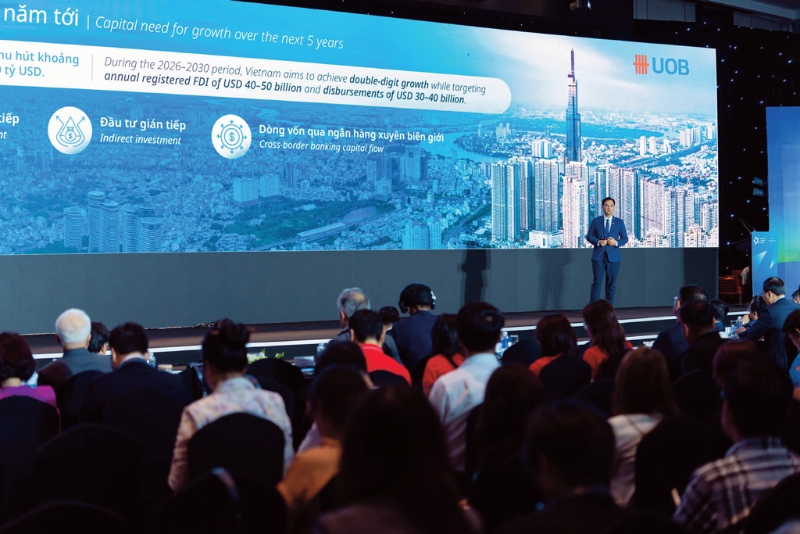
- What do you see as Vietnam’s biggest advantage in maintaining its FDI attractiveness amid increasingly fierce competition among countries for investment?
Among developing economies, Vietnam currently possesses many notable advantages and continues to maintain a positive position in attracting foreign investment.
While it may be difficult to make direct comparisons with large-scale markets such as the US, Europe, South Korea, and Singapore, Vietnam is emerging as an attractive destination among emerging economies. Within ASEAN - a region drawing substantial global investment flows - Vietnam ranks among the leading destinations for FDI.
According to UOB, an even more important factor lies in the confidence Vietnam has built with the international investment community. In addition to a stable political environment, Vietnam has maintained supportive foundations for investors, including its workforce, investment climate, and incentive policies over many years.
Notably, the regular organization of dialogue forums with the business community demonstrates efforts to improve the investment environment in a more proactive and responsive manner. This reflects Vietnam’s determination not to rely solely on its existing advantages but to continue enhancing its competitiveness.
What stands out in discussions with the FDI business community is the government’s commitment to reform and partnership with investors, not only for businesses already operating in Vietnam but also for new capital inflows in the future.
Whereas FDI attraction may once have prioritized quantity, the direction is now clearer toward selecting high-quality investment aligned with high-growth and sustainable development goals in the new phase.
- Links between FDI enterprises and domestic businesses are seen as essential in increasing value-added and supply chain participation. What is the biggest barrier preventing Vietnamese enterprises from effectively connecting with the FDI sector? What should businesses do to better meet the standards and requirements of FDI firms?
FDI enterprises often operate across multiple markets and have early exposure to international standards in financial governance, business planning, product quality, and market capabilities.
Meanwhile, a certain gap remains between domestic businesses and the FDI sector in governance standards and modern operating methods. Some major Vietnamese corporations have made notable progress and gradually aligned with international standards. However, many small and medium-sized enterprises (SMEs), particularly those evolving from household business models, still face gaps in management technology, production governance, and financial management.
Banks are currently implementing various support solutions tailored to different business groups. For large corporations, UOB not only provides domestic financing but also supports access to international capital markets and connections with foreign investors. These financing sources address not only short-term needs but also long-term capital for business expansion.
For SMEs, deeper participation in supply chains presents an opportunity to strengthen capabilities. The bank’s teams regularly work with businesses to support access to standards in production management, financial governance, and international practices, thereby enhancing efficiency and competitiveness.
Mr. Dinh Duc Quang, Country Head of Global Markets at UOB Vietnam, tells Van Nguyen of its myriad support for local and foreign enterprises as well as Vietnam itself.
FDI enterprises have always been a key customer segment that the bank seeks to support. UOB’s advantage comes from its extensive network across countries in the region and globally.
For example, when a Singaporean business invests in Vietnam or expands into other ASEAN markets, UOB can leverage system-wide connectivity to provide seamless support across the markets in which the business operates.
By understanding customers comprehensively - including financing needs, business plans, and group-level credit limits - the bank can allocate resources effectively in each market. This also allows it to maximize system-wide resources to improve its support for FDI enterprises.
In addition, longstanding relationships and cross-market data with FDI enterprises allow UOB access to financial statements, business plans, and operational information at the group level, significantly shortening the appraisal process.
For priority clients or businesses with effectively-managed cash flow, the bank develops tailored product packages, including interest rate policies, fee structures, and financial solutions designed to meet each company’s specific needs.
- FDI often operates through supply chains involving not only FDI ecosystems but also other exporters. Does the bank currently offer supply chain financing? What standards do Vietnamese SMEs need to meet to participate in such financing chains?
This is one of our core business areas and a major focus for development. Beyond financing and banking services for large enterprises or manufacturers, UOB aims to expand support across the entire ecosystem of businesses linked within supply chains.
The model is based on relationships between anchor companies and distributors, agents, or satellite businesses, many of which are Vietnamese SMEs. When working with lead enterprises, the bank simultaneously engages with related partners to introduce suitable financial solutions.
Understanding business relationships within supply chains significantly shortens the time needed to assess business plans, cash flow management, and operational effectiveness, thereby improving capital access and expanding service coverage across supply chains.
- How do you assess the potential for attracting foreign portfolio investment into Vietnam, particularly through the bond market?
Regarding indirect investment flows, Vietnam still has substantial room to attract foreign investors to its bond market, particularly government bonds. Data shows that foreign ownership of Vietnam’s government bonds currently stands at only around 1-2 per cent; significantly lower than in many regional peers.
In Thailand, the figure is around 10 per cent, equivalent to approximately $20 billion in holdings. In Malaysia and Indonesia, foreign investors hold around 20-25 per cent of government bonds issued, equivalent to around $60-70 billion. With concrete measures to deepen foreign participation in the government bond market, this could become a major source of capital for Vietnam.
The corporate bond market is also viewed as a promising avenue for connecting domestic enterprises with international capital. However, foreign investors are most concerned about the infrastructure for credit risk assessment, pricing mechanisms, and benchmark yield curves. These are critical foundations for risk modeling, asset pricing, and investor confidence in Vietnam’s corporate bond market.
There is hope that authorities such as the Ministry of Finance and the State Bank of Vietnam will continue coordinating with market participants to improve pricing infrastructure and establish benchmark yield curves for both short-term money markets and long-term capital markets.
- In the context of an increasingly volatile and unpredictable global financial environment, what should Vietnamese businesses do to strengthen governance and improve long-term resilience?
In today’s environment, businesses have little choice but to closely monitor market developments and proactively strengthen risk management capacity.
Given global volatility, businesses often struggle to independently access comprehensive information. This makes partnerships with financial institutions and commercial banks increasingly important.
In addition to a stable political environment, Vietnam has maintained supportive foundations for investors, including its workforce, investment climate, and incentive policies over many years.
Through the research, analysis, and advisory systems of financial institutions, businesses can stay updated on trends in exchange rates, interest rates, international trade, and macro-economic developments, enabling more timely decisions.
At UOB, we support businesses in treasury management, cross-border trade, and regional capital connectivity. Since 2020, the bank has supported more than $55 billion in investment into ASEAN and Greater China and, through its FDI Advisory unit, has assisted nearly 5,500 enterprises to expand internationally.
Following the acquisition of Citibank Vietnam’s retail banking business in 2023, UOB has continued expanding its operations across customer segments in the country. The bank has also announced plans to invest in an office tower within Ho Chi Minh City’s International Financial Center area.
As an FDI enterprise operating in Vietnam’s financial sector, we are committed to long-term partnerships with other FDI enterprises while supporting stronger connections between Vietnamese enterprises and international capital flows, thereby contributing to sustainable growth in the years ahead.








 Google translate