


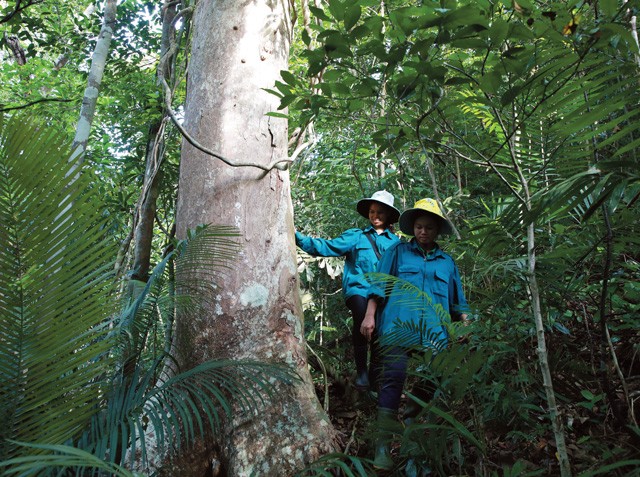
Forests are increasingly playing a key role as carbon sinks as Vietnam responds to climate change and implements its greenhouse gas emission reduction commitments. Total carbon stored in forest biomass nationwide is estimated at 780.9 million tons, with natural forests accounting for more than 663 million tons, or about 85 per cent.
In recent years, forest carbon absorption and storage services have gradually emerged as a source of financing for the forestry sector. Emission reduction result transfer agreements have opened opportunities to mobilize additional resources for forest protection and development.
Potential opportunities
Notably, the Emission Reductions Payment Agreement (ERPA) for the North Central Region was Vietnam’s first emission reduction result transfer agreement in forestry, marking a step toward turning the carbon value of forests into financial resources.
At COP26 in 2021, what is now the Ministry of Agriculture and Environment (MAE) signed a Letter of Intent on an emission reduction purchase agreement with the Lowering Emissions by Accelerating Forest Finance (LEAF) Coalition. Vietnam is expected to transfer 5.15 million tons of CO2 from the central highlands and south-central coast at a minimum price of $10 per ton. Initial transactions show that forest carbon absorption and storage services are becoming a potential new source of financing for forestry.
Several localities are also moving to tap this resource. On August 18, the Da Nang City People’s Committee approved a scheme for developing and managing forest carbon credits for 2026-2030, with a vision to 2035. The city plans to survey forest conditions, calculate carbon stocks, and classify 100 per cent of forest areas with potential for carbon projects.
By 2030, Da Nang aims to have one to three approved forest carbon projects, be cooperating with at least two domestic and international partners, complete one or two project and credit registration dossiers, and sign at least one domestic or international carbon credit purchase agreement.
The nearby Quang Ngai Provincial Party Committee, meanwhile, has issued a resolution on sustainable forestry development through 2030, with a vision to 2035. It aims to expand the forest economy beyond timber to include ecosystem services and the forest carbon market. By 2030, Quang Ngai’s forestry sector aims to reduce emissions by approximately 1.129 million tons of carbon while absorbing and storing about 10 million tons, creating a foundation for future participation in the carbon credit market.
Determining credit prices
As Vietnam’s carbon market develops, the key issue is increasingly not simply how many credits forests can generate or their potential price but their quality, recognition mechanism, and eligible markets.
For forest carbon, one ton of CO2 stored or absorbed does not automatically translate into a commercially-valuable credit. Credits must meet requirements covering baselines, additionality, measurement, reporting, and verification (MRV), leakage, permanence, reversal risks, carbon rights, social and environmental impacts, and double counting. These factors ultimately affect credibility and market value.
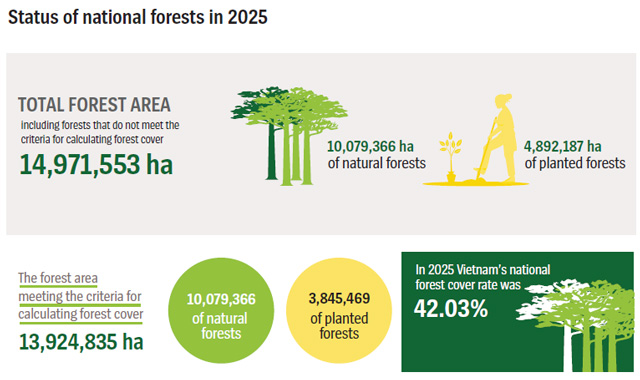
Mr. Nguyen Trung Thong, a carbon finance specialist at CARE International in Vietnam, said forest carbon credit quality is drawing greater attention as international commitments are expected to drive demand for carbon credits and projects.
A carbon credit represents one ton of carbon absorbed or emissions avoided. To qualify as a credit, the amount must be measured, assessed, verified, and recognized under a specific methodology or standard. However, issuance alone does not guarantee quality.
Mr. Thong noted that certification is only the first layer of protection. Forest carbon projects are more complex because they involve natural ecosystems, biological and spatial data, and risks that can persist for decades. Additionality, permanence, and reversal risks are among the key quality factors. He added that forest credits are no longer “one price fits all,” with prices increasingly determined by quality ratings. The share of supply from forestry and land-use rose to 36 per cent, while renewable energy fell 38 per cent from the previous reporting period.
A late-2025 survey by climate consultancy South Pole found strong interest among potential buyers in Vietnam’s forest carbon market. Some 33 per cent of respondents reported high interest in forest carbon credits, while 40 per cent were willing to explore purchasing opportunities further.
At a recent carbon forum, a representative from VinaCarbon highlighted the importance of credit quality to investors, including how credits are generated, whether they meet standards, how they are independently verified, their eligibility for trading, and their connection to domestic and international markets.
Investors are also concerned with project efficiency and sustainability, including land-use rights, ownership, carbon revenue sharing, and impacts on communities and the environment. Mr. Nguyen Ngoc Tung, CFA and Head of the VinaCarbon Climate Impact Fund at VinaCapital, said these factors need to be assessed together with economic efficiency, profitability, and long-term project sustainability. Project scale is also important, with VinaCarbon estimating that a forest carbon project needs at least around 5,000 ha to achieve economic efficiency.
Turning forests into value
Forest carbon credits provide a way to assign value to CO2 absorbed by forests. Companies can purchase credits to offset emissions, while forest owners receive income from protecting forests, creating an economic incentive to maintain and restore forest areas.
Forestry holds an advantage in terms of emission reductions because of its natural carbon absorption capacity and its potential to support sustainable livelihoods. However, every ton of CO2 absorbed must be measured and verified through an MRV system before forest credits can be traded.
Mr. Pham Hong Luong, Deputy Director of the Department of Forestry and Forest Protection at the MAE, said forestry benefits from long-established systems for surveying, inventorying, monitoring, and reporting forest conditions. This data enables emission reductions to be calculated and independently assessed.
Under the ERPA for the North Central Region, Vietnam demonstrated 16.2 million tons of CO2 emission reductions during the first reporting period, which were recognized by the World Bank. Vietnam subsequently completed two transfers totaling 11.3 million tons and generated $56.5 million.
The figures show that large forest areas and carbon absorption capacity simply represent potential. Mr. Luong emphasized that financial value requires carbon absorption or emission reductions be quantified using an appropriate methodology, supported by monitoring data and subjected to assessment and verification. A benefit-sharing mechanism is also essential.
Experience from forest environmental services payments has been used to allocate carbon revenues. Under the North Central Region program, the central government retains 3.5 per cent for management, provincial authorities retain 10 per cent, and the remainder goes to forest owners and other beneficiaries. The program has distributed revenue to around 80,000 forest owners, including approximately 40,000 households, individuals, and communities. This experience is particularly relevant as Vietnam completes its legal framework for forest carbon absorption and storage services.
Decree No. 180/2026/ND-CP on forest carbon absorption and storage services took effect on July 15, requiring localities to prepare data and assess the current status and carbon absorption potential of their forests. Experts expect the decree to mobilize additional resources for forest management, protection and development while improving livelihoods for communities dependent on forests.
More recently, Circular No. 31/2026/TT-BNNMT provided detailed regulations on forest valuation, forest price frameworks, and methods for determining payments for forest carbon absorption and storage services. According to experts, these rules will help standardize forest resource valuation and provide a foundation for developing forest environmental services and carbon credit markets.
For forest carbon, one ton of CO2 stored or absorbed does not automatically translate into a commercially-valuable credit. Credits must meet requirements covering baselines, additionality, measurement, reporting, and verification (MRV), leakage, permanence, reversal risks, carbon rights, social and environmental impacts, and double counting.







 Google translate