



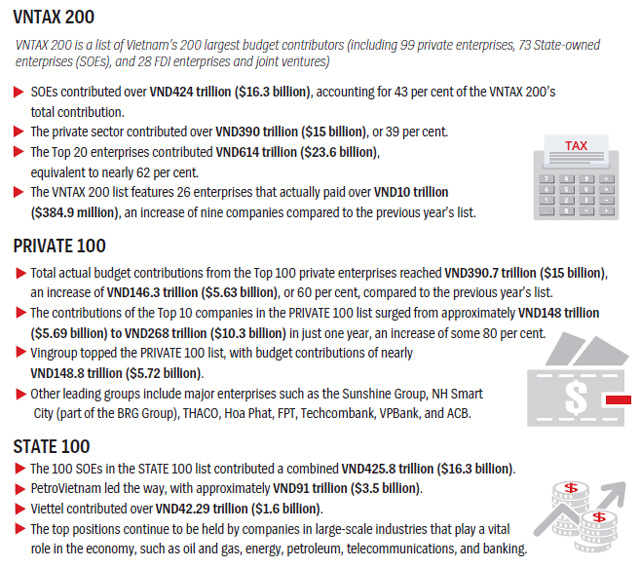
According to data released at a ceremony honoring Vietnam’s largest taxpayers in 2026 (VNTAX 2026) held on September 15, the total tax actually paid by the 200 enterprises in the VNTAX 200 list stood at VND989.3 trillion ($38 billion); an increase of VND195.3 trillion ($7.5 billion), or 25 per cent, compared to the previous year. Against a backdrop of total State budget revenue being projected at approximately VND2,650 trillion ($101.9 billion), these 200 enterprises contributed over 37 per cent of the nation’s total revenue.
Dr. Nguyen Van Phung, former Director of the Large Enterprise Tax Management Department at the General Department of Taxation, said that figures for the first eight months of 2026 show strong momentum, with State budget revenue exceeding VND2,000 trillion ($76.9 billion), or 80 per cent of the full-year estimate and marking a 16 per cent increase year-on-year. “These results reflect the vital contribution of approximately 1 million enterprises and 5 million business households and individual business owners, particularly large and leading enterprises,” he added.
Key economic sectors
According to Mr. Dau Anh Tuan, Deputy Secretary General of the Vietnam Chamber of Commerce and Industry (VCCI), the figures highlight the pivotal role leading enterprises play in generating budget revenue. However, this concentration also underscores the significant impact that would arise should these leading enterprises face operational difficulties. At the same time, it also signals substantial room for growth among the remaining enterprises.
Excluding Vingroup, the growth of total contributions from the Top 200 enterprises fell from 25 per cent to approximately 13.9 per cent. Nevertheless, a 13.9 per cent increase remains a positive figure, indicating that the budget contributions of the other enterprises are also continuing to rise. “In short, while we have reached new peaks in budget contributions, the next step is to strengthen the underlying base to create a more robust and substantial structure,” Mr. Tuan said.
By sector, real estate and construction was the largest contributor to the VNTAX 200, with total payments exceeding VND234 trillion ($9 billion), accounting for nearly 24 per cent of the total. Ranking second was the energy and natural resources sector, encompassing oil and gas, petroleum, electricity, and coal and minerals, with a total contribution of over VND220 trillion ($8.46 billion), accounting for 22.3 per cent. The financial sector followed, comprising 40 enterprises contributing some VND139 trillion ($5.35 billion).
In addition to these three sectors, the VNTAX 200 list features major enterprises from industries such as automotive, technology and telecommunications, food and beverages, aviation and logistics, retail, chemicals, and construction materials, among others. “Beyond the sectors subject to Special Consumption Tax rates, such as beer, tobacco, and automobiles, the list of the 200 largest taxpayers includes 21 lottery companies,” Mr. Tuan added. “This is a noteworthy detail, highlighting the significant contribution that goods and services subject to the Special Consumption Tax make to the State budget.”
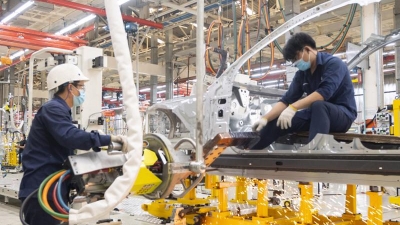
Meanwhile, the technology and telecommunications sector currently accounts for only about 6.6 per cent of total tax payments. “From the perspective of budget revenue structure, this indicates substantial untapped potential for contributions from sectors that generate high value-added,” Mr. Tuan continued. “Tax revenue derived from productivity is a key indicator of an economy’s sustainable development. This is particularly significant at present, as Vietnam implements Politburo Resolution No. 57 and various key laws aimed at fostering technological advancement and driving new growth engines.”
The VNTAX 200 comprises State-owned enterprises (SOEs), FDI enterprises, and private companies, but there are only seven FDI enterprises, contributing VND137.8 trillion ($5.3 billion), or 18 per cent of the total contribution by VNTAX 200. “This indicates a structural disparity, with the contribution of the FDI sector remaining concentrated among a specific group of enterprises,” Mr. Tuan believes.
Notably, in the first eight months of 2026, the FDI sector accounted for over 80 per cent of Vietnam’s export turnover, whereas the domestic private sector contributed less than 20 per cent. However, the list of the Top 200 largest taxpayers does not include large companies such as Samsung, Canon, or Intel, despite their massive contributions to export value.
Mr. Tuan highlighted several key reasons. First, the production model of the FDI sector has largely relied on assembly, with a high proportion of imported inputs, resulting in limited domestic value retention. Furthermore, Vietnam has utilized tax incentives as a primary tool to attract foreign investment. Many projects benefit from tax exemptions during their initial years, followed by a 50 per cent reduction for a subsequent period, even though the effective tax rate might otherwise be around 15 per cent.
Against this backdrop, Politburo Resolution No. 10 regarding foreign investment represents a significant policy shift. In particular, the implementation of a 15 per cent Global Minimum Tax for multinational corporations is altering the landscape. Consequently, tax incentives may no longer serve as a major advantage for Vietnam in attracting foreign investment in the time ahead.
Data from VNTAX 2026, compiled based on actual budget contributions made by enterprises during the 2025 fiscal year across the VNTAX 200, PRIVATE 100, and STATE 100 categories, reveals a notable shift in the landscape of Vietnam’s budget revenue sources.
Improvements for the better
Mr. Phung argued that the list of corporate taxpayers should be viewed within the broader context of the revenue structure. Budget revenue remains heavily reliant on land and natural resources, whereas revenue growth driven by the economy’s value-added remains modest.
To achieve a better ranking of budget-contributing enterprises by 2030, he added, changes must be implemented starting now. Adjustments to regulations, policies, and tax administration are required to remove existing bottlenecks. The recent campaign to clean up tax identification numbers with “status 03” and “status 06” designations also contributes to the process of refining data and improving taxpayer management. “Enterprises currently leading in scale and budget contributions will maintain their pioneering role, driving growth and making even greater contributions to the economy,” he said. “Meanwhile, large enterprises not currently on the list will also continue to grow, expand their operations, and make increasingly substantial contributions to the State budget.”
Mr. Tuan also believes there is significant room for improvement in corporate performance metrics, particularly regarding the value-added generated and retained domestically in the near future. Furthermore, tax policies must align with the health of the economy while ensuring competitiveness.
Regarding revenue from the banking sector, it is essential to ensure that capital flows into areas that boost productivity and generate tangible wealth. Relying on capital primarily for asset hoarding is not a positive trend. Similarly, regarding the platform economy, Vietnam needs to foster growth and formalize the individual entrepreneurs and business households operating on these platforms, which is a key priority for the coming period. “Looking ahead, the institutional framework must establish a broad and stable foundation,” he believes. “We need to cultivate a large number of successful enterprises rather than simply creating a few isolated peaks of success.”







 Google translate