


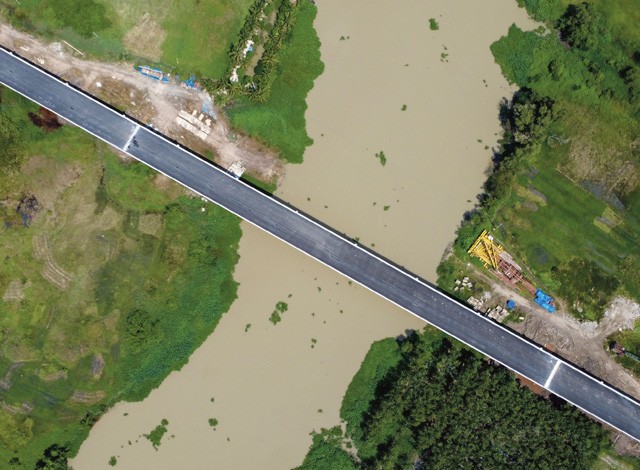
As Vietnam enters a new phase of growth, meeting its increasingly urgent infrastructure needs will require capital on a scale that traditional funding sources may struggle to provide. According to VIS Rating, total infrastructure funding needs for the 2026-2030 period are estimated at around $450 billion, of which some $30.9 billion is needed to expand the country’s expressway network to 5,000 km, $128 billion for the North-South high-speed railway and urban rail networks, and $134.7 billion to raise power generation capacity to 210 GW, alongside a series of multibillion-dollar investments in airports and seaports.
The challenge is not merely the size of the funding requirement but also the need for long-term capital and a framework that can allocate and share project risks in a way that attracts private investors. As the share of public investment is expected to decline from nearly 30 per cent of total social investment in previous years to around 21 per cent in the near future, the private sector and capital markets are expected to provide around $150 billion.
Categories of risk
With banks primarily relying on short and medium-term funding, the bond market is seen as a key channel for financing large-scale and “mega” infrastructure projects. Yet legal barriers, limited guarantee mechanisms, and concerns over policy risk continue to constrain the flow of capital, highlighting the need for broader and more coordinated legal reforms.
While Vietnam’s corporate bond market is showing signs of recovery, around 90 per cent of new issuances remain concentrated in banking and real estate. Infrastructure companies are still largely absent, reflecting the higher risk profile of their projects. VIS Rating data shows that 56 per cent of public projects have been delayed by land clearance problems. Cost overruns are also widespread, with five urban railway projects seeing their combined investment costs rise by as much as VND90 trillion ($3.46 billion).
Mr. Nguyen Hoang Long, Vice Chairman of the GELEX Infrastructure JSC, said that, based on the company’s experience in project implementation, businesses typically face three major categories of risk: land clearance, investment procedures and policy changes, and gaps between the financial assumptions in feasibility studies and actual project performance.
Legal risk is one of the biggest concerns for investors. Changes in policy during project implementation, particularly when applied retroactively, can fundamentally undermine a project’s original financial assumptions. “No matter how robust or realistic the financial model is, once policy changes, projects are almost forced to stop,” said Mr. Nguyen Duc Hai, Head of Fixed Income at Manulife Asset Management (Vietnam).
Mr. Tran Duc, Senior Partner at A&O Shearman, said authorities need to take a more active role in resolving project obstacles rather than acting solely as regulators. Capital structures should also be flexible enough to accommodate contingency scenarios and refinancing once projects reach stable operations, allowing risks to be allocated and shared more effectively among stakeholders.
Credit ratings and guarantees
Infrastructure projects typically have long asset lives, spanning 10, 20, or even 25 years, while commercial banks primarily rely on short and medium-term funding. According to VIS Rating, long-term funding accounts for only around 15 per cent of total funding across the banking system on average, though the ratio exceeds 20 per cent at some major banks. This maturity mismatch could heighten liquidity risks if banks are required to finance a large share of infrastructure investment.
One approach commonly used internationally is a two-stage financing model. Banks provide funding during construction, when project risks are highest but the construction period is relatively short. Once the project enters stable operations, the company can issue long-term project bonds to refinance the project and repay its bank debt.
Pension funds and life insurers are natural investors for such bonds because they seek assets capable of generating relatively stable cash flows over 10 to 30-year periods. However, these institutions are generally less suited to taking on construction risks or unstable cash flows during a project’s early stages.
This is where credit guarantee institutions can play a critical role. The Asian Development Bank (ADB)-backed Credit Guarantee and Investment Facility (CGIF), for example, has developed an ecosystem supporting infrastructure bonds across ASEAN, with cumulative guarantees totaling $4.67 billion. The mechanism helps companies meet stringent credit requirements while strengthening risk management through in-depth due diligence.
Mr. Jeffrey Lee, Senior Vice President - Strategy & Business Management for Asia-Pacific at Moody’s Ratings, said the huge amount of capital Vietnam needs for infrastructure could create systemic risks if financing becomes overly dependent on bank balance sheets. Independent credit ratings, combined with payment guarantees, could help shift some of that risk from the banking system to the capital markets. “Once one project succeeds, others can be rolled out more quickly,” he explained. “Credit ratings will help make risks more transparent.”
Closing the legal gaps
To create a legal framework for bond financing of public-private partnership (PPP) projects, regulators are working to develop and amend relevant regulations. One notable proposal would ease public bond issuance requirements for PPP project companies.

A&O Shearman welcomed the draft decree amending and supplementing provisions of the Law on Public-Private Partnerships. The draft removes a requirement that project companies, typically newly-established entities that have yet to generate profits during construction, record a profit in the year immediately preceding bond issuance. Instead, they will be required to provide audited reports on contributed capital.
The draft also proposes requiring guarantees covering 100 per cent of bond principal and interest if a project has not yet entered operations, while giving bond obligations priority before a company distributes dividends.
However, a single decree is unlikely to be enough to unlock the market. What is needed is a coordinated legal framework covering the full range of long-term funding sources.
First, infrastructure bonds are intended in part to support refinancing, yet the current Law on Insurance Business does not allow insurers to purchase bonds for this purpose. This significantly limits the participation of long-term investors that are otherwise well suited to infrastructure assets. Other large pools of capital, including the Social Insurance Fund, with assets exceeding VND1,500 trillion ($57.7 billion), and voluntary pension funds, also face restrictions on their investment portfolios.
Second, Vietnam lacks an appropriate partial guarantee mechanism for large-scale infrastructure projects. While a 100 per cent guarantee provides a high degree of security, it is difficult to implement for multibillion-dollar projects because few institutions have sufficient capacity to cover the entire obligation.
Ms. Luong Thuy Ngan, Head of the Corporate Finance Department at Vietcombank Securities, said authorities should consider a partial guarantee mechanism covering, for example, 20-30 per cent of the obligation, combined with credit ratings or a co-guarantee structure. Guarantee fees of 1-2 per cent could also significantly increase funding costs, potentially pushing them as high as 12 per cent, she said, making it necessary to establish a mechanism for incorporating guarantee costs into project costs.
Third, the absence of a legal framework for infrastructure asset securitization limits the ability to raise capital against projects with relatively stable cash flows. As a result, some projects have had to explore financing structures in the US and other international markets.
Fourth, and perhaps most critically, are contract termination mechanisms and step-in rights. To attract private and international investors, project contracts need to clearly define the parties’ responsibilities and the government’s compensation obligations in the event of termination. “If we can ensure the bankability of project contracts, with clear termination mechanisms and step-in rights, long-term investors will be especially willing to participate,” Mr. Hai believes.








 Google translate