


With a range of decisive measures introduced, localities have been stepping up efforts to meet social housing development targets and help to rapidly expand housing supply while giving more workers the opportunity to establish stable homes and livelihoods. At the same time, such efforts are expected to contribute to the goal of “double-digit” socio-economic growth while strengthening social welfare.
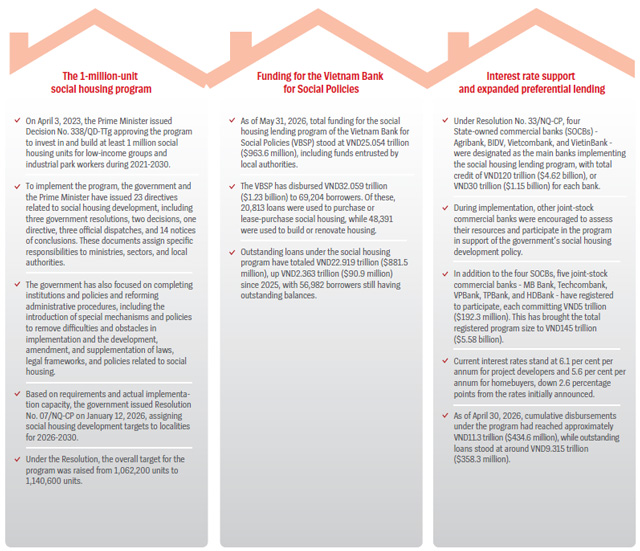
According to Mr. Ha Quang Hung, Deputy Director General of the Department of Housing and Real Estate Market Management at the Ministry of Construction (MoC), Vietnam has stepped up the development of social housing and worker housing alongside commercial housing in recent years, with the aim of supporting low-income groups who would otherwise struggle to secure housing for themselves and their families.
He noted that the adoption of National Assembly Resolution No. 201/2025/QH15, which pilots a number of special mechanisms and policies for social housing development, together with the relevant implementing decrees, addressed many bottlenecks and streamlined administrative procedures related to planning, land, construction investment, and other areas for social housing projects. “These measures are aimed at achieving the target of investing in and building at least 1 million social housing units by 2030,” he said.
Targets achieved
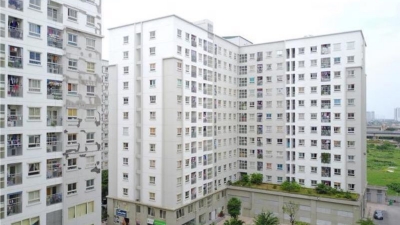
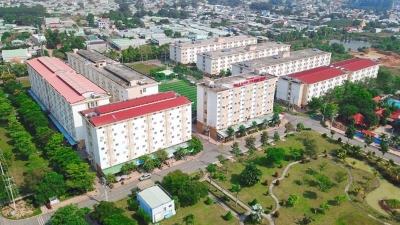
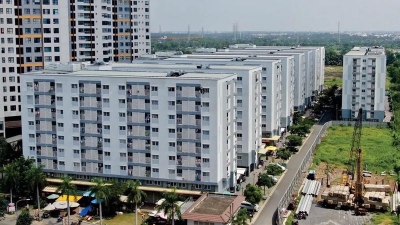
A report on the implementation of the 1 million-unit social housing program recently released by the MoC shows that, cumulatively, 875 social housing projects are currently being implemented nationwide, with a total planned scale of 773,457 units and estimated total investment of around VND637.019 trillion ($24.5 billion). Of these, 289 projects have been completed, providing 197,805 units with total investment of approximately VND162.912 trillion ($6.3 billion).
Nationwide, local authorities have also planned 1,986 sites covering approximately 10,279 ha for social housing development. These include 944 independent land funds covering about 6,047 ha; 837 land funds equivalent to 20 per cent of commercial housing projects, covering approximately 3,174 ha; 123 land funds for the people’s armed forces, covering around 475 ha; and 82 land funds for worker accommodation, covering approximately 583 ha.
Many localities have prioritized social housing land in convenient locations close to urban centers and industrial parks, with access to technical and social infrastructure. Major allocations include Dong Nai with 1,723 ha, Ho Chi Minh City with 1,740 ha, Hanoi with 1,555 ha, Bac Ninh with 754 ha, Tay Ninh with 570 ha, and Quang Ngai with 461 ha.
In practice, beyond projects already under development, many localities, particularly Hanoi and Ho Chi Minh City, are also pursuing breakthrough measures to enable the early commencement and accelerate the implementation of a large number of additional social housing projects.
Hanoi
Hanoi has drawn up plans to break ground at 114 housing projects during the second half of 2026. The Chairman of the Hanoi People’s Committee issued Directive No. 16/CT-UBND on July 20, 2026, requiring the time taken to process administrative procedures be reduced by at least 50 per cent. The capital will also apply a “green lane” mechanism to applications related to planning, investment, land, and social housing construction. The Directive clearly assigns responsibilities to relevant agencies and units throughout the implementation process.
The capital has also established a special task force for social housing investment and construction, which is responsible for monitoring and directing measures to accelerate investment and construction; consolidating difficulties and obstacles arising during implementation; reviewing and promptly resolving issues related to administrative procedures, planning, investment, land, and construction; accelerating site clearance, compensation, and resettlement; implementing housing support policies for eligible groups; and addressing investment funding and tax incentives for social housing projects. It is also tasked with recommending measures for projects that are behind schedule, fail to meet quality requirements, or violate regulations.
City leaders have instructed departments, agencies and local authorities to clearly define their responsibilities, maintain a high level of focus, and coordinate closely to remove obstacles and accelerate project implementation. They have also called for more proactive and decisive action on site clearance, as well as the preparation, appraisal, and approval of planning documents within the authorities’ respective jurisdictions.
Ho Chi Minh City
Ho Chi Minh City is similarly applying special mechanisms, accelerating administrative reforms, and expanding its land fund to increase social housing supply. According to a plan presented by the southern city’s Department of Construction at a regular socio-economic press briefing on August 13, the number of social housing projects expected to break ground between now and early 2027 is substantial.
On National Day, September 2, the city is scheduled to break ground on five projects with around 10,000 units. In the third quarter of the year, another 57 projects are expected to commence construction, with approximately 56,400 units, and a further 40 projects are planned in the fourth quarter, with a combined 40,000 units. Subsequently, the city expects to break ground on an additional 53 projects in the first and second quarters of 2027, comprising approximately 80,500 units.
Mr. Nguyen Van Hoan, Deputy Head of the Urban Development Division at the Department of Construction, said the city had broken ground on ten social housing projects since the beginning of this year, with a combined 11,362 units. Cumulatively, 22 projects are now under construction, comprising approximately 19,878 units, equivalent to 69.7 per cent of the city’s target of 28,500 units for 2026. The simultaneous rollout of these projects is intended to create a foundation for the city to achieve the government-assigned target of developing 199,400 social housing units by 2030.
Supply remains limited
Despite significant progress in social housing development, the MoC said that supply actually reaching the market remains limited and disproportionate to the substantial demand among workers, employees, and low-income earners in urban areas and at industrial parks. Some localities have yet to give sufficient attention to social housing development and have not allocated local budget resources for compensation, support, and resettlement, or for the technical infrastructure investment needed to create serviced land for social housing projects and hand it over to developers.
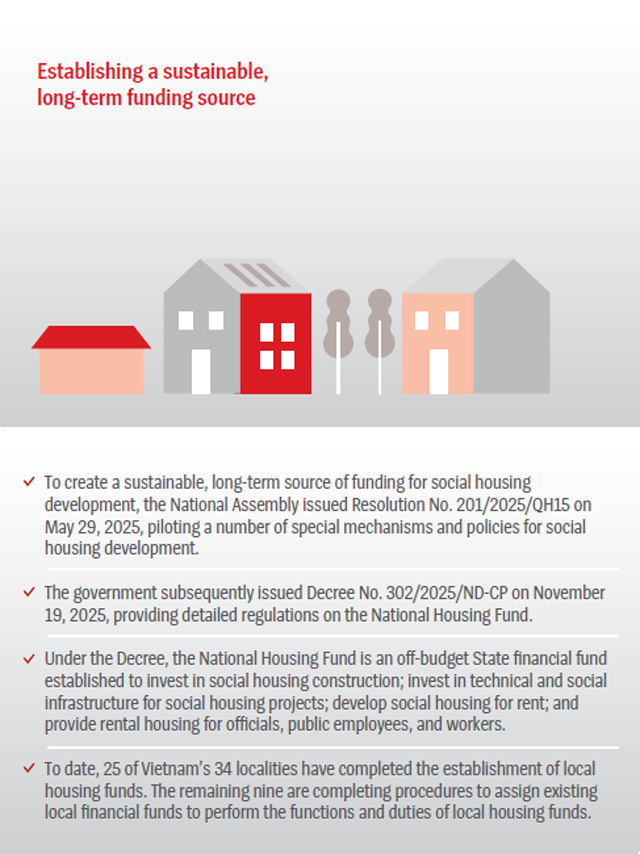
Businesses have also reported difficulties in the implementation process, particularly with planning, site clearance, land allocation, and the resolution of outstanding issues. Coordination between State management agencies in handling procedures remains insufficiently synchronized, increasing investment preparation times and business costs. Access to bank credit support remains challenging, while preferential State funding is limited even though housing projects, including social housing projects, require substantial upfront investment and have relatively long capital recovery periods, particularly social housing for rent.
Against this backdrop, the MoC has called on local authorities to incorporate targets for social housing and rental housing development into their annual socio-economic development plans. Localities have also been urged to proactively allocate budget resources for compensation and site clearance and to create clean land funds for social and rental housing development. They should strictly comply with regulations on allocating land for worker accommodation within industrial parks.
At the same time, local authorities need to review their land funds and complete their planning. Social and rental housing plans should be closely integrated with technical infrastructure, essential social services, and cultural, healthcare, and educational facilities. Priority should be given to urban areas, economic zones, industrial parks, high-tech parks, and areas undergoing rapid urbanization. “Localities also need to continue simplifying procedures for social and rental housing development through a one-stop-shop, single-point mechanism,” an MoC leader said. “Procedures relating to investment, planning, land allocation, construction permits, and access to preferential credit must be shortened and made more convenient, with clear deadlines and individual responsibilities.”
The measures are intended to further accelerate project implementation and facilitate the early completion of the program to invest in and build at least 1 million social housing units for low-income earners and industrial park workers during 2021-2030.






 Google translate