


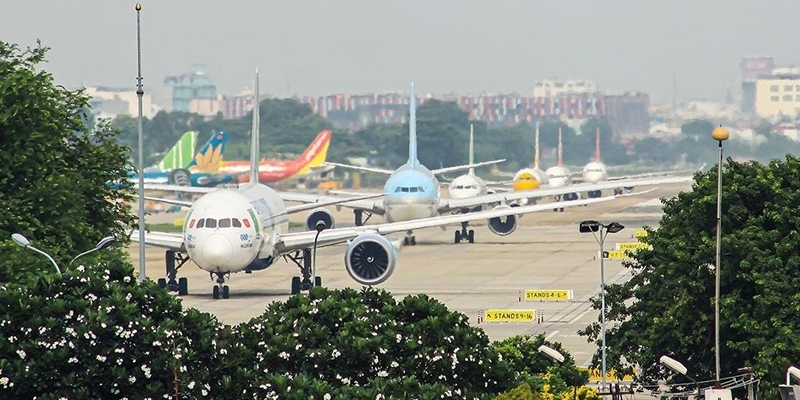
Figures from the Civil Aviation Authority of Vietnam (CAAV) show that the country’s aviation sector carried 83.5 million passengers in 2025, up 10.7 per cent year-on-year and the highest number on record. This growth momentum continued during the 2026 Lunar New Year (Tet) holiday, when the sector carried nearly 2.6 million passengers and handled 19,200 tons of cargo, representing increases of 15.9 per cent and 43 per cent, respectively, compared to Tet 2025. Domestic transport accounted for more than 1.1 million passengers and 2,400 tons of cargo, while international transport reached nearly 1.5 million passengers and 16,900 tons of cargo. The sharp rise in the international segment indicates a clear structural shift.
“Billion-dollar” lever
Aircraft purchasing contracts signed in early 2025 have become a strategic lever for the next development phase. Witnessed by Party General Secretary To Lam during his working visit to the US, Vietnamese airlines signed agreements worth nearly $32 billion for approximately 96 aircraft.
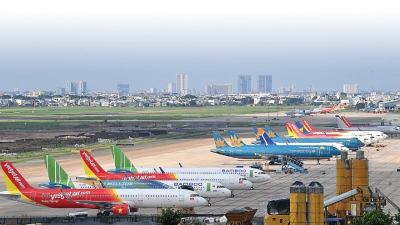
Vietnam Airlines signed a contract to purchase 50 Boeing 737-8 aircraft valued at about $8.1 billion, and discussed plans to invest in an additional 30 wide-body aircraft with an estimated total value exceeding $12 billion to support its international network expansion strategy.
The new market entrant, Sun PhuQuoc Airways, ordered 40 Boeing 787-9 Dreamliner aircraft worth approximately $22.5 billion.
Meanwhile, Vietjet Air reached a financing agreement to acquire six Boeing 737-8 aircraft valued at about $965 million and signed a contract with Pratt & Whitney to supply engines and maintenance services for 44 A321neo / A321XLR aircraft, worth approximately $5.4 billion.
According to CAAV Director General Uong Viet Dung, these contracts will drive growth and fleet restructuring in line with the master plan for developing the airport system for 2021-2030 with a vision to 2050.
The Authority noted that these orders will rejuvenate fleets, improve operational efficiency, and secure long-term transport capacity, targeting 275-300 million passengers annually by 2050. The allocation between narrow-body, wide-body, and mid-range aircraft is aligned with the planned shift of the operational axis towards Long Thanh, Gia Binh, and Chu Lai airports.
From a technology and environmental perspective, new-generation aircraft and engines can reduce fuel consumption and CO₂ emissions by 15-25 per cent compared to previous generations and cut noise by up to 50 per cent, supporting net-zero by 2050 commitments under the International Civil Aviation Organization (ICAO)’s roadmap. Beyond transport, the contracts also open the possibility of developing an integrated “airport city - logistics - tourism” ecosystem, in which wide-body aircraft will support international transit, air logistics, and cross-border e-commerce.
However, Mr. Dung emphasized the need for financial risk management given the tens of billions of dollars involved. Monitoring equity, debt ratios, cash flow, and guarantee mechanisms will be essential to ensure airlines’ execution capacity.
Regulators assess that these agreements lay three foundations for the next 20-30 years: green and sustainable growth, safety modernization in line with ICAO standards, and an enhanced national position. The contract signings with Boeing and Pratt & Whitney may represent the second strategic turning point for Vietnam’s civil aviation, after its period of market liberalization.
Infrastructure expansion
While fleets determine capacity in the air, airport infrastructure defines limits on the ground. For many years, Vietnam’s aviation growth has been constrained by capacity at Tan Son Nhat and Noi Bai International Airports in Ho Chi Minh City and Hanoi. The current wave of infrastructure expansion therefore goes beyond adding terminals; it represents a structural adjustment of traffic flows and a reorganization of the nationwide operating network.
The commissioning of Tan Son Nhat’s Terminal 3 and progress on Phase 1 of Long Thanh International Airport are reshaping the southern operational axis. Once Long Thanh becomes operational, about 80 per cent of international flights and 10 per cent of domestic flights are expected to move there. This will not only relieve congestion at Tan Son Nhat but also redistribute traffic between airports, prompting adjustments in network strategies and hub potential.
In the north, the completion of Noi Bai’s Terminal 2 expansion will add capacity for 5 million passengers annually and upgrade the airport to 4F standards. At the same time, the five-star Gia Binh Airport project is underway, expanding the capital region’s aviation capacity towards a multi-airport model rather than relying solely on Noi Bai. Meanwhile, Airports Corporation of Vietnam (ACV) is accelerating expansion plans for Phu Quoc, Cat Bi, Phu Cat, and Dong Hoi airports to strengthen capacity in key economic and tourism centers.
As infrastructure capacity expands, competitive dynamics will inevitably shift. According to Saigon-Hanoi Securities, Vietnam already has an airport network above the global average relative to population and land area, with accessibility improving under the approved master plan. With 83.5 million passengers carried in 2025 - a historic high - demand fundamentals provide room to absorb new capacity.
One notable factor is the increasingly open legal framework for private investment in aviation infrastructure. Van Don International Airport, developed by the Sun Group under the build-operate-transfer (BOT) model, exemplifies the trend toward socialization. Private participation not only adds capital resources but also changes operational organization towards integrated ecosystems linking airports, airlines, and tourism services.
Entering 2026, as fleet sizes across the market expand simultaneously, competitive pressure is expected to intensify. According to MBS, fleet growth is projected at around 18 per cent; significantly outpacing passenger growth. This will put direct pressure on domestic market share and force airlines to optimize costs, restructure networks, and utilize new hubs more efficiently.
Divergence between airline groups is becoming more pronounced. Leading carriers are focusing on international and regional routes to protect profit margins, while expanding airlines are seeking advantages in tourism, charter services, and hub-and-spoke models to optimize operating costs. VNDIRECT has noted that 2026 will highlight ecosystem-based investment strategies, where advantage lies not only in fleet size but also in the ability to control the value chain from infrastructure to services.
In this context, competition is no longer a simple race over frequency or fares but a process of redistributing traffic between airports and airlines. With fleets expanding and infrastructure being upgraded within a short period of time, the market is entering a phase of deep adjustment in which scale and efficiency must advance together. This shift marks a new cycle for Vietnam’s skies - broader in capacity and fundamentally different in operational structure and competitive dynamics.

![[Interactive]: Economic overview - September 2026](https://premedia.vneconomy.vn/files/uploads/2026/10/06/9e0f403040dd4384ad690004bc1911ab-124594.png?w=400&h=225&mode=crop)



 Google translate