


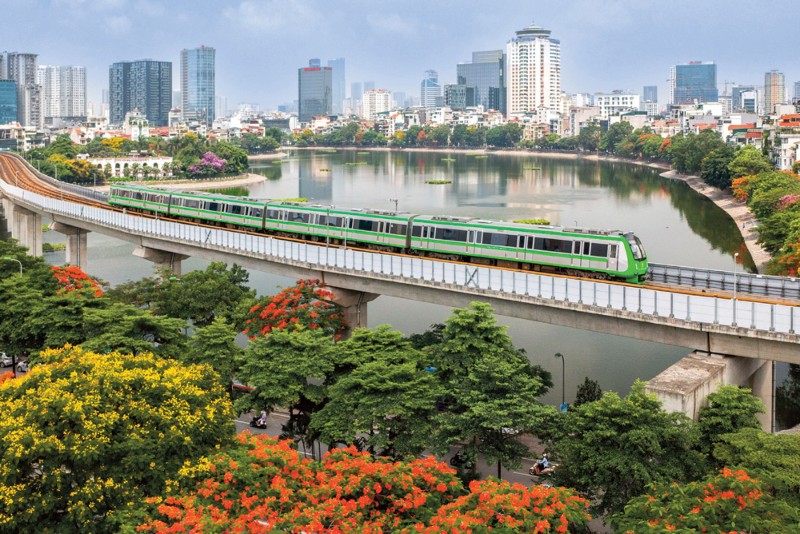

Applying international lessons to Hanoi’s unique urban context highlights a range of potential risks and challenges that the capital should anticipate and address as it implements Transit-Oriented Development (TOD) based on the 8D principles: Density, Diversity, Design, Distance to Transit, Destination Accessibility, Demand Management, Demographics, and Development Onsite.
Density: Hanoi’s fragmented private land ownership structure, particularly in former village areas and neighborhoods along planned metro corridors, shares many similarities with Bangkok, Thailand, and Manila in the Philippines. Existing infrastructure is also under significant strain, echoing the experiences of Delhi and Mumbai in India, where technical infrastructure has struggled to keep pace with urban intensification. Community resistance to high-density development is another concern, as residents may fear the loss of traditional urban character and the risk of gentrification driven by developer interests. These are important lessons Hanoi should take into account when pursuing TOD.
Diversity: Though Hanoi has developed several large mixed-use urban areas, detailed planning regulations continue to limit the integration of new functions into established neighborhoods.
Design: Hanoi continues to face a significant shortage of well-planned, secure parking facilities for motorcycles and bicycles at metro stations. The widespread occupation of sidewalks by parked motorcycles and street vendors presents challenges similar to those experienced in Ho Chi Minh City. At the same time, the city’s road design philosophy remains heavily-oriented toward private vehicles, while inactive street frontages in newer urban developments risk eroding Hanoi’s distinctive tradition of vibrant, active streetscapes.
Distance to Transit: Poor pedestrian conditions, including obstructed sidewalks and chronic traffic congestion, significantly reduce the perceived accessibility of transit stations. International experience also shows that insufficient integration between metro systems and feeder bus services can substantially reduce convenience in reaching stations.
Destination Accessibility: Hanoi risks repeating the jobs-housing imbalance seen in Beijing, China, where large-scale residential developments have expanded into suburban areas while employment opportunities remain concentrated in the city center.
Demand Management: Hanoi is pursuing an ambitious transport demand management agenda, including congestion charging for the city center and restrictions on motorcycle use. However, these measures carry considerable political and social risks, particularly given that motorcycles remain the primary means of livelihood for millions of residents.
Demographics: Hanoi faces a high risk of repeating the gentrification experienced in Shanghai, China, and Seoul, South Korea, where rapidly-rising property values along metro corridors pushed the residents most dependent on public transport farther away from stations. Lessons from London, UK, and Oakland, California, underscore the importance of introducing intervention policies early and strengthening community participation throughout the urban development process.
Development Onsite: Institutional fragmentation presents one of Hanoi’s greatest challenges. Metro systems are largely implemented by central government agencies, while land management falls under the authority of the city and local ward and commune governments. As in many developing countries, sophisticated financing mechanisms such as land value capture (LVC) remain relatively new, while limited institutional capacity to manage complex, integrated development projects remains a significant concern.
In conclusion, implementing the TOD model is a strategic priority that will play a decisive role in shaping Hanoi’s long-term sustainable development. However, international experience demonstrates that TOD implementation is a complex process involving interconnected institutional, financial, technical, and social challenges.
____________________________

Railway systems enhance regional connectivity, attract residents, increase property values, and generate financial resources for further reinvestment and network expansion.
To illustrate the relationship between public transportation and urban development around stations, I would like to highlight the redevelopment of the area surrounding Futako - Tamagawa Station in Tokyo, Japan.
Following the redevelopment, the Futako - Tamagawa area now accommodates approximately 1,000 residential units, 12,000 office workers, and 180 retail stores. Passenger traffic at the station has increased by an average of approximately 2.9 per cent annually. This demonstrates that when housing, employment, retail, and daily destinations are concentrated around stations, public transportation can sustain a more stable ridership base. Conversely, as passenger volumes increase, surrounding areas gain greater opportunities for commercial and service development, creating additional urban value. A key principle is that public transportation should not be introduced after a city has already been built, but instead be integrated into the urban development framework from the outset.
Ensuring the long-term sustainability of urban rail networks therefore requires more than railway infrastructure alone. It also depends on integrated urban development around stations.
This approach is reflected in the urban development model promoted by Becamex Tokyu in Binh Duong New City in Vietnam’s southern region. The company is developing residential, commercial, and public spaces in an integrated and carefully-planned manner, creating an urban environment where living, working, and community activities are well balanced. The development is also designed to accommodate future integration with public transportation.
Experience has shown that securing stable ridership for urban rail networks requires far more than building the railway itself. One of the key lessons for metro development is that if station areas lack destinations, pedestrian connectivity, feeder bus services, and urban amenities, metro lines will struggle to attract regular passengers. In other words, constructing the metro is only one part of the equation. Organizing the space around stations so that people can travel, work, shop, and carry out their daily activities is ultimately what determines the system’s long-term success.
___________________________

I believe Hanoi’s decision to simultaneously develop multiple metro lines marks a significant shift in the city’s urban development strategy, demonstrating its commitment to making urban rail the backbone of the capital’s public transport system. Under the new implementation model, with the Hanoi Metropolitan Railway Management Board serving as the project owner and domestic companies taking on larger roles in design, construction, and metro-oriented urban development, I expect many of the lessons learned from earlier projects will be incorporated into future lines.
Looking back at previous metro projects, most were implemented through official development assistance (ODA), relying on foreign consultants, technologies, and engineering, procurement, and construction (EPC) contractors. While this model enabled Vietnam to access advanced technologies, it also exposed several limitations, including lengthy project preparation, complex adjustment procedures, cost overruns, and limited autonomy for Vietnamese stakeholders. Greater participation by domestic companies offers several advantages. It can improve decision-making efficiency and coordination, strengthen the capabilities of Vietnam’s urban railway industry across design, construction, and operations, and enable transport infrastructure and urban development, particularly TOD areas surrounding stations, to be planned and implemented in a more integrated manner.
However, these advantages also come with significant responsibilities. Urban rail systems are neither conventional real estate developments nor standalone infrastructure projects. They are highly-complex engineering systems with life spans extending for decades, even centuries, and they fundamentally shape a city’s long-term urban structure. The greatest challenge, therefore, is not simply delivering projects quickly or on schedule, but ensuring high-quality planning, thoughtful design, and a long-term strategic vision.
From my research on TOD and metro station architecture, I am particularly interested in whether the new lines can move beyond viewing stations solely as transport infrastructure. What I hope to see most is not simply newer trains or faster construction, but the integration of public spaces around stations, pedestrian connectivity, inclusive design, local architectural identity, underground spaces, and high-quality user experiences from the earliest planning and design stages.
In other words, the success of Hanoi’s new metro lines should not be measured solely by the number of kilometers of track laid or the speed of construction, but by their ability to create genuine TOD districts, high-quality urban spaces, and a development model suited to Hanoi’s unique conditions. International experience shows that if these elements are not incorporated from the outset, they become extremely difficult and expensive to retrofit once the system is operational.
For that reason, Hanoi’s objective should extend beyond simply building more metro lines. It should aim to establish a TOD model with a distinct identity that reflects both the capital and Vietnam as a whole. If implemented successfully, the new metro network will not only address transportation challenges but also help create more livable urban environments for generations to come.
__________________________

The breaking of ground at five new metro lines marks a major milestone in Hanoi’s transition from developing individual rail lines to implementing an integrated, citywide urban railway network. It also represents an important step toward realizing the Capital Master Plan with a 100-year vision, recently approved by the city. Under this plan, public transport is positioned as the primary driver shaping Hanoi’s future urban development. Urban rail will serve as the backbone for a polycentric, multi-directional urban structure, supporting the development of new urban areas while revitalizing existing districts.
Another significant feature of these five metro lines is that they are financed entirely through public investment. This enables the city to fully utilize the special mechanisms introduced by the National Assembly for urban railway projects. As a result, administrative procedures have been significantly streamlined.
For example, new urban railway projects will no longer require the preparation and approval of separate investment policy proposals, substantially reducing project preparation time.
In addition, land acquisition and site clearance will be separated into independent projects, allowing them to begin immediately after route alignments and station locations are approved. This approach is intended to ensure construction sites can be handed over to contractors promptly after project approval and contractor selection, helping to keep implementation on schedule.
Investment in these five metro lines will also contribute to the government’s objective of achieving double-digit economic growth. Public financing provides greater flexibility in selecting technical standards, regulations, and technologies, ensuring consistency and interoperability across the metro network while supporting the development of Vietnam’s domestic railway industry in line with government policy. These are highly significant strategic benefits.
Under Hanoi’s 100-year Capital Master Plan, the city’s urban railway network will eventually comprise 18 lines with a total length of 979 km. Development will be phased over time, with approximately 500 km expected to be completed by 2035 and the remaining network scheduled for completion between 2035 and 2045.
Beyond the urban metro system, Hanoi is also planning regional railway connections linking the capital with neighboring provinces. These lines are intended to create an integrated regional transport network that supports both passenger mobility and freight transportation across the Greater Hanoi metropolitan area.
Such an ambitious railway program requires enormous financial resources. For the five metro lines now under construction, the city plans to rely on its own budget. For subsequent projects, however, it intends to diversify funding sources by attracting private investment and implementing public-private partnership (PPP) models in accordance with government regulations.
___________________________
Under Hanoi’s 100-year Master Plan, approved recently by the Hanoi People’s Council, the capital will develop into a multi-polar, multi-tier, and multi-centered city, creating new growth hubs connected by a modern, integrated infrastructure network.
Within this vision, the urban railway system has been designated as the city’s strategic backbone infrastructure, playing a leading role in shaping urban development and restructuring Hanoi’s overall transport network. Beyond addressing traffic congestion, the metro system will serve as the framework for reorganizing Hanoi’s urban space, promoting Transit-Oriented Development (TOD), expanding the city’s footprint along North-South and East-West corridors, and connecting Noi Bai International Airport and Hanoi Railway Station with emerging growth centers such as Hoa Lac, Thu Lam, Co Loa, and Gia Lam, as well as neighboring localities across the Capital Region. In doing so, it will strengthen regional connectivity, enhance competitiveness, and create new growth drivers for Hanoi over the decades to come.
The objectives set out in the Master Plan represent a significant departure from previous development strategies. Hanoi aims to become a city with substantial influence both domestically and internationally across multiple dimensions, supported by a strong economy and a level of household income that ranks it among the world’s high-income cities.
Achieving these ambitions requires world-class infrastructure. The breaking of ground at five metro projects will strengthen connections between the city center and emerging growth poles, improve links among those growth centers themselves, and enhance connectivity between Hanoi and neighboring localities. This will effectively overcome spatial barriers and lay the foundation for stronger development across the wider Capital Region.
Previously, Hanoi functioned as a single growth pole centered on the urban core, resulting in congestion, inefficient development, and underutilized land surrounding the city center. Today, the city has identified TOD as a central strategy for restructuring Hanoi’s urban form into a denser, mixed-use, and more efficient city that is less dependent on private vehicles and makes better use of land resources. Developing a network of multiple urban centers connected by a modern public transportation system, and linking major urban districts with the city center and with one another, will create an integrated urban ecosystem that stimulates growth in the economy, services, and real estate. In turn, this will boost economic activity, create jobs, and improve residents’ quality of life.
Alongside the launch of new metro projects, Hanoi is also expanding and upgrading its urban road network. This demonstrates the determination and strong commitment of the city’s authorities to achieve the goals outlined in the Master Plan as quickly as possible.
Equally significant is the government’s changing approach to infrastructure development. In the past, Vietnam actively courted foreign companies to bring in capital and technology for major projects. Today, assigning these projects to domestic enterprises reflects a fundamental shift in the government’s thinking, vision, and governance. Particularly following the issuance of Politburo Resolution No. 68, which identifies the private sector as a key driver of national economic growth, the government has introduced policies and institutional reforms that strengthen the capabilities of Vietnamese businesses and enhance their competitiveness.
These policies include entrusting leading domestic companies with the delivery of major and technically-complex infrastructure projects, including airports, expressways, and urban rail systems. In practice, many of these projects have been completed on schedule, met quality standards, and successfully entered into operation. This approach not only strengthens the capacity and resilience of Vietnamese enterprises but also creates an important source of long-term economic growth, supporting the country’s transition toward more sustainable development.
___________________________
Against the backdrop of rapid urbanization, soaring private vehicle ownership, and increasingly limited land available for transport infrastructure, Hanoi’s simultaneous launch of five new metro lines demonstrates the strong commitment of both the central government and the city to transform its transportation model toward one that is modern, green, and sustainable. More importantly, Hanoi has shifted from investing in individual metro lines to developing an integrated urban rail network, with the metro serving as the backbone of the public transportation system. This is not merely the construction of transport infrastructure but the beginning of a broader transformation in the city’s urban development model.
First and foremost, the metro network will significantly enhance the capacity of public passenger transportation, reducing dependence on private vehicles and, in turn, easing traffic congestion, lowering accident rates, and cutting environmental pollution. More importantly, it will become a catalyst for restructuring Hanoi’s urban development. Metro lines will strengthen connections between the city center and satellite cities, Noi Bai International Airport, Hoa Lac Hi-Tech Park, and emerging growth hubs, creating new development corridors while redistributing population and resources in a more balanced and sustainable manner.
In my view, the greatest contribution of the metro network is not simply the introduction of modern trains, but the transformation of travel behavior and the way urban space is organized. Today, Hanoi residents still rely heavily on motorcycles and private vehicles. As the metro network expands and Transit-Oriented Development (TOD) principles are fully implemented, people will gradually adopt multimodal travel patterns, with the metro serving as the backbone connected seamlessly to buses, public bicycles, feeder services, and other forms of shared mobility. Residential communities, commercial centers, office developments, and service facilities will naturally cluster around metro stations. People will increasingly choose where to live, work, and spend their leisure time based on access to public transportation, much like in Tokyo, Seoul, and Singapore. The metro will not only change how people travel but also help foster a greener, more modern, and more sustainable urban lifestyle.





 Google translate