


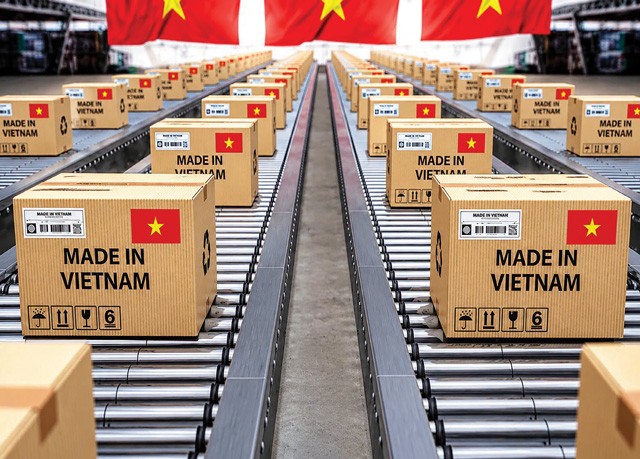
Vietnam’s e-commerce market is still growing rapidly, but some of the numbers underneath that growth are moving in opposite directions. According to Makreo Research, transaction volumes across major e-commerce platforms in Vietnam fell by about 8 per cent in late 2025, even as average selling prices rose 33 per cent, while the number of active seller storefronts declined 7.4 per cent and platform revenue climbed nearly 35 per cent.
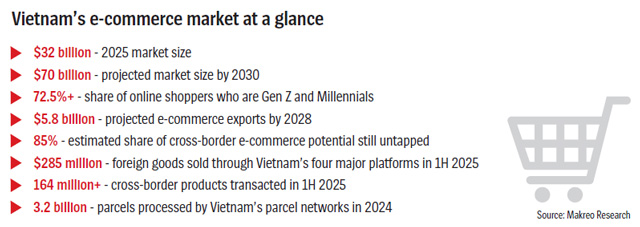
The figures point to something more significant than a simple slowdown. Vietnam’s e-commerce market reached approximately $32 billion in 2025, sustaining annual growth of around 20 per cent, but the market is entering a new phase - one shaped less by the discount-driven, customer-acquisition playbook of the past and more by rising platform costs, tighter regulation, changing consumer behavior, and increasing competition for profitable growth.
That transition is also changing how Vietnamese consumers shop. TikTok Shop’s rapid growth has helped push livestreaming and short-form videos deeper into the purchasing journey, while AI is making searches more conversational, complex, and personalized. The result is a consumer journey that is becoming harder to predict even as expectations for a seamless shopping experience continue to rise.
For retailers and e-commerce businesses, the challenge is therefore no longer simply how to grow faster, but how to grow more intelligently - by understanding customer intent, retaining existing customers, connecting online and offline channels, and using AI without losing control of costs, data, or compliance. That is the shift now reshaping Vietnam’s next phase of e-commerce growth.
Growth getting harder
The shift is particularly visible in what consumers value and where platforms are concentrating growth. At the Vietnam Retail & E-commerce Summit 2026, held recently by Google Ads Academy, speakers highlighted a combination of rising platform costs, increasingly selective consumers, and tighter regulatory requirements that are putting pressure on businesses to build more sustainable growth models.
One of the clearest shifts is the growing importance of trust and seller credibility. Makreo Research noted that official brand stores have been gaining share on major platforms, reflecting consumers’ increasing preference for authorized sellers and greater confidence in established brands. The trend is reinforced by a broader push toward platform verification and more transparent online commerce as regulation becomes stricter.
At the same time, competition is becoming increasingly concentrated around platforms and formats that can generate demand rather than simply capture it. TikTok Shop’s rapid expansion is a case in point: its combination of livestreaming, short-form videos, and creator-led selling is changing how products are discovered, particularly among younger online shoppers. Makreo Research estimates that Gen Z and Millennials now account for more than 72.5 per cent of Vietnam’s online shopper base, making content-led commerce increasingly difficult for brands to ignore.
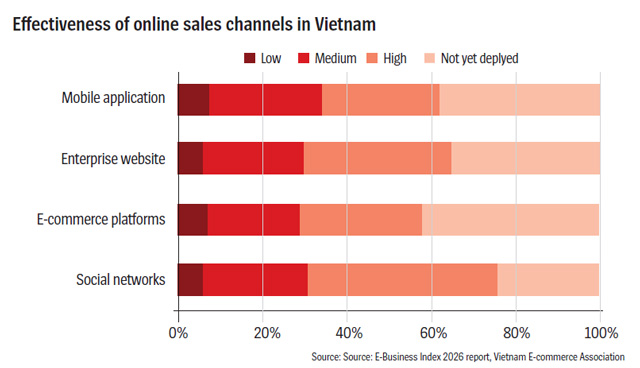
Mr. Bui Van Quang, Founder and CEO of TOPHANGSI, said the challenge for businesses is increasingly about delivering the right product, at the right price, and at the right moment, while maintaining consistency across advertising, online content, sales teams, and physical stores.
For Mr. Nguyen Manh Tan, CMO of Haravan, the pressure is particularly acute for businesses operating on marketplaces, where generating sales does not necessarily translate into owning the underlying customer relationship.
The implication is that Vietnam’s e-commerce competition is moving beyond traffic and transaction volume toward trust, direct customer relationships, and operational discipline. The next question is how businesses can understand consumers as their shopping journeys become increasingly complex, and that is where AI is beginning to reshape the market.
Regulation raises the stakes
Vietnam’s e-commerce market is not only becoming more competitive, it is also becoming more regulated. New rules are raising the compliance bar for platforms, sellers, and brands at a time when businesses are already dealing with higher acquisition and operating costs.
The Law on E-Commerce, effective July 1, 2026, introduces requirements such as seller identity verification, greater transparency around ranking algorithms, timely handling of livestream-related complaints, and the retention of transaction data for at least three years. Meanwhile, the Law on Artificial Intelligence, effective March 1, 2026, introduces requirements around labeling AI-generated content, controlling “shadow AI”, and strengthening human oversight of AI systems used in areas such as retail and e-commerce.
For businesses, the significance goes beyond adding another layer of paperwork. Makreo Research argued that the new Law on E-Commerce will require meaningful compliance investment from both platforms and sellers, while rising fees and tighter regulation are narrowing the room for businesses to rely on speed and low-cost growth alone. Regulatory readiness is increasingly becoming a market-entry requirement rather than an afterthought.
The impact is particularly relevant as AI becomes embedded across marketing, customer service, content creation, and commercial operations. Ms. Tu Tran, Account Manager at Cloud Ace, argued that AI can no longer be treated as a series of independent experiments within individual departments. Systems that interact with customers, generate content, or influence recommendations and rankings need to operate within a more structured governance framework.
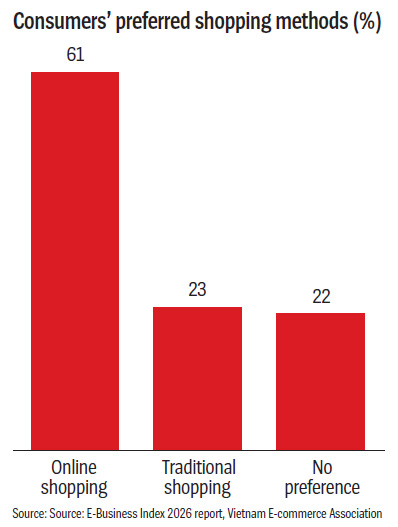
That creates a new balancing act for retailers. Marketing teams need to move quickly, operations need to automate more processes, and executives need to demonstrate returns on AI investment - but all three must operate within increasingly demanding compliance requirements. As Ms. Tu noted, these challenges are interconnected: automation without governance can create compliance risks, while AI investment without integration into core business processes can raise costs without fundamentally improving operations.
The result is a market where compliance is becoming part of the operating model itself, rather than a legal issue addressed after the business has already scaled. For e-commerce companies entering their next phase of growth, the ability to innovate quickly will increasingly need to be matched by the ability to govern that innovation responsibly.
Rewriting the shopping journey
The next shift is also happening at the level of the consumer. The traditional path to purchase - from discovering a need, searching for information, and comparing products to making a purchase - is becoming increasingly non-linear as consumers move between platforms, revisit earlier decisions, and interact with brands in different ways.
Mr. Nghia Nguyen, Accelerated Growth Manager, Google Customer Solutions Vietnam, described the emerging journey as more complex but accompanied by a paradox: consumers expect the experience to become more seamless and convenient, even as the number of touchpoints involved continues to increase.
AI is accelerating that change. As consumers become more accustomed to AI-powered search and chat, their queries are becoming longer and more complex. Google research cited by Mr. Nghia shows long-form search queries growing 107 per cent year-on-year, with particularly strong growth among queries containing five to ten or more words. Consumers are also increasingly using multimodal search, combining text with images to describe what they want or to solve problems they cannot easily express through keywords.
That is changing the role of search itself. Rather than simply matching advertisements to specific keywords, Google is increasingly focused on understanding the intent behind a query. Mr. Nghia described this evolution as a shift from “keyword-based” to “intent-based” advertising, with Google’s AI Max for Search designed to help advertisers capture demand that may not be expressed through the exact keywords they have anticipated.
The same shift is visible beyond traditional search. Google AI Overview, for example, is designed to interpret complex queries and bring together relevant information, while Google has begun introducing sponsored products within AI-powered search experiences in some markets.
But the change is not only about technology. It is already visible in how consumers interact with businesses. Mr. Tran Xuan Nam, E-commerce Director at FPT Retail, said more than 50 per cent of FPT Long Chau customers now come through chat. The shift reflects both changing consumer habits and growing trust in e-commerce for healthcare, particularly as customers increasingly prefer to consult pharmacists through conversation rather than visit a store in person.
For FPT Long Chau, the importance of this conversational journey goes beyond convenience. Mr. Nam identified “speed and trust” as two critical success metrics for healthcare commerce. As AI dramatically expands the amount of health information available to consumers, the challenge is increasingly to help customers distinguish useful information from information that may be inaccurate or confusing.
The implication is that the shopping journey is no longer simply about finding a product. It is increasingly about helping consumers navigate information, intent, and decisions across multiple touchpoints, with AI becoming an increasingly important layer connecting those experiences.
Omnichannel becomes intent-driven
As shopping journeys become more fragmented, simply being present across multiple channels is no longer enough. The next challenge for retailers is to understand where, when, and how a customer wants to engage, and then connect those touchpoints into a single journey.
This is particularly visible in the evolution of O2O (Online-to-Offline) commerce. Rather than treating online and offline as separate sales channels, retailers are increasingly using digital interactions to influence what happens in physical stores, and vice-versa.
Mr. Nam described FPT Long Chau’s approach as moving beyond a traditional omnichannel model toward what he sees as an “intent commerce” model. The earlier focus was on connecting inventory, demand forecasting, and online-to-store journeys. The next step is to combine customer history, preferences, and intent to determine which solution or channel is most relevant to each individual customer.
That means the objective is no longer simply to move a customer from an online channel into a physical store. The store is only one possible destination. Depending on the customer’s needs and behavior, the most appropriate outcome could be a store visit, an online purchase, a chat with an advisor, or another digital interaction.
Measurement is becoming equally important. Google’s Store Visits capability, for example, allows businesses to connect online advertising and interactions with subsequent visits to physical locations. Combining store-visit measurement with behavioral signals can help businesses identify audiences with similar characteristics and scale campaigns more efficiently. This creates a different way of thinking about omnichannel strategy. The goal is not to maximize presence across every available platform, but to orchestrate the customer journey around intent.
For retailers, that distinction matters. A customer who discovers a product on social media may ultimately want to buy through a marketplace; another may prefer to ask questions through chat before visiting a store; while someone else may want to complete the entire transaction online. The winning model is therefore less about forcing customers into a predetermined channel and more about allowing the business to respond intelligently to how each customer chooses to buy.
Customer intelligence
As customer acquisition becomes more expensive and shopping journeys become more fragmented, retailers are facing a fundamental question: how can they turn the customers they already have into a long-term source of growth?
Mr. Tan highlighted customer retention as one of the capabilities that will become increasingly important over the next three to five years. Businesses selling through marketplaces often have limited access to customer data, making it harder to reconnect with existing buyers and drive repeat purchases. Building the ability to understand, engage, and retain existing customers will therefore be critical to generating sustainable profit.
This is also where AI can move beyond being a productivity tool and become part of the commercial infrastructure. Mr. Nghia described the next stage as “hyper-personalization” - moving from traditional segmentation and customized messaging toward increasingly automated personalization based on a deeper understanding of individual customers.
That shift puts customer intelligence at the center of the model. Instead of simply knowing which segment a customer belongs to, businesses need to understand their history, preferences, and intent, and use those signals to determine what the customer is most likely to need next. For Mr. Nghia, this makes the ability to own and understand customer data increasingly strategic.
That shift also makes governance increasingly important, as businesses need to ensure AI is integrated into core operations rather than deployed as isolated tools. These challenges cannot be solved independently. More demand generated by marketing is of little value if operations cannot fulfil it. Automation without appropriate governance can create compliance risks, while investing in AI without integrating it into core business processes can simply increase technology costs without improving the underlying economics.
The competitive advantage, therefore, is shifting from having the most traffic to having the best customer intelligence and operating capabilities: understanding data faster, making better decisions, and automating more of the business while keeping risk under control.
That sets up the next question for Vietnam’s e-commerce market: what happens when AI moves from helping businesses understand and serve customers to actively participating in the commerce journey itself?
The next phase
Looking three to five years ahead, speakers at the Summit broadly agreed that the next phase of e-commerce will be defined less by any single technology than by how quickly businesses can adapt to AI, changing consumer expectations, and a more demanding regulatory environment.
For Mr. Quang, the defining capability will be adaptability. As AI develops rapidly and regulation becomes stricter, businesses need to learn how to apply AI to make operations faster and more accurate while simultaneously building the legal and governance frameworks needed to operate sustainably.
Mr. Manh, meanwhile, identified three priorities for the next three to five years: developing the ability to use AI across advertising, planning, and forecasting; strengthening the capability to retain and resell to existing customers; and adapting to new regulations, including changes in advertising and tax rules.
The next battleground will also be speed. Mr. Nam expects quick commerce to become more prominent in Vietnam as consumers continue to raise their expectations for delivery times. But faster fulfilment will not be enough on its own. As the delivery process becomes increasingly optimized, businesses will need to focus on the part of the journey that happens before fulfilment, from attracting customers to converting them into buyers. Automated chat and other AI-enabled tools could play a growing role in shortening that journey.
The implication is that speed will increasingly mean more than delivering a product quickly. It will also mean reducing the time between a consumer expressing an intent and a business successfully converting it into a purchase.
Mr. Nghia sees the next stage of this evolution through three broader shifts. The first is agentic commerce, where AI largely helps consumers find and understand information. The second is deeper customer intelligence, with AI making increasingly personalized interactions possible at scale. And the third is the opportunity to build sustainable Vietnamese brands for global markets. Makreo Research projects Vietnam’s cross-border e-commerce exports will increase from $3.5 billion in 2023 to $5.8 billion by 2028, while estimating that around 85 per cent of the country’s cross-border e-commerce potential remains untapped. The challenge is to move beyond manufacturing for foreign brands and build Vietnamese brands that can compete directly in global markets.
Those perspectives suggest that Vietnam’s next e-commerce chapter will not simply be about more transactions, more platforms, or more traffic. It will be about building businesses that can understand customers more deeply, respond faster, automate intelligently, retain the relationships they create, and operate with enough discipline to scale sustainably. The winners of the next phase may therefore be the businesses that adapt fastest, not simply the ones that grow fastest.









 Google translate