



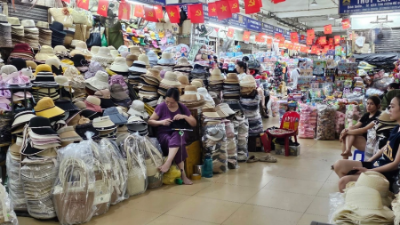
Vietnam has around 5 million household businesses at this time, including roughly 3 million that incur tax obligations; far outnumbering the approximately 1.066 million active companies. The sector is highly flexible, remarkably adaptable to market shifts, and acts as a strong “social safety net,” helping Vietnam’s economy weather financial shocks such as the 1997 Asian Financial Crisis.
Yet unlocking the potential of more than 5 million household businesses will require moving them from the “gray zone” into an environment with greater transparency, simplifying administrative procedures, reducing compliance costs, and easing barriers to credit.
Under strain
Despite their role in driving consumption and retail activity, household businesses face mounting challenges. A survey by the Vietnam Chamber of Commerce and Industry (VCCI) of more than 1,000 household businesses across Vietnam’s 34 cities and provinces paints a worrying picture in terms of revenue performance, with 81.5 per cent reporting declining revenue and 33 per cent planning to scale back operations, while only 1.8 per cent had the potential to break out and post growth.
Ms. Cao Thi Thanh Lan from the Department of Tax, Fee and Charge Policy Administration and Supervision at the MoF, said the VCCI survey found that, beyond legal difficulties, 59.3 per cent of household businesses were struggling with high input costs, 43.8 per cent were affected by weaker market demand, and 32.6 per cent faced shortages of capital and labor. In 2025, only 1.9 per cent achieved their expected level of profit, while 73.7 per cent reported low profits, 12.9 per cent broke even, 9.3 per cent posted small losses, and 2.2 per cent suffered significant losses. These figures show that most household businesses operate on very thin margins, leaving little room to accumulate capital for expansion.
Market conditions are not the only challenge. Changes in the regulatory environment have also created significant disruption. 2026 marks the first year Vietnam has officially abolished the presumptive tax system. The rollout of e-invoices and cash register connections for businesses with annual revenue above VND1 billion ($38,500), under Decree No. 70/2025/ND-CP, while improving transparency, has created confusion among businesses accustomed to traditional operating practices.
Ms. Vu Thi Binh, Director of the Binh Vu Enterprises Advisory and Training Co., Ltd., said the past two years have been particularly challenging for household businesses transitioning from presumptive taxation to tax declaration. Applying tax rates based on actual revenue has significantly increased financial obligations and created uncertainty among business owners. As a result, many establishments have exited the market as profits have been squeezed or they have struggled to meet regulatory requirements. Those that remain often fear penalties because they are unfamiliar with rules governing when e-invoices must be issued or worry about minor technical errors.
Mr. Nguyen Thanh Lam, Partner - Leading Hanoi Office at RSM Vietnam, echoed such concerns, saying that many existing regulations impose excessive compliance costs. For small businesses and household businesses in particular, where profit margins are already thin, excessive regulatory and operating costs can render policy incentives ineffective.
Room to grow
In response to the difficulties facing the business community, lawmakers and government agencies are taking stronger policy measures aimed at supporting the household business sector.
Ms. Lan said the National Assembly passed Law No. 09/2026/QH16 on April 24, 2026, amending several tax laws. Under Decree No. 141/2026/ND-CP, issued on April 29, the annual revenue threshold for exemptions from personal income and value-added taxes, as well as the threshold for corporate income tax exemptions, was raised to VND1 billion ($38,500), effective January 1, 2026. The move raised the tax exempt threshold from VND100 million ($3,850) in 2025, balancing taxpayer support with State revenue needs.
In addition, a tax incentive package submitted to the National Assembly, with implementation proposed from the third quarter of 2026, would cut personal income tax rates by 30 per cent in 2026 and 2027 for individual businesses with annual revenue below VND10 billion ($384,600), and corporate income tax by 30 per cent for small and micro enterprises with annual revenue below the same threshold. It would also reduce the number of required accounting books from four to one for 99.86 per cent of household businesses.
Ms. Nguyen Thi Bich Thuy from the Agency for Private Enterprise and Cooperative Economic Development (APED) at the Ministry of Finance (MoF) said Decree No. 20/2026/ND-CP, issued by the government on January 15, 2026, provides a range of incentives, including a 30 per cent reduction in land rents in industrial parks and clusters, a three-year tax exemption for newly-established small businesses, and support for setting up science and technology development funds. In particular, the government will provide household businesses and micro-enterprises with free accounting software, shared digital tools, and training courses in management, taxation, and accounting.
Regarding the draft Law on Small and Medium Enterprise Development, which would replace the Law on Support for Small and Medium Enterprises 2017 and is expected to be submitted to the National Assembly for passage in October, Ms. Thuy said the legislation would shift the policy mindset from “supporting vulnerable groups” to “creating incentives for growth.” The support selection process would be fully digitized and based on shared databases to reduce compliance costs.
Restoring business confidence
Many experts argue that beyond tax exemptions and reductions, changing the regulatory mindset and rebuilding business confidence will be decisive.

The law must shift firmly from ‘management’ to ‘enabling and promoting development,’ ensuring clarity, predictability, and low implementation costs.

Ms. Nguyen Thi Thu Ha, Deputy Secretary General of the Vietnam Tax Consultants Association, welcomed the increase in the tax exempt threshold to VND1 billion ($38,500), saying it would reduce tax authorities’ administrative burden as 96 per cent of household businesses fall into this category. However, regulations governing household businesses are currently scattered across three laws, five decrees, and seven circulars, creating significant confusion.
Ms. Ha called on regulators to issue consolidated regulations and detailed guidance tailored to different business sectors. During the first two years of the transition, she proposed a “soft” transition period under which administrative penalties would not be imposed for inadvertent technical violations. Rather, businesses would only be required to pay back taxes and late-payment interest. She also proposed shifting tax officials’ performance indicators away from the amount of penalties collected toward the number of taxpayers achieving good compliance.
From a broader institutional perspective, Dr. Nguyen Dinh Cung, former Director of the Central Institute for Economic Management, now the Institute for Policy and Strategy Studies, said private sector development is entering a favorable period as it is being placed at the center of economic policy. However, a sense of “worry and fear” continues to weigh on the business community. “We need to decisively abandon the mindset that ‘if you cannot manage it, ban it’,” Dr. Cung said. “The law must shift firmly from ‘management’ to ‘enabling and promoting development,’ ensuring clarity, predictability, and low implementation costs.”
Mr. Bui Anh Tuan, Director of APED, said the MoF views household businesses as an important growth driver and a vulnerable group requiring careful policymaking. The roadmap to abolish presumptive taxation, raise the simplified tax threshold to VND10 billion ($384,600), digitize invoicing, and promote cashless payments aims to move household businesses from the “gray zone” into a more transparent “light zone.”
With greater cash-flow transparency and new provisions in the draft Law on Small and Medium Enterprise Development, banks will be better positioned to lend based on cash flow data rather than relying primarily on “red book” collateral, he added.
)





 Google translate