


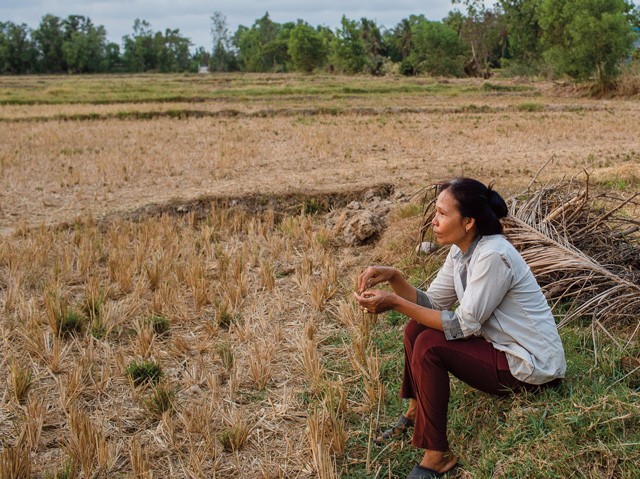
Vietnam’s agricultural sector is confronting a widening range of climate threats, from saltwater intrusion and drought to floods, typhoons, and rising temperatures. A new report from the International Institute for Sustainable Development (IISD) argued that trade policy could become an important, but so far underused, tool for helping farmers and agricultural businesses adapt.
The report, entitled “Leveraging Trade Policy for Climate Change Adaptation in Vietnam’s Agricultural Sector,” identified the goods and services needed to advance Vietnam’s adaptation priorities and examined the barriers that could prevent them from reaching the market. Its central finding was that while tariffs have generally declined as Vietnam has integrated into the global trading system, non-tariff measures and regulatory requirements can still make adaptation technologies more costly and difficult to access.
Adoption priorities
The report found that climate change is affecting all eight cities and provinces studied, though the risks vary considerably by region. In the Mekong Delta, saline intrusion is among the most pressing threats. Ben Tre, Tra Vinh, and Ca Mau provinces experienced their most severe saline intrusion in more than 60 years during the 2015-2016 and 2019-2020 dry seasons, damaging rice and fruit and causing major economic losses. In An Giang province, increasingly irregular cycles of flooding and drought have disrupted traditional rice production and aquaculture.
Central coastal provinces face a different combination of risks. Khanh Hoa and Phu Yen are exposed to stronger storms, drought, and coastal erosion, while Quang Nam and Hue have suffered repeated typhoons, floods, and landslides.
Citing World Bank estimates, the report said climate-related damage could cost Vietnam 12-14.5 per cent of GDP by 2050, equivalent to cumulative losses of $400 billion-$523 billion. Agriculture alone has about $1 billion in annual GDP and 1.5 million workers directly exposed to intense flood risks, while 1.1 million tons of aquaculture production worth almost $1 billion in exports are at risk from flooding each year.
Vietnam’s National Adaptation Plan for 2021-2030, with a vision to 2050, identifies 27 adaptation priorities for agriculture. The IISD report found that 19 of them have an international trade dimension because they involve goods or services that can be bought, sold, or provided across borders.
The solutions required are highly-dependent on local conditions. In the north, farmers may need cold-tolerant crop varieties, soil stabilization technologies, and small-scale irrigation. Central localities have greater demand for drought-resistant crops, decentralized water storage, and storm-resilient infrastructure. In the Mekong Delta, meanwhile, priorities include salt-tolerant rice, brackish-water aquaculture breeds, and equipment for monitoring salinity.
The report grouped adaptation goods into four broad categories: climate-resilient crop and livestock varieties; efficient irrigation systems; post-harvest handling and storage equipment; and protective infrastructure.
It also identified consulting and technical training, water-quality monitoring, weather forecasting, early-warning systems, disease detection, agricultural insurance, market services, and engineering as part of the adaptation toolkit.
Its research found that many of these solutions are already being adopted. In the Mekong Delta, farmers and cooperatives in Ben Tre, Tra Vinh, and Ca Mau are moving away from conventional rice production toward rice-shrimp systems that can operate in brackish water.
In An Giang, adaptation has focused on irrigation, resilient rice varieties, and closed-loop aquaculture. The province has invested in the VND147 billion ($5.9 million) Bay Nui irrigation system, while farmers have diversified into vegetables and flowers grown in greenhouses. In Khanh Hoa, aquaculture operators are adopting storm-resistant high-density polyethylene cages and automated systems, while more than 800 ha of rice land have been converted to higher-value crops.
Hidden barriers
Since joining the WTO in 2007, Vietnam has signed more than 17 free trade agreements, including the Comprehensive and Progressive Agreement for Trans-Pacific Partnership (CPTPP) and the EU-Vietnam Free Trade Agreement (EVFTA). But the report found that specific adaptation technologies can still face residual tariffs or classification problems. Specialized equipment such as hydrological sensors and precision irrigation components may fall under tariff lines that do not qualify for zero-duty treatment, raising the cost of adoption.
More significant, however, are non-tariff measures. Importers of climate-resilient seeds, livestock breeds, and agricultural technologies can face authorization, testing, product registration, certification, labeling, and traceability requirements. While these measures can serve legitimate goals such as protecting human, animal, and plant health, the report said they can also delay market entry and raise costs.
For specialized, low-volume adaptation products, those costs can be particularly burdensome. Imported salt-tolerant seeds, for example, may require labels containing detailed information that differs from the original packaging used by international suppliers, forcing importers to undertake additional relabeling.
The barriers extend beyond physical products. Foreign providers of specialized adaptation services can encounter restrictions on foreign ownership and commercial presence, while climate modelers, agronomists, and engineers may need work permits or additional recognition of their qualifications. The report said the resulting administrative requirements can increase the time, cost, and regulatory uncertainty involved in bringing specialized expertise into Vietnam.
The “Leveraging Trade Policy for Climate Change Adaptation in Vietnam’s Agricultural Sector” research, conducted by the International Institute for Sustainable Development (IISD), the Ministry of Agriculture and Environment, and local experts, drew on four policy workshops held between April 2025 and May 2026 and 54 interviews conducted in eight cities and provinces in central and southern Vietnam in June and July 2025. The fieldwork covered Ben Tre, An Giang, Ca Mau, Tra Vinh, Khanh Hoa, Phu Yen, Quang Nam, and Hue, allowing researchers to examine different climate risks and agricultural systems.
Data rules could become another constraint as climate services become increasingly digital. Advanced weather forecasting and AI-driven climate models depend on continuous, two-way data flows. The report noted that Vietnam’s evolving cybersecurity and data-localization framework may affect the transfer of non-personal scientific and meteorological data, potentially creating operational hurdles for international providers.
Coordinated trade
The IISD report called for Vietnam to establish an official category of climate adaptation goods and services and to regularly update it as climate risks, technologies, and agricultural needs change.
That list could then become the basis for reviewing tariffs, customs procedures, standards, and services regulations. The report recommended reducing or eliminating import tariffs on identified adaptation goods where appropriate, simplifying tax exemptions and customs procedures, and using digitalization and risk-based controls to accelerate trade.
It also called for greater regulatory convergence, including alignment with international standards and mutual recognition agreements that could reduce the need for repeated testing and certification.
For services, the report recommended mutual recognition of professional qualifications, faster visa and work permit procedures for foreign specialists, and trade provisions that facilitate cross-border flows of non-personal climate data.
The report stopped short of presenting trade liberalization as a solution on its own. Rather, it argued for closer coordination between trade, agriculture, water, and infrastructure policy-makers, supported by technical assistance, climate finance, and capacity building.
Its broader message is that the goods and services needed for adaptation will evolve, and policy will need to evolve with them. Vietnam must identify where domestic supply is sufficient, where imports or foreign expertise are necessary, and where international cooperation can fill gaps.
For an agricultural economy increasingly exposed to climate shocks, the report suggested that trade policy should not be viewed only as a mechanism for moving goods across borders. Properly designed, it can also help determine how quickly farmers gain access to the technologies, knowledge, and services needed to keep producing in a changing climate.




 Google translate