


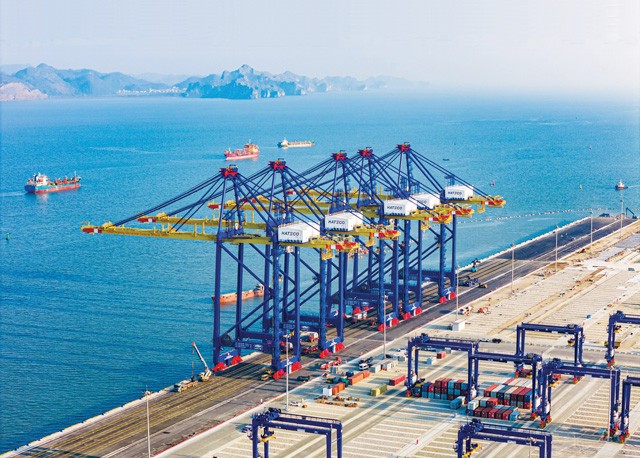
Vietnam has affirmed its position as a proactive participant in global economic integration, having signed and implemented 17 free trade agreements (FTAs). However, the extent to which the country can realize the potential of these international commitments depends directly on implementation capacity at the local level and the initiative of its business community.
The Ministry of Industry and Trade has released the 2025 Provincial Free Trade Agreement Implementation Index (FTA Index 2025). Based on a survey of 4,066 import-export enterprises nationwide, the Index provides a comprehensive picture of how new-generation FTAs are being implemented, highlighting both major advances and persistent capacity gaps.
The FTA Index 2025 assessed Vietnam’s 34 cities and provinces across 31 indicators, evenly distributed among four pillars of new-generation FTA implementation: information access (nine indicators); legal implementation (seven); use of preferences and business support (nine); and sustainable development (six).
Proactive implementation
The combined results show that the 34 localities scored an average of 21.66 out of 40, with a median of 22.25. Scores ranged widely, from 10.57 to 35.62. The most positive development in 2025 was that no locality was classified as “weak,” while six achieved a rating of “good” or higher. The results point to broad improvements in governance quality and growing attention from local authorities to economic integration.
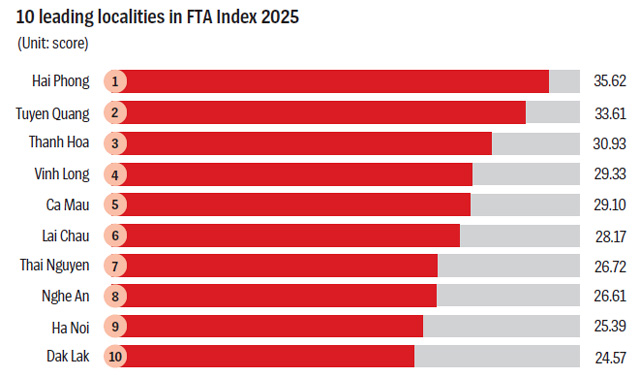
Hai Phong topped the rankings, with 35.62 points, followed by Tuyen Quang with 33.61, Thanh Hoa with 30.93, Vinh Long with 29.33, Ca Mau with 29.10, Lai Chau with 28.17, Thai Nguyen with 26.72, Nghe An with 26.61, Hanoi with 25.39, and Dak Lak with 24.57.
The presence of mountainous and delta provinces such as Tuyen Quang, Vinh Long, Ca Mau, and Lai Chau among the leaders comes from them outperforming major industrial centers, which ranked only “fair” or lower.
Under the pillar measuring the use of preferences and business support, as many as eleven of the 34 localities fell into the “needs improvement” category, while six achieved high effectiveness, 15 were rated above average, and two were rated average. The data shows that while businesses’ demand for support varies little from one locality to another, the biggest differences lie in their ability to access available support policies.
Practical barriers
Under the information access pillar, businesses’ understanding of FTAs remains limited. Only 21.6 per cent of surveyed companies said they had a “good” or “very good” understanding of the agreements, with 16.6 per cent saying they knew them well and 5 per cent saying they knew them very well. By contrast, 32.2 per cent had only a “basic” understanding, while 27 per cent knew little and 18.4 per cent knew nothing at all about them.
In terms of information channels, newspapers and television were the most widely used sources, at 69.7 per cent, followed by social media at 58.4 per cent, specialized websites at 56.5 per cent, seminars at 52.1 per cent, and training programs at 37.1 per cent.
Among government agencies supporting businesses, provincial Departments of Industry and Trade had the broadest reach, at 65.8 per cent, while specialized agencies such as Departments of Agriculture and Environment, Science and Technology, and Foreign Affairs each reached fewer than 10 per cent of businesses.
Notably, FTA information portals, despite having received substantial investment, were the least-used channel. Only 15.3 per cent of businesses accessed them regularly, while 26 per cent have never used them. Though market forecasts were considered relatively reliable, with a 59.5 per cent confidence rating, their level of specificity, at 51.6 per cent, and timeliness, at 51.1 per cent, remained below expectations.
The legal implementation pillar revealed a clear mismatch between the complexity of regulations and the capacity to provide guidance. Businesses have a relatively solid grasp of preferential tariff schedules and rules of origin, both scoring 3.49 out of 5. However, they face significant difficulties with non-tariff requirements. Technical barriers to trade were considered the most complex, cited by 65.5 per cent of respondents, followed by sanitary and phytosanitary measures at 63.2 per cent and environmental commitments at 62.1 per cent.
Meanwhile, two-way policy engagement between government agencies and businesses has yet to become routine. Only 14.7 per cent of businesses regularly or quite regularly participated in consultations on legal and regulatory documents, with an average score of 2.8 out of 5. Just 20.9 per cent regularly participated in training programs.
As with the legal framework, the results under the preference utilization and business support pillar reveal a significant imbalance in how businesses take advantage of FTA commitments. Vietnamese companies primarily make use of traditional, more visible benefits: 76.9 per cent have used tariff reductions, while 72.3 per cent have applied rules of origin to obtain preferential certificates of origin.
The main barriers preventing businesses from making better use of FTAs include difficulty finding partners in relevant markets, cited by 40.6 per cent of respondents; a lack of in-depth market information, at 40.1 per cent; and insufficient understanding of FTA commitments, at 34.3 per cent.
The sustainable development pillar recorded the widest gap between awareness and actual implementation capacity. More than 70 per cent of businesses acknowledged that compliance with sustainability standards is extremely important when seeking partners, at 72.2 per cent, and signing export contracts, at 70.5 per cent. Yet actual readiness remains a major concern, with only 3.7 to 5.6 per cent of businesses saying they clearly understand and are capable of meeting new sustainability requirements.
From assessment to action
Speaking at the release of the FTA Index 2025, Permanent Deputy Prime Minister Pham Gia Tuc stressed the need to move decisively from measurement and assessment toward concrete action, positioning the FTA Index as an important tool for managing international economic integration. He called for every finding from the FTA Index to be tied to a specific solution and a responsible agency while having a clear deadline for resolution.
Based on the results of the FTA Index 2025, he also called on ministries, sectors, and local authorities to focus on three key priorities. First, FTA implementation should be treated as an integral part of socio-economic development strategies and as an important measure of local administrative capacity and integration readiness. Each locality should incorporate FTA implementation into its administrative agenda, assign clear responsibility to its leadership, and develop an action plan following the release of the FTA Index to decisively address bottlenecks.
Second, central ministries and agencies should continue to improve the regulatory framework, simplify administrative procedures, and strengthen data sharing. A coordinated and accessible FTA information system should be developed, with AI gradually deployed to help businesses search for information on commitments, rules of origin, market standards, and potential risks.
And third, businesses must become the center and driving force of FTA implementation and effective utilization. The failure to fully capitalize on commitments after agreements are signed remains a weakness that must be addressed. The government is responsible for creating a favorable environment and removing institutional bottlenecks, while businesses must proactively upgrade technology, improve management, build brands, and meet green, labor, and traceability standards.
The ultimate goal of the FTA Index is not to create another set of rankings, but to improve the quality of governance, implementation capacity, and the ability of localities to develop and integrate sustainably.





 Google translate