


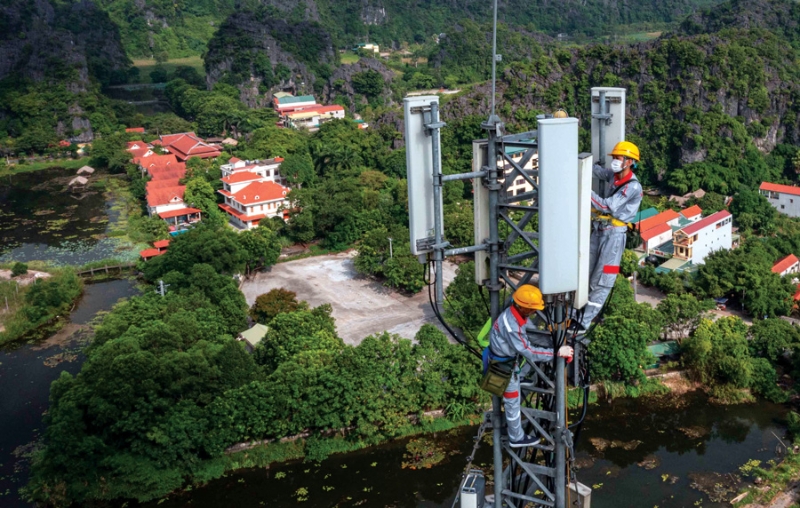
Telecommunications infrastructure is increasingly being redefined amid mounting economic and geopolitical volatility, viewed not merely as a commercial service but as a strategic asset at the national level. As global supply chains shift and production networks realign, the demand for reliable digital infrastructure and connectivity has surged, placing telecom networks at the center of economic resilience and growth.
What was once considered a supporting layer of the digital economy is now its foundation. From banking systems to manufacturing operations, from e-commerce platforms to government services, the stability and resilience of telecom infrastructure have become indispensable.
“Lifeblood” of the digital economy
From the perspective of the banking sector, the importance of telecommunications infrastructure is particularly pronounced. Mr. Tran Phu Nghia, Chief Information Officer at Vietbank, described telecom networks as the “lifeblood” of financial operations. “When transmission connectivity is disrupted, a wide range of activities, from accounting processes to interbank payment flows, can come to a halt,” he said. “This directly affects clearing and settlement operations and may even impact system-wide liquidity.”
The relationship between telecom infrastructure and banking operations is deeply intertwined. Physical infrastructure, including fiber optic cables and power systems, underpins the availability of digital services. Any disruption to these systems can cascade through the financial ecosystem.
Equally critical is the concept of business continuity. Financial institutions must be able to respond instantly to disruptions, ensuring uninterrupted service delivery. In practice, this means activating contingency plans, switching to backup transmission channels, or rerouting through alternative service providers.
“The aim is to minimize the recovery time objective (RTO) to the greatest extent possible, allowing banking services and customer transactions to return to normal quickly,” Mr. Nghia explained. A core principle in ensuring resilience is infrastructure diversification. Relying on a single transmission route or provider exposes institutions to systemic risks. Conversely, diversified networks reduce the likelihood that a single point of failure could disrupt entire systems.
Beyond immediate recovery, resilience also depends on system design. As Mr. Nghia noted: “It is not just about repairing damaged cables. It is about designing systems that can adapt and self-adjust, ensuring continuous operations even under stress.” This becomes particularly important when considering cascading risks. A disruption at a major network node can affect multiple financial institutions simultaneously if they share the same infrastructure. Such scenarios highlight the need for both redundancy and intelligent network architecture.
According to Dr. Duong Van Thinh, Vice Chairman of the Veron Group, several sectors are currently among the heaviest users of telecom infrastructure. These include banking and finance, e-commerce, e-government, and international digital service providers.
The scope of telecom infrastructure use is expanding rapidly. Digital transformation is no longer confined to traditionally tech-intensive industries, and is now spreading across the broader economy, particularly into manufacturing. This shift underscores a broader trend: connectivity is no longer optional. It is integral to how modern businesses operate, compete, and scale.
Key to resilience
While the importance of telecom infrastructure is widely acknowledged, disruptions remain somewhat inevitable. According to Mr. Ha Nhu Hai, CEO of the TPX Technology JSC, the critical issue is not whether disruptions occur, but how they are managed. In telecommunications, incidents are almost unavoidable. What matters most is how quickly and effectively they are handled, as this determines the extent of impact on businesses and financial institutions.
Today, service-level agreements between providers and clients typically include clear commitments regarding downtime and response times. These agreements reflect the growing recognition of telecom services as mission-critical infrastructure.
Disruptions generally fall into two categories: proactive and reactive. In proactive scenarios, operators take preventive measures by redesigning network architectures, optimizing core nodes, and establishing ring-based connectivity. These designs allow traffic to be rerouted automatically in the event of a disruption, improving system stability.
Reactive scenarios, on the other hand, involve unexpected incidents such as cable damage or power outages. In such cases, operators must deploy emergency solutions, including laying alternative cable routes or switching to backup systems.
Following major incidents, telecom providers often conduct comprehensive reviews of their networks. These reviews aim to identify vulnerabilities and implement structural improvements to prevent similar disruptions in the future.
Initial network design plays a decisive role in determining resilience. Systems must be built not only for efficiency but also for rapid response and prioritized recovery.
Incident response also requires coordination between multiple stakeholders. Typically, three groups are involved: telecom service providers, power utilities (as telecom cables are often integrated with power infrastructure), and relevant authorities such as fire and safety agencies. This multi-layered coordination highlights the complexity of telecom infrastructure, and the importance of integrated planning.
From service to infrastructure
As the economy becomes increasingly dependent on data and digital connectivity, telecommunications infrastructure is emerging as one of the most critical foundations of modern society. From banking transactions and electronic payments to e-commerce and online services, virtually all activities within the digital economy rely on the stability of transmission networks. Investment in telecom infrastructure, therefore, is no longer solely a matter for the technology sector, but a key factor in ensuring the smooth functioning of the entire economy.
According to Mr. Le Thanh Tam, CEO of IDG Vietnam, individual consumers tend to focus on just two main factors - price and promotions - when assessing satisfaction with 4G or 5G telecom services. Users typically choose the provider offering lower prices and more stable service, paying little attention to aspects such as maintenance, after-sales support, or how incidents are handled behind the scenes.
For organizations, however, the perspective is markedly different. Enterprise bandwidth providers are not merely telecom service vendors, but critical infrastructure partners that directly support operational activities. As such, the importance of these services differs fundamentally from that of consumer telecom offerings.
“According to an IDG survey, as many as nine out of ten CIOs using these services say their top concerns are incident response capabilities and cybersecurity,” Mr. Tam said. “These are the two most important factors for them.” In particular, interviews with companies in sectors such as banking and finance and e-commerce reveal a strong emphasis on the stability of critical infrastructure.
As bandwidth capacity increases, the financial value associated with transactions and data transmitted over networks rises accordingly. This also means that the risks of financial loss or data breaches become significantly higher. As a result, businesses are especially concerned with how service providers respond to connectivity disruptions, including the effectiveness of troubleshooting and the speed at which systems can be restored to normal operation.
More broadly, experts argue that telecommunications infrastructure should be viewed not only as a commercial service but also as a strategic asset at the national level. According to Dr. Thinh, global economic and geopolitical dynamics are accelerating this shift. In this context, demand for digital infrastructure and connectivity services continues to grow, becoming a crucial factor in helping businesses sustain operations and expand into new markets amid ongoing global uncertainty.
When transmission connectivity is disrupted, a wide range of activities, from accounting processes to interbank payment flows, can come to a halt. This directly affects clearing and settlement operations and may even impact system-wide liquidity.








 Google translate