


The government issued Decree No. 90/2001/ND-CP on September 11, 2001, the first legal document to define small and medium-sized enterprises (SMEs) and introduce measures to support their development. Nine years ago, the National Assembly (NA) passed the country’s first law dedicated to SMEs - the Law on Support for Small and Medium-sized Enterprises.
On August 11, 2026, the government issued Resolution No. 224/NQ-CP approving the draft Law on Small and Medium-sized Enterprise Development, which will replace the amended Law on Support for Small and Medium-sized Enterprises, for submission to the second session of the 16th NA.
International context
According to the World Economic Forum, around 400-420 million SMEs are currently operating worldwide, of which 150-200 million are formally registered. Around 50 million new businesses enter the market each year. SMEs account for 90-99 per cent of all businesses in any one country and provide around 70 per cent of total jobs, while contributing roughly half of global GDP.
Yet today’s SMEs face a very different operating environment from those of previous decades. Alongside familiar challenges such as limited access to finance, technology, and resources, businesses are increasingly turning to AI as a new source of growth. They are also moving from “Just-in-Time” to “Just-in-Case” supply approaches as global and regional supply chains face greater risks from disruption.
There is no universally-accepted definition of an SME. Thresholds vary significantly between countries, with some definitions based on the number of employees and others on criteria such as registered capital, assets, revenue, or export value. By way of example, an SME could employ up to 1,200 people in certain industries in the US, fewer than 250 in the EU, no more than 200 in Vietnam, and 50 in Egypt.
Despite these differences, the importance of SMEs is widely recognized. They account for the vast majority of businesses in most countries, create jobs and incomes, and contribute to poverty reduction. At the same time, their smaller scale and more limited resources often leave them at a disadvantage when accessing finance, technology, and markets.
Supporting SMEs therefore has implications beyond the business sector. Socially, it helps expand the middle class and sustain a more resilient model of development. Economically, SMEs maintain dynamism through entrepreneurship, business-model adaptation, and participation in value chains. They also contribute to innovation and resilience during periods of crisis. At the individual level, they provide people across generations with an opportunity to turn entrepreneurial ambitions into reality.
In recent years, the emphasis has expanded to digital transformation, innovation, internationalization, and sustainable development, alongside improving access to finance. Many of today’s global corporations also demonstrate the potential of small businesses to scale. Apple, Amazon, Microsoft, Google, and HP all began as micro-enterprises or family businesses, in some cases operating from home garages. Major technology companies also regularly acquire startups and SMEs to strengthen innovation, adopt new technologies and reduce the risks associated with developing them internally.
OECD reports and studies by other international organizations indicate that SMEs can be particularly innovative, especially in high-income economies. In some cases, micro-enterprises can even achieve higher business productivity than large corporations.
Vietnam’s SME sector
A typical newly-registered Vietnamese SME in 2026 has an average of 4.7 employees, down 10.9 per cent year-on-year, and registered capital of VND12.1 billion ($465,000), up 63.6 per cent.
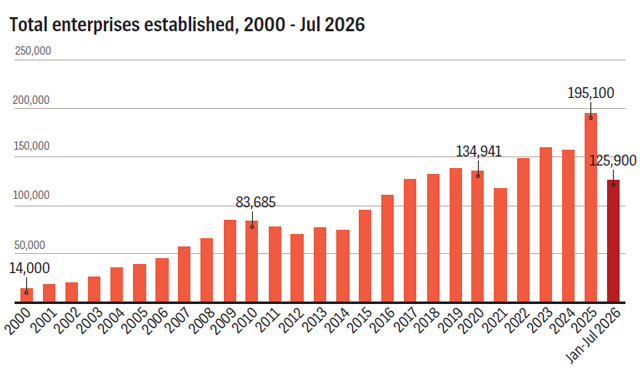
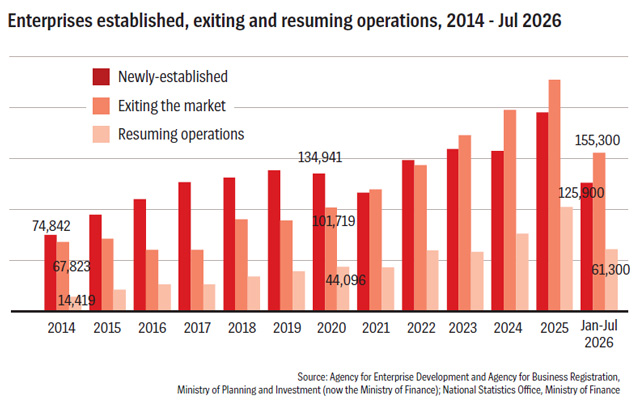
Though the number of new businesses declined during periods of economic crisis, including 2011-2014, and during the Covid-19 pandemic in 2020-2021, the longer-term trend has been positive. The number of newly-established enterprises has continued to rise, and 2026 is expected to be the first year in which Vietnam records more than 200,000 new businesses.
SMEs accounted for nearly 98 per cent of all Vietnamese enterprises as of the end of 2024. Micro-enterprises made up roughly two-thirds of the total, small enterprises more than one-quarter, and medium-sized and large enterprises some 3 per cent each.
Despite their numbers, however, Vietnamese SMEs still make a relatively modest contribution to the economy and cannot yet be considered its “backbone” in the way SMEs are in many developed economies. Only around 8 per cent of domestic enterprises participate in exports, accounting for approximately 25 per cent of total export value. SME loans accounted for just 17.6 per cent of total outstanding credit in 2024.
Links between the SME and FDI sectors also remain poor, with limited improvements overall in the technological capabilities, management capacity, and market access of domestic enterprises. Previous surveys have shown that Vietnam’s participation in global value chains remains significantly lower than in ASEAN neighbors such as Thailand and Malaysia.
Investment in science and technology and R&D is another weakness. Vietnamese businesses spend less than 1 per cent of revenue on the task on average, compared with around 5 per cent in India, 10 per cent in South Korea, and 50 per cent in Japan. In developed ASEAN economies such as Singapore, Thailand, and Malaysia, the average is at least 9 per cent of total revenue.
The road ahead
These gaps underline the scale of the challenge facing SME development in the years ahead. International best practices traditionally emphasize three areas for government action: creating a favorable business environment, facilitating access to finance, and providing access to business-development services, including human resources, consulting, information, science and technology, production facilities, market expansion, and public procurement.
In today’s volatile global market, however, this agenda needs to go further. Governments must also support innovation, the digital economy, and sustainable development, while helping SMEs diversify their supply chains and adapt to rapidly-changing technologies.
Vietnam has already established a new strategic framework through a series of major Politburo resolutions that set out a long-term vision, seek to remove institutional bottlenecks, and look to create new momentum for different sectors of the economy, particularly SMEs, to mobilize resources and turn potential into competitive advantages.
Against this backdrop, high expectations will be placed on the Law on Small and Medium-sized Enterprise Development, which is expected to be submitted to the National Assembly at its upcoming session.
The change is more than a matter of terminology - from the “Law on Support for Small and Medium-sized Enterprises” to the “Law on Small and Medium-sized Enterprise Development.” The concept of “development” should reflect a broader and stronger understanding of what SMEs require in order to grow, one that is better aligned with current policy priorities and the realities of economic governance.
The new Law should build on the legal and institutional foundations established over the past 25 years, expand policy space for an enabling state, incorporate international experience, and, most importantly, establish SMEs as the true center of policy.
The government’s role, however, should not be to replace the market. It should create the conditions for businesses to succeed - achieving the greatest and broadest impact at the lowest possible cost, providing support where it is most needed, minimizing unnecessary intervention, and, above all, giving SMEs stronger incentives to adapt, innovate, and take control of their own future.
International experience has placed strong emphasis on SME development for nearly 80 years, while Vietnam began this journey only a quarter of a century ago. There is therefore still considerable room to unlock the sector’s potential and strengthen its contribution to national development.
As Vietnam pursues rapid and sustainable growth and seeks to make the private sector a major driver of the economy, the new Law on Small and Medium-sized Enterprise Development should be more than a change in name. It should mark a shift in development thinking, and a stronger commitment to putting SMEs at the center of Vietnam’s next stage of growth.
(*) Mr. Nguyen Hoa Cuong is the Deputy Director of the Institute for Policy and Strategy Studies (IPSS) at the Central Commission for Policy and Strategy.





 Google translate