


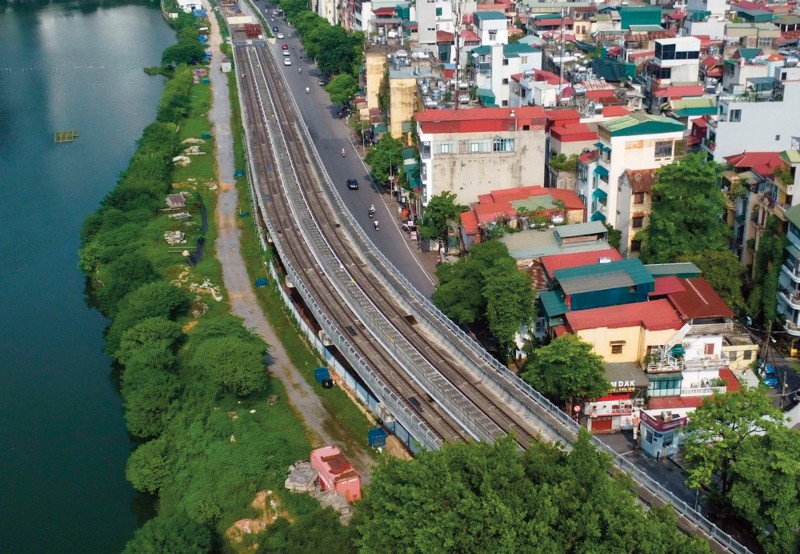
Vietnam is accelerating investment into metro networks and Transit-Oriented Development (TOD), making it increasingly critical to establish appropriate policies on land recovery, resettlement, and land value capture.
The Land Law 2024 introduced provisions allowing land recovery for projects in areas surrounding transportation hubs and transport corridors with development potential (Clause 26, Article 79), while also establishing principles governing land development, management, and utilization (Article 112). These provisions provide a legal foundation for mobilizing land resources to support infrastructure and urban development.
However, the current framework primarily establishes broad principles and lacks sufficiently robust mechanisms to effectively capture the increase in land values generated in TOD areas. It also does not comprehensively address compensation, resettlement, and livelihood restoration policies for residents affected by such projects.
Making TOD work
Experience from implementing urban railway networks and other large-scale public transportation projects shows that land values around stations and along TOD corridors rise rapidly following infrastructure investment. Yet land development in surrounding areas remains fragmented, with limited coordination between transport infrastructure investment and urban development.
At the same time, when land is acquired in central districts or TOD areas, many affected households are relocated far from their original communities, disrupting their living conditions, employment, and livelihoods. This is particularly problematic given that these locations often possess significant commercial and service value.
To implement TOD effectively, Vietnam should draw on the experience of countries that have successfully adopted similar models. One example is the Rail + Property (R+P) model developed by Hong Kong (China)’s MTR (Mass Transit Railway). Under this approach, the government acquires land in designated TOD station areas and adjacent urban districts before transferring it to MTR, the majority State-owned railway operator.
The Urban Renewal Authority provides compensation based on current market property values while also offering a housing allowance that enables affected residents to purchase a replacement property equivalent to a seven-year-old apartment of similar size in the same district. The objective is to ensure displaced residents can either purchase a higher-quality home nearby or be accommodated within the city’s public housing system.
The Hong Kong (China) administration also grants MTR development rights for land surrounding stations and railway depots along new rail lines. MTR pays the government a land premium based on the market value of the land before the railway line is built. The corporation then partners with private developers to build residential and commercial projects above and around stations, receiving returns through a share of development profits, ownership of selected commercial assets, or fixed payments. These revenues are used to finance the construction of new railway lines, while private developers earn profits from their allocated commercial real estate.
The model has delivered significant results. More than 4 million sq m of residential floor space has been developed since 1995. Between 1980 and 2005, the Hong Kong (China) Government generated approximately HK$140 billion ($17.9 billion) in net revenue from the program. MTR reported profits of $2.72 billion in 2017, while its 2025 annual report recorded net profit exceeding HK$14.6 billion ($1.87 billion). The success of the model rests on several key conditions: high population density, limited land supply resulting in high land and housing prices, extensive government land ownership, and a clear legal framework governing development rights.
Japan offers another notable example through its integration of TOD with urban redevelopment. When an aging urban neighborhood, typically comprising older residential areas or low-rise buildings near railway stations or planned boulevards, is selected for TOD redevelopment, an independent valuation council first conducts surveys and property assessments. Rather than simply determining cash compensation, each property’s value, including land area, building floor area, and location, is converted into an original ownership ratio for each landowner across the redevelopment project.
Residents voluntarily transfer their land use rights to the government or project developer, allowing the land to be cleared for public infrastructure, including roads, plazas, railway stations, and parks. The remaining core land - or, where engineering conditions permit, land directly above stations or major transport corridors - is then used to develop one or more mixed-use high-rise towers.
To facilitate redevelopment, authorities allow significantly higher floor area ratios (FAR) and greater building heights, reflecting the fact that substantial land has already been dedicated to public roads and open space.
Once construction is completed, ownership rights are redistributed. Residents’ original ownership ratios are converted into ownership of new apartments within the completed towers, with allocations corresponding to the value of their former properties. Additional apartments created through higher allowable FAR can then be sold or auctioned, generating financial resources to help fund public infrastructure investment.
Policy recommendations
Based on international experience, we propose several policy recommendations for Vietnam. First, for TOD projects, policymakers should shift from the traditional mindset of “recovering land for urban development” to one of “urban restructuring through shared benefits.” Residents living within TOD areas should not only receive compensation and resettlement assistance but also be guaranteed continued access to employment opportunities, public services, and a fair share of the increase in land value generated by infrastructure investment.
Second, the Land Law should be amended to include a more comprehensive legal framework for TOD, including the following provisions.
It should establish mechanisms for the integrated development of land surrounding public transportation infrastructure in accordance with approved planning. Investors should be permitted to simultaneously implement transport infrastructure projects alongside residential, commercial, and service developments within TOD areas. Revenue generated from increases in land value should be prioritized for reinvestment in public transportation systems and urban infrastructure.
The Law should also prioritize on-site resettlement, or resettlement within the same TOD area, for households and individuals whose land is acquired. This may be achieved through the allocation of residential land or apartments, enabling affected residents to continue benefiting from urban development while minimizing displacement to locations far from city centers.
In addition, compensation, support, and resettlement plans for TOD projects should be required to include comprehensive livelihood restoration measures. These plans should assess the impacts on employment, business activities, and household incomes, while providing vocational training, job transition assistance, and opportunities for residents to participate in commercial, service, and tourism activities after project completion.
Unlocking urban renewal
Vietnam’s major cities continue to face mounting challenges, including traffic congestion, environmental pollution, and severe housing shortages. As a result, alongside developing new urban and residential projects, the country must also accelerate the redevelopment of aging urban districts. However, progress in urban renewal has remained largely stagnant for many years due to the absence of appropriate legal and policy mechanisms governing compensation, resettlement, and redevelopment.
The Land Law 2024 introduced provisions on land pooling and land readjustment (Article 219), creating an initial legal framework for urban renewal and the redevelopment of rural residential areas while minimizing compulsory land acquisition and balancing the interests of the State, investors, and land users. This represents an important policy advance consistent with Resolution No. 18-NQ/TW and international trends in urban development.
Nevertheless, the current provisions remain largely principle-based. They do not comprehensively define implementation procedures, eligibility conditions, or mechanisms for sharing benefits among stakeholders. Nor do they establish methodologies for determining land contribution ratios, allocating land following readjustment, or addressing situations where consensus cannot be reached among all land users.
As a result, land pooling and land readjustment have rarely been implemented in practice. Most urban redevelopment projects continue to rely on compulsory land acquisition by the State, leading to substantial compensation costs and prolonged site clearance processes.
(*)Associate Professor Tran Van Tuan is the Head of the Department of Land Management, University of Science, Vietnam National University Hanoi.



 Google translate