


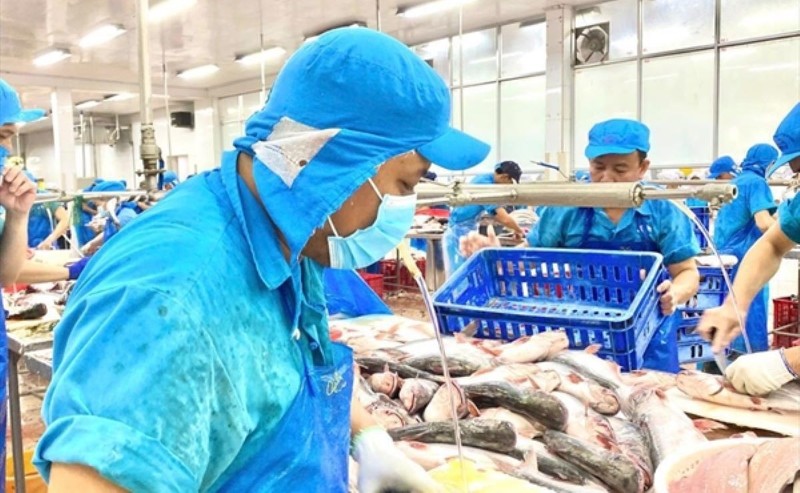
The Vietnam Association of Seafood Exporters and Producers (VASEP) has issued Official Dispatch No 152/CV-VASEP to the Ministry of Finance, and its Department of Taxation and Customs Department, highlighting tax policy bottlenecks facing seafood processing and exporting enterprises.
VASEP commended the tax authorities to resolve value-added tax (VAT) refund bottlenecks, as well as issues related to the Department of Taxation's Official Dispatch No 6810/CT-QLNT on September 14, 2026 (governing exchange rate determination on invoices for economic and financial transactions in foreign currencies) and its Official Dispatch No 6936/CT-QLTT on September 18, 2026 (concerning the handling of VAT refund dossiers based on risk-management principles).
However, according to VASEP, seafood enterprises continue to face major hurdles due to inconsistent interpretations and enforcement of policies across different localities, regulatory authorities, and periods.
For seafood exporters, input VAT is substantial and refund claims arise continuously. Prior to Official Dispatch 6936, numerous refund applications were delayed by automated risk alerts linked to invoices or secondary (F2) and tertiary (F3) tier suppliers, leaving even unflagged, legitimate transactions frozen pending verification.
VASEP noted that Official Dispatch 6936 affirmed an essential principle: a risk warning serves solely as a trigger for classification and verification—it does not inherently mean a transaction is fraudulent. If only a portion of the refund claim carries risk, that specific portion should be cordoned off for examination, while the remainder—if eligible—should proceed with processing.
The association recommends applying this principle uniformly nationwide, clearing backlogged applications, and refraining from automatically rejecting or reclaiming refunds solely on the basis of F2/F3 alerts or post-transaction changes in supplier tax status. It also urged authorities to clarify VAT refund eligibility for raw materials imported under code A11/A12 that are subsequently used in production and exported under code B11, basing decisions on the actual use of goods and supporting documentation rather than custom code mismatches alone.
Another challenge highlighted by VASEP is that identical frozen products—such as shrimp, fish, squid, and clams—are subject to inconsistent VAT treatment across localities. These variances hinge on whether the goods are farm-raised or procured externally, their degree of preliminary or deep processing, the seller entity, and the distribution stage.
VASEP emphasized that profit margins on many seafood export orders hover around only 3%–5%. Consequently, should an enterprise absorb an uncredited or non-refundable VAT rate of 8% or 10%, transaction viability is severely undermined.
The association called for standardized national guidelines, alongside an official lookup table categorized by product group and production phase, complete with concrete examples for fresh, frozen, steamed, and boiled shrimp, fish, squid, and clams, as well as common pre-processing stages.
Distinction needed between "pre-processing" and "processing"
VASEP identified the blurry boundary between "pre-processing" and "processing" as a core structural bottleneck.
Prime Ministerial Decision No 36/2025/QD-TTg on the Vietnam Standard Industrial Classification (VSIC) classifies Sector 1020 as "Processing and preserving of fish, crustaceans, and mollusks," encompassing chilling, drying, smoking, salting, packaging, and dressing operations such as heading, gutting, cutting into portions, and freezing.
However, VASEP pointed out that that regulation serves economic statistical classification and does not directly define taxable/non-taxable categories or preferential tax eligibility. Therefore, the association proposed separating the two regulatory layers: defining operational nature under the industrial classification system, while independently determining the corresponding tax regime under specific VAT and corporate income tax laws.
Regarding exported goods returned for repair, reprocessing, and subsequent re-export, VASEP recommended that where returned shipments strictly undergo repair or reprocessing before being re-exported—and comply fully with legal requirements—they should be treated as VAT-exempt rather than subject to the "pay-first, refund-later" mechanism.




 Google translate