


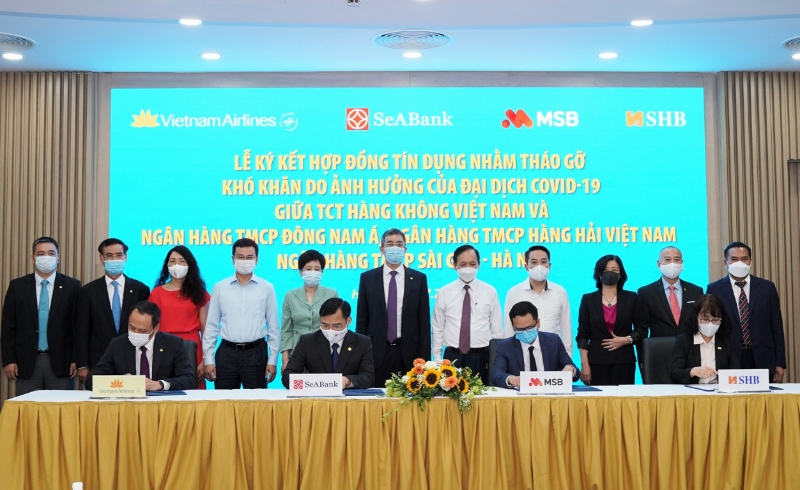
Vietnam Airlines signed credit contracts on July 7 worth a total of VND4 trillion ($173.7 million) with three commercial banks - SeABank, MSB, and SHB - to weather the financial impact of the Covid-19 pandemic.
The three local lenders and the national flag carrier are actively negotiating a mutual agreement for early disbursement, which is expected this month.
After the National Assembly and the government issued a resolution on the support package at the end of 2020, Vietnam Airlines actively worked with a number of credit institutions to seek approval for loans.
The fact that the credit institutions have agreed to sign loan packages expresses their belief in the carrier’s response to the crisis and its resilience and development post-pandemic.
The refinancing loan solution is part of the VND12 trillion ($521.7 million) support package approved by the National Assembly last December to help Vietnam Airlines overcome the crisis. It is one government solution in its role as State shareholder, with 86.19 per cent of shares. The carrier is continuing to take steps relating to its plan to issue shares to existing shareholders to raise its charter capital by VND8 trillion ($347.8 million), which is to be finalized by the end of the third quarter.
In addition to the government’s support package, Vietnam Airlines implemented many other solutions this year and last to cut costs, such as business restructuring, narrowing its business according to market size, optimizing aircraft maintenance, negotiating with suppliers to extend or postpone payments, and applying a specific salary policy.
The national flag carrier is continuing to maintain and implement these solutions to cope with the difficulties it faces. It has also proposed the government, ministries, and departments consider further support to help the aviation industry overcome the crisis and create recovery momentum in the years to come.
Vietnam Airlines conducted around 96,500 flights last year, a decline of more than 48 per cent against 2019. It served 14.23 million passengers and handled nearly 195,000 tonnes of cargo, down 51 per cent and 47 per cent, respectively.
According to its financial report, as of December 31, 2020, it had borrowed VND258 billion ($11.2 million) from MSB and some VND460 billion ($20 million) from SeABank. Other lenders include Vietcombank, BIDV, VietinBank, Techcombank, MB, and Eximbank.
In its consolidated financial statement for 2020, it reported long-term debts of VND9 trillion ($391.3 million) and short-term debts of VND6.8 trillion ($295.65 million).





 Google translate