


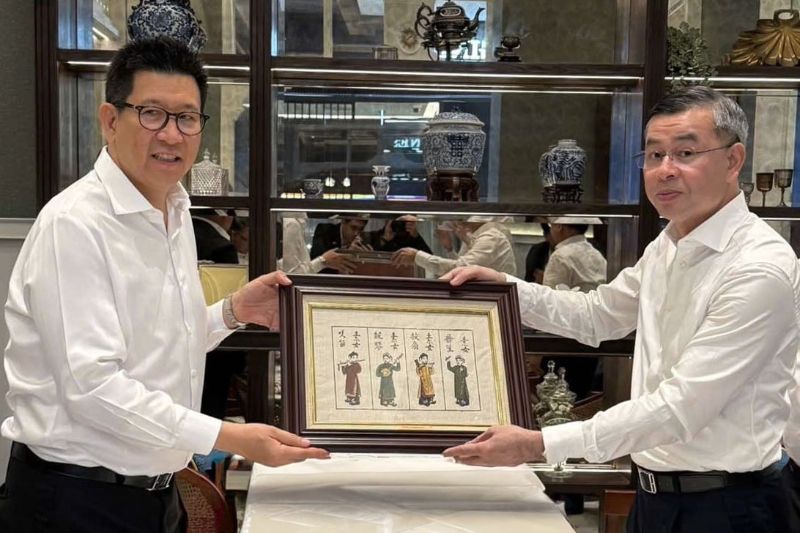
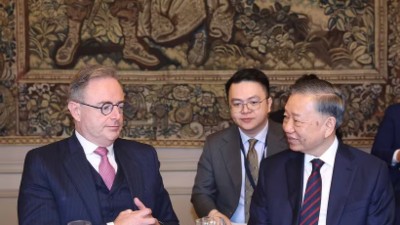
Within the framework of the official state visit to Thailand by General Secretary of the Communist Party of Vietnam Central Committee and President of Vietnam To Lam, Vietnam’s Minister of Finance Ngo Van Tuan on May 28 met with Thailand’s Deputy Prime Minister and Minister of Finance Ekniti Nitithanprapas.
During the meeting, the two sides exchanged views on macroeconomic developments, fiscal policy orientation, administrative reforms, public investment, FDI attraction, and bilateral economic cooperation.
Sharing updates on Vietnam’s socio-economic situation, the Vietnamese Finance Minister said Vietnam is accelerating institutional reforms, streamlining its administrative apparatus, and building a more efficient tax system.
Vietnam is also targeting double-digit economic growth in 2026 and the following years, which will require substantial investment resources, the minister said, adding that total social investment is projected to account for around 40 per cent of GDP, while public investment is expected to make up approximately 20–22 per cent of total investment.
The minister noted that Vietnam’s economic scale is now approaching that of Thailand. As both countries are highly open economies attracting strong FDI inflows, energy security plays a critical role in sustaining economic growth.
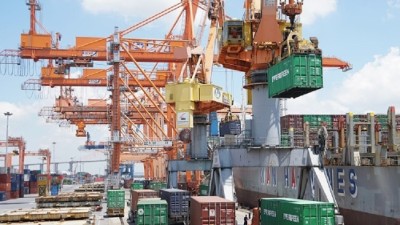
According to the minister, the two countries have maintained strong and dynamic trade-investment ties. Bilateral trade turnover reached approximately $22.1 billion in 2025.
He noted that while the two countries compete in certain sectors, they also have significant potential for cooperation in agricultural exports, particularly durian and rice. He proposed that the two sides strengthen coordination to better tap export markets.
Regarding investment attraction, the minister said Vietnam is prioritizing the power sector and manufacturing and processing industry, while highly appreciating the presence of many major Thai enterprises in Vietnam.
Thailand currently remains one of Vietnam’s leading foreign investors, with 804 valid projects and total registered FDI exceeding $15.4 billion.
Thailand’s Deputy Prime Minister and Minister of Finance Ekniti Nitithanprapas, for his part, shared Thailand’s experience in evaluating public investment projects. According to him, Thailand uses the Economic Internal Rate of Return (EIRR) as a key indicator to assess project effectiveness, rather than relying solely on financial returns or interest rates.
The Thai side also shared its experience in reforming tax incentives to adapt to the global minimum tax (GMT) through the qualified tax credits mechanism, which is currently being incorporated into the country’s legal framework.
In the industrial sector, the Thai Deputy Prime Minister noted that many Japanese and Chinese corporations have established home appliance manufacturing facilities in his country under brands such as Toshiba and Midea. At the same time, Thai enterprises are also supplying components and spare parts for Vietnam’s VinFast.
Thailand’s Deputy Prime Minister and Finance Minister also praised Vietnam’s success in attracting Samsung’s investment in the semiconductor sector and stressed that ASEAN should strengthen supply chain linkages to enhance its position in global value chains.
Concluding the talks, both sides agreed to promote not only cooperation but also substantive connectivity between the two economies in the coming years.


 Google translate