


According to a report by property consultancy Avison Young Vietnam, younger buyers are increasingly splitting into three distinct groups: cautious savers, suburban movers, and long-term renters. The trend reflects broader shifts in priorities, pricing, and capital allocation.
Changes in homeownership demand are also driving demand for housing supply, satellite cities, and the rental market, while creating opportunities for new housing models.
Buying a home no longer an urgent priority
Homeownership was once widely regarded as a key milestone of adulthood. However, many Millennials and Gen Z consumers in Vietnam now divide their aspirations into different categories.
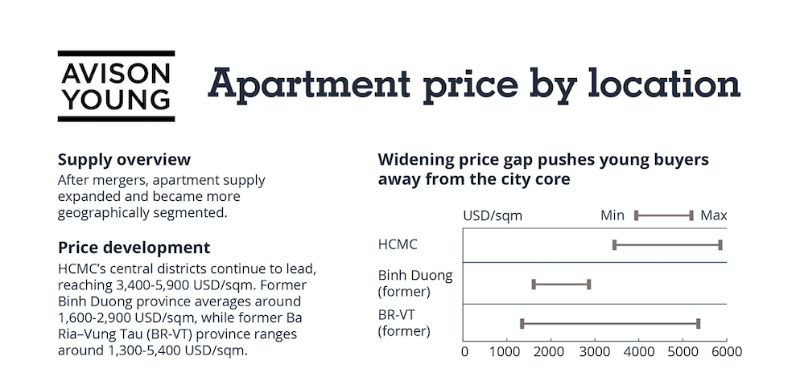
Firstly, property prices have significantly exceeded income growth. Over the past five years, apartment prices in Hanoi, Ho Chi Minh City, and Da Nang have risen by 72 per cent, 50 per cent, and 34 per cent, respectively, against average income growth of only 6–10 per cent annually. By the first quarter of 2025, residential property prices had reached nearly 20 times the average annual household income, according to data from the Asia Pacific Home Attainability Index 2025. In the second quarter of 2026, primary market prices averaged around $3,900 per square meter in Ho Chi Minh City and $3,950 per square meter in Hanoi.
Secondly, the supply of affordable housing has been declining for years. As property prices outpace disposable income growth, many young buyers are forced to revise their plans. Most now prefer to rent in central urban districts or opt for social housing projects rather than pursuing homeownership in city centers, according to Avison Young Vietnam.
Thirdly, the savings gap is also widening for younger consumers. Urban Consumer Price Index (CPI) rose 8.4 per cent in April 2026, driven mainly by higher utility and construction material costs. Meanwhile, average wages increased by only 3.5 per cent, according to the General Statistics Office of Vietnam.
As a result, the traditional idea of buying a home early in life is gradually being replaced by more flexible living arrangements and lifestyle priorities. Survey data shows that homebuying decisions among younger consumers are increasingly tied to financial planning and long-term lifestyle considerations.
A survey conducted in early 2026 by Happiness Saigon found that 350 Gen Z respondents aged 18–26 viewed self-development, savings, and investment as more important financial priorities than homeownership. This suggests many young people now consider homeownership a long term objective rather than an immediate necessity, while balancing other goals such as career development, investment, and quality of life.
Three tiers of young urban buyers
These four factors are driving a visible split among Vietnam’s young urbanites into three distinct groups, differentiated by financial capacity, risk tolerance, and lifestyle philosophy.:
The first group continues to aspire to homeownership but is delaying purchases amid high interest rates, rising living costs, and concerns over long-term financial security. Many are prioritizing savings accumulation and waiting for more favorable credit conditions before committing to a mortgage.
The second group is taking a more proactive approach, accepting higher financial risk in anticipation of continued property price growth. These buyers are increasingly shifting toward satellite cities and suburban districts surrounding Ho Chi Minh City in search of homes priced below VND5 billion. Areas such as Thuan An, Di An, and Thu Dau Mot have become key destinations for mid-range housing demand. However, many buyers remain heavily dependent on family support or high loan-to-value borrowing, creating repayment pressure that could last for decades.
Meanwhile, a third group is actively choosing long-term renting over ownership. For many young residents, renting is no longer viewed as a temporary solution but as a strategic financial and lifestyle decision. Later marriage ages, smaller households, and more flexible career paths are contributing to this trend. Rental demand has continued to rise, particularly among residents aged 25–34, supported by concerns over mortgage burdens and housing affordability.
The report noted that these changing attitudes are restructuring Vietnam’s housing market. Demand has not disappeared, but is becoming increasingly selective as housing prices continue to outpace income growth. As speculative demand gradually weakens, reasonably priced housing in satellite urban areas is expected to emerge as a strategic segment in the next development cycle.
At the same time, the rental market is expected to become more professionalized, with build-to-rent models and long-term rental housing likely to play a larger role in Vietnam’s urban development strategy.






 Google translate