



Vietnam’s next breakthrough will depend not only on the scale of investment, but more importantly on the capacity to implement reforms effectively and translate policy shifts into better living standards for its people.
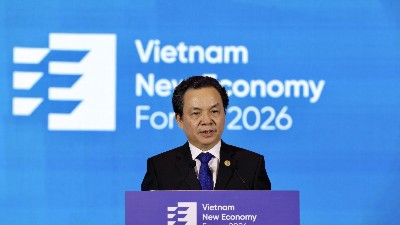
World Bank Division Director for Vietnam, Cambodia, and the Lao PDR, Ms. Mariam J. Sherman, emphasized that point at the annual Vietnam New Economy Forum 2026 in Hanoi on October 3.
According to Ms. Sherman, Vietnam stands at a watershed moment following the adoption of Resolution 19-NQ/TW on renewing Vietnam’s development model (Resolution 19) in July 2026.
She noted that Resolution 19 establishes a new development model, transitioning from growth driven primarily by capital accumulation and labor expansion to growth powered by productivity, innovation, and efficient resource allocation.
“The strategic direction is clear and entirely sound,” she said, while raising the core question of how breakthrough policies can deliver tangible results that enterprises, localities, and citizens can clearly see in practice.
She observed that this is an opportune time for Vietnam to accelerate development investment. However, international experience demonstrates that nations escaping the middle-income trap are not necessarily those that invest the most capital. What matters more is investing effectively, alongside building institutions and market mechanisms capable of sustaining private investment and innovation over the long term.
Guided by this approach, Ms. Sherman focused on three core pillars: institutions, breakthrough policies, and financial resources.
Institutions must shift from input control to delivering outcomes
Ms. Sherman's first message was that institutions must pivot their focus from input controls to outcome evaluations.
Resolution 19 reflects this shift by calling for a transition from administrative management to development governance, and from ex-ante approvals to intelligent ex-post supervision.

In practice, this transition can start with three areas:
Taking outcomes as the benchmark across the entire public sector: In public investment, education, healthcare, or state governance, the focus should not merely be on whether procedures were properly followed or budgets disbursed, but on what citizens and enterprises actually receive.
Ensuring clear, stable, and consistently applied regulations: Businesses and investors need a predictable, level playing field with fewer pre-approval requirements and tighter oversight concentrated in high-risk areas.
Empowering local governments and civil servants with both authority and accountability: Localities now command larger administrative scale while shouldering greater operational responsibilities for public services, infrastructure, and the local business climate.
Subnational administrations, she emphasized, will serve as the growth engines of the new development model.
Synchronizing incentives and diversifying capital sources
Her second message addressed breakthrough policies. Ms. Sherman noted that the most effective policies align incentives so that public investment, private enterprise, and state budget revenues mutually reinforce each other.
Trade and tourism—two growth drivers underscored at the forum—offer clear examples. Vietnam’s logistics costs remain elevated compared to regional peers. New expressways, deep-water ports, and modernized railway lines can help cut costs, unlock new markets for domestic businesses, and bring visitors to a wider range of destinations.
However, physical infrastructure alone is not enough. Enterprises also require an enabling environment to incorporate, operate, and scale up. Continuing to streamline licensing requirements, shifting to risk-based inspections, and digitizing public services will help businesses fully capitalize on new infrastructure.
Her third message centered on capital mobilization. Ms. Sherman cited projections showing that Vietnam’s 2026–2030 development investment plan requires a massive VND38.5 quadrillion (equivalent to $1.48 trillion), with roughly 80% expected to come from the private sector.
“Public resources cannot meet this demand alone,” she stressed. Nor should the commercial banking system bear the brunt of the burden, given that long-gestation infrastructure projects require patient, long-term capital. Over-allocating commercial bank credit to infrastructure risks squeezing credit access for productive business development.
One pathway she highlighted is developing the depth of the domestic corporate and municipal bond market. Another strategic priority is formulating policies aimed at elevating Vietnam’s sovereign credit rating to investment grade, in line with the Government’s roadmap through 2030.









 Google translate