



Driven by breakthrough institutional reforms, Vietnam’s business climate has seen tangible improvements. However, implementation capacity at the subnational level is now playing a decisive role in turning regulatory opportunities into sustainable growth momentum for the enterprise community.
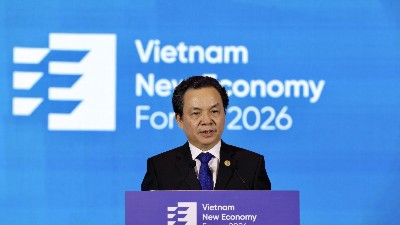
Addressing the annual Vietnam New Economy Forum 2026 (VNEF 2026), held in Hanoi on Octover 3, Assoc. Prof. Dr. Ho Sy Hung, President of the Vietnam Chamber of Commerce and Industry (VCCI), affirmed that the past two years witnessed unprecedented institutional breakthroughs, unlocking developmental headroom and creating robust momentum for enterprises.
Citing tangible examples from some localities, the VCCI President emphasized that the evolving policy framework is turning exceptionally favorable, granting substantial leeway and resilience to businesses.
In northern Phu Tho province, for instance, realized and registered foreign direct investment (FDI) reached $2.4 billion by the end of September 2026—achieving 151.3% of the annual target and doubling the figure recorded in the same period last year. In southern Tay Ninh province, a single investment promotion conference organized for the first eight months of 2026 saw 93 projects approved with aggregate registered capital of approximately VND900 trillion ($34.6 billion), of which groundbreakings commenced immediately on projects totaling VND116 trillion ($4.46 billion).
Cross-border trade also logged notable progress through the deployment of the "smart border gate" model in northern Lang Son province. Commercial vehicle throughput increased from 650–750 trucks per day in 2024 to more than 1,000 trucks per day, while customs clearance turnaround times fell from 4–5 days to under 24 hours, reducing operational costs for enterprises by 30% to 40%. Consequently, Lang Son's two-way trade turnover in the first nine months of 2026 exceeded $91 billion, up 37% over 2025.
Four critical gaps in execution
Emphasizing that developmental headroom for businesses remains substantial, Mr. Hung noted that the business community expects administrative bottlenecks to be dismantled with even greater determination.
Although registered FDI in the first nine months of 2026 recorded an impressive surge to $50.36 billion (up 76.4%), domestic private capital reached only around VND1.65 quadrillion ($63.5 billion)—lagging behind total social investment benchmarks and falling short of Government targets.
Several factors account for this discrepancy, prominent among which is a pronounced divergence in problem-solving efficiency among different localities. According to the VCCI President, this divergence stems from administrative political will and the organizational approach to execution.

Drawing on empirical findings from VCCI's 2026 field surveys, he highlighted four major implementation gaps:
First, the gap between statutory authority on paper and real-world administrative behavior: Because governing regulations often lack clarity, enforcement bodies tend to adopt the safest course of action for themselves, shifting legal and procedural risks onto enterprises.
Second, the gap between central policy intent and local interpretation: Disjointed, inconsistent legal application across subnational jurisdictions exposes businesses to substantial operational uncertainty.
Third, the gap between decentralization and execution capability: While administrative machinery has been streamlined, professional human capital and technical expertise at the commune level have struggled to keep pace with newly delegated responsibilities.
Fourth, the gap between reducing administrative burdens and actively fostering development: While several localities have expedited paperwork processing, proactive developmental support remains limited, particularly toward household business establishments.
A 2026 VCCI survey covering more than 1,000 household businesses revealed that 73.3% faced significant or severe regulatory hurdles, and merely 15.6% planned to incorporate as formal enterprises within the next two years.
According to the VCCI President, these four disconnects make one thing clear: breakthrough execution cannot be achieved simply by churning out more administrative circulars or regulations; it requires structural changes to how delivery is organized, how accountability is apportioned, and how performance outcomes are measured.
Grassroots solutions for breakthrough execution
To bridge these gaps and achieve the national target of 2 million operating enterprises by 2030, Mr. Hung proposed four key solution clusters:
First, establishing "safe harbor" execution rules by codifying four statutory principles: When a regulation is subject to multiple interpretations, priority must be given to the interpretation most favorable to citizens and enterprises; public agencies may not reject administrative dossiers due to the absence of subordinate implementing guidelines; officials who act in strict compliance with written guidelines must be exempted from liability; and detrimental retroactivity must be strictly prohibited.
"These principles will give businesses the confidence to exercise their statutory rights, while providing local civil servants with a clear legal basis to act decisively and execute without fear," Mr. Hung stressed.
Second, ensuring unified nationwide statutory interpretation: Requiring ministries and central agencies to issue detailed implementing guidelines complete with reference annexes and concrete practical examples. Official guidance and formal clarifications provided to one locality must be made public to serve as standardized precedents for similar cases across all jurisdictions.
Third, upgrading grassroots capacity alongside data interoperability: Commune-level staffing allocations must be aligned with actual administrative caseloads rather than rigid headcounts, reinforced by technical backstopping from provincial authorities, while replacing manual inter-provincial paper verifications with centralized, real-time database queries.
Fourth, evaluating execution quality by concrete outcomes: Instituting an independent index to measure actual processing turnaround times, out-of-pocket compliance costs, and regulatory consistency across jurisdictions.
"Policy innovation creates opportunities, but execution capacity at the local level is the ultimate deciding factor in turning those opportunities into substantive economic growth," Mr. Hung said.









 Google translate