


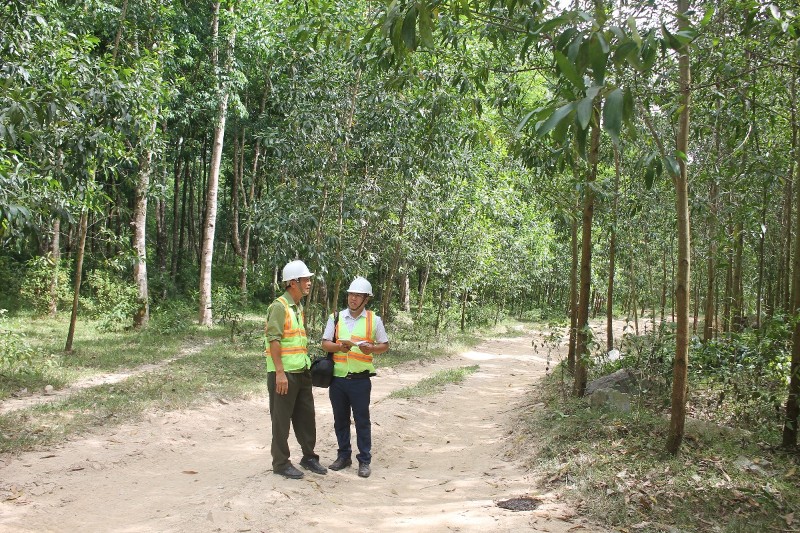
Amid sharp polarization across export destinations and escalating traceability mandates, domestic planted forest timber is emerging as a pivotal strategic advantage, enabling Vietnam’s wood sector to curb reliance on imports and sharpen its global competitiveness.
According to the Ministry of Agriculture and Environment, wood and wood product exports in September 2026 reached $1.62 billion, lifting total exports for the first nine months of the year to nearly $13.43 billion—up 7.3% compared to the same period in 2025.
To sustain this upward momentum, domestically planted timber resources and ongoing harvesting operations continue to serve as the operational backbone for the downstream processing sector.
Data from the ministry shows that timber harvested from planted forests over the first three quarters of 2026 reached 18.9 million cubic meters, representing a 5.3% year-on-year increase. Harvest volumes expanded against a backdrop of elevated and stable raw timber prices, incentivizing smallholders and foresters to expedite logging across mature forest stands.
Vietnam’s competitive edge in the timber sector is pivoting from pure processing capacity toward an integrated ecosystem encompassing raw material sourcing, processing, and market reach. Within this model, domestic plantation timber serves as a core asset, allowing manufacturers to reduce dependence on imported logs, improve supply-chain transparency, and meet increasingly stringent environmental criteria in foreign markets.
According to the ministry's national forest status inventory, total plantation forest area expanded from 3.08 million hectares in 2010 to 4.89 million ha by 2025, with commercial production forests growing from 2.28 million ha to roughly 4.16 million ha over the same period.
Between 2012 and 2021, total industrial roundwood utilized for domestic production surged from 11.8 million cu.m to 37.9 million cu.m. Despite raw material consumption tripling, the share of imported timber in total manufacturing input dropped from 26% to 16%.
Forestry expert Pham Duc Thieng noted that this shift underpins the sector's evolution from a simple processing hub to a fully integrated ecosystem spanning materials, processing, and markets. With major export destinations scrutinizing origin, legality, and traceability, domestic raw timber backed by transparent chain-of-custody documentation is becoming a primary competitive asset for manufacturers.
However, the industry continues to grapple with fragmented upstream supply, driven by millions of smallholder farming households. Rather than forcing smallholders to scale up into large formal corporations, Mr. Thieng recommended consolidating them into concentrated raw-material zones governed by collective management structures, with downstream processors serving as anchor off-takers.
Another imperative is overhauling plantation methods. While past demand for woodchips fueled widespread tree planting, short-rotation woodchip forestry differs markedly from large-timber silviculture required for interior and exterior furniture manufacturing. Transitioning to long-rotation timber requires tripartite collaboration between the state, scientific institutions, and enterprises, alongside direct linkages with growers to upgrade seedling quality, planting density, harvesting rotations, and silvicultural techniques.
Mr. Nguyen Quoc Khanh, Chairman of the Vietnam Timber and Forest Products Association (VIFOREST), remarked that Vietnam’s wood sector remains predominantly a manufacturing hub positioned at the downstream tail of the global value chain. The vast majority of firms operate as original equipment manufacturers (OEMs), with limited adoption of original design manufacturing (ODM) or own-brand manufacturing (OBM).
To reposition the industry on the global value curve, he proposed five strategic priorities: Elevating design capabilities and building national timber brands; Accelerating factory automation, digital transformation, and AI integration; Maintaining environmental sustainability, transparency, and traceability standards; Restructuring supply chain linkages across Southeast Asia; and Proactively managing commercial diplomacy and market intelligence.
"Vietnam currently possesses 14.97 million ha of forest, including 4.89 million ha of planted forests. A secure domestic timber supply, coupled with verified legal origin, represents the industry's ultimate passport to sustaining international competitiveness," Mr. Khanh said.








 Google translate