


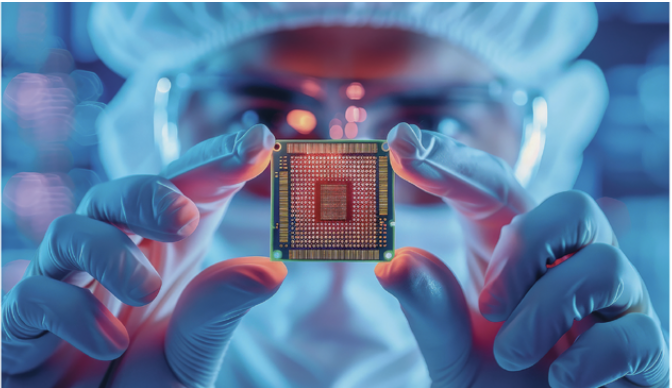
Vietnam’s semiconductor industry has been gradually moving beyond the orientation and policy discussion stage and towards concrete implementation in recent times. Alongside the Law on Science, Technology and Innovation, the Law on Digital Technology Industry, which took effect on January 1, has laid a legal foundation for semiconductor development in the country. The first standalone legislation of its kind globally, the Law aims to promote the digital industry, with a focus on semiconductors, AI, and digital assets.
Investment incentives
The Law on Digital Technology, together with other laws on investment, corporate income tax, and import-export activities, introduces special support mechanisms and incentives for industrial semiconductor activities. For example, semiconductor manufacturing R&D projects with investment capital starting from VND6 trillion ($230.76 million) will be subject to a 5 per cent tax rate for 37 years; a tax exemption for six years followed by a 50 per cent reduction for the next 13 years; full exemptions from land and water surface rental fees; personal income tax exemptions for highly-qualified personnel for five years; and five-year visa and work permit exemptions for highly-skilled foreign workers.
According to Mr. Nguyen Khac Lich, Director General of the Department of Information Technology Industry at the Ministry of Science and Technology, these are exceptional, sector-specific incentives. Comparable incentives in other priority sectors typically apply only to projects with investment capital of at least VND30 trillion ($1.15 billion).
In November, the Ministry also issued six circulars guiding implementation of the Law on Digital Technology and submitted two decrees to the government, both of which took effect simultaneously with the Law on January 1. “This demonstrates the Vietnamese Government’s comprehensive vision in creating favorable conditions for key suppliers to participate in the domestic value chain,” Mr. Lich said.
On December 24, the Minister of Science and Technology issued Decision No. 4386/QD-BKHCN defining the functions and structure of the national center for support of semiconductor chip pilot production, called the Vietnam National Multi-Project Wafer Coordination Center (VNMPW/CC), under the Ministry’s Department of Information Technology Industry. The Center will connect research institutions and chip design companies with fabrication plants (fab plants), packaging and testing facilities, and technology partners at home and abroad, supporting the entire pilot production chain from design to chip evaluation.
Mr. Bui Thanh Minh, Deputy Professional Director of the Office of the Private Economic Development Research Board (Board IV), noted that Vietnam’s push for semiconductor development comes amid a global resurgence of industrial policy. Excessive reliance on a few manufacturing hubs is now viewed as a strategic risk, he explained, and as global supply chains shift, Vietnam cannot remain outside such a trend. Moreover, the country’s growth model, based largely on low-cost labor and resource extraction over the past 30-40 years, has helped lift it out of poverty but is reaching its limits in boosting productivity and incomes.
“As the population ages and labor advantages decline, the need to transition to a knowledge, technology, and high value-based growth model becomes urgent,” he said. “Following the path of many economies, after light industry and electronics, semiconductors and AI-related technologies represent the next inevitable stage of development rather than a temporary choice.”
Asserting a role
Vietnam has identified semiconductors as a strategic technology crucial for enhancing its competitiveness, driving its economic growth, and strengthening its national standing. At the SEMI EXPO Vietnam 2025 in November, Deputy Minister of Science and Technology Bui Hoang Phuong said the country currently hosts more than 170 foreign-invested semiconductor projects with total registered capital of nearly $11.6 billion. Vietnam’s semiconductor supply chain mainly focuses on two stages: chip design and chip packaging and testing.
Ms. Linda Tan, President of SEMI SEA, emphasized Vietnam’s remarkable progress, noting that the country has refined policies, strengthened infrastructure, and heavily invested in talent - laying the groundwork for a vibrant, globally-connected semiconductor ecosystem.
Also attending the event, Ms. Ly Nguyen, Manager of Asia Pacific Advisory at the Tony Blair Institute for Global Change (TBI), highlighted Vietnam’s favorable conditions for gradually asserting its role in the global semiconductor value chain. To move closer to becoming a regional hub or a recognized player on the global semiconductor map, she said Vietnam must ensure coordinated alignment between policies, implementation capacity, and links across stakeholders, from government and businesses to educational and research institutions.
Vietnam is on the right track, Ms. Ly noted, having adopted both a semiconductor development strategy and a workforce development strategy for the sector. The country must clearly define the core value it can offer, leverage its human capital advantages, and select segments that deliver sustainable value aligned with long-term socio-economic goals, while identifying the needs it can meet regionally and globally.
Clear delineation of stakeholder roles, including government, industry, and academia, is essential for effective coordination, knowledge diffusion, and the establishment of measurable targets for each priority segment of the semiconductor industry.
Standardizing and harmonizing technical standards with international benchmarks would give domestic suppliers a significant competitive advantage in becoming Tier 1 vendors to global corporations, she added. Clear policies, especially strong intellectual property protection, are also a leading concern for foreign investors in high-tech sectors, including semiconductors.
Opening new opportunities
These policy and institutional requirements align with expectations from global technology corporations. According to Mr. Brian Tan, Regional President of Southeast Asia at Applied Materials, the Covid-19 pandemic made supply chain resilience a top priority, shifting the world from a “just-in-time” to a “just-in-case” mindset. Applied Materials’ supply chain strategy rests on four pillars.
The first is sustainability and resilience, as the fast-growing semiconductor industry faces geopolitical and macro-economic volatility. The second is delivery time and environmental sustainability, with supply chains moving closer to operational hubs. Before Covid-19, Southeast Asia accounted for about 10 per cent of Applied Materials’ global supply chain spending; this has now risen to more than 20 per cent, reflecting a strategic shift.
The third pillar is trust, as customers prefer to work only with reliable partners - a message consistently conveyed to suppliers across the ecosystem. And the fourth is intellectual property protection, viewed not only as a business process requirement but also as a matter of corporate security for companies holding core technologies.
According to H.E. Kees van Baar, Ambassador of the Netherlands to Vietnam, understanding partners’ needs will open new opportunities for Vietnam as manufacturing capacity grows and the supporting industrial ecosystem strengthens. These factors position Vietnamese companies to become suppliers to global semiconductor companies, particularly those already operating in the country. Strengthening Vietnam’s semiconductor capabilities will diversify global supply chains, benefiting both Vietnam and other countries.
Vietnam currently has 58 design companies, including 13 domestic and 45 foreign firms. The government is developing a project to build a small-scale, high-tech semiconductor fab plant to serve research, design, and production needs, with operations planned by 2030. In addition, there are eight packaging and testing projects - one domestic and seven foreign-invested, including by Intel, Amkor, and Hanna Micron. Vietnam is also seeing the emergence of companies supplying semiconductor materials and equipment, such as Coherent and VDL Enabling Technologies Group.
Mr. Lich said Vietnam’s approach to semiconductor development is to define a clear national strategic direction, with the State acting as a facilitator through policy while enabling deep private sector participation in global supply chains. Rather than pursuing a broad-based model, Vietnam is focusing on segments aligned with domestic capabilities and creating favorable conditions for businesses to connect with international corporations. “Overall, three factors determine international companies’ investment decisions in Vietnam: the policy environment, geopolitical advantages, and human resources,” he said.








 Google translate