



With the ambition of becoming a strong country in terms of blockchain, Vietnam is approaching the field with a proactive and decisive mindset. National-level blockchain infrastructure has begun to be built and some was put into pilot operation starting in 2025. A series of major initiatives is being rolled out, including the formation of International Financial Centers and regulatory sandboxes (policy and technology testing environments) in central Da Nang city, with plans to later expand to Ho Chi Minh City.
Notably, the southern city recently established its first venture capital fund, with initial charter capital of VND500 billion ($19.23 million), which is expected to increase to VND5 trillion ($192.31 million) by 2035, or ten-fold the initial level. The fund focuses on emerging technologies such as blockchain, AI, and other high-tech sectors, and is expected to begin official operations in the first quarter of this year. The capital is expected to provide a major boost to the innovation ecosystem, accelerate the development of the blockchain industry.
From observer to participant
Most recently, the Ministry of Finance issued Decision No. 96/QD-BTC, announcing new administrative procedures to pilot the digital asset market. These are highly positive steps, marking Vietnam’s transition from a “gray zone” to a clearer legal framework for blockchain and digital assets.
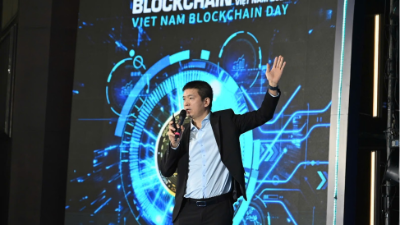
Mr. Dat Le, Head of Growth at Varmeta, affirmed that Vietnam is no longer at the stage of “standing on the sidelines” and has officially entered the blockchain game with a decisive stance. “Instead of crowding into traditional sectors that are already saturated and fiercely competitive, blockchain is a ‘blue ocean’ - a vast open sea of career opportunities for anyone willing to adapt,” Mr. Dat emphasized.
Meanwhile, Mr. Jeffrey Tchui, Executive Director of US software company Hashgraph - the developer of the Hedera Hashgraph distributed ledger, which provides enterprise-grade blockchain infrastructure for Web3 and digital asset applications - said that based on his experience working in major financial centers such as Dubai, Singapore, and Hong Kong (China), he sees that Vietnam is moving very quickly. “The legalization of digital assets and the piloting of digital asset exchanges will mark a major, structural shift in the market,” he believes.
Successful financial centers such as Hong Kong (China), Singapore, the UAE, and Switzerland all follow one common principle: develop human capital first, then attract capital. “Talent always comes before money,” Mr. Tchui emphasized. “Vietnam’s major advantage is that it is developing later than traditional financial centers, without being constrained by heavy historical legacies. This allows it to rapidly build a modern legal framework and an efficient new financial ecosystem.” He added that Hong Kong (China) took a great deal of time to establish legal clarity, capital market depth, and institutional credibility.
Drawing global attention
Vietnam currently ranks among the countries with the highest rates of digital asset adoption in the world. Many studies, however, show that around 70-80 per cent of retail investors still incur losses due to cryptocurrency scams. This reflects a significant gap in knowledge and risk awareness, an issue not only of the market but also of human capacity and systems.
According to experts, as International Financial Centers open up further and transparent policies move the blockchain and digital asset market “from gray to light,” international companies and organizations are coming to Vietnam in search of both markets and talent. “What we need are not just programmers, but people with strong financial foundations, basic technological literacy, legal awareness, systems thinking, and the ability to understand how technology interacts with economic and social systems, especially an entrepreneurial mindset,” Mr. Tchui said.
He further noted that global platform organizations are not only building financial centers but also providing open source technologies so that high-quality talent in Vietnam can use the best tools to build the next generation of applications. He hopes that Vietnam’s younger generation and students will take greater interest in careers in AI and digital finance, deepen their understanding of national policies related to International Financial Centers, and contribute to domestic development.
Dr. Phan Huu Nghi, Deputy Director of the Institute of Banking and Finance at the National Economics University (NEU), said that, in the near future, when Vietnam establishes digital asset and cryptocurrency exchanges with the participation of banks, securities firms, and technology companies, sectors such as digital banking, digital finance, and fintech will have “tremendous room for growth.” The NEU will soon roll out specialized training programs in fintech and digital assets to provide students with the most solid preparation ahead of shifts in the labor market.
According to Mr. Tchui, blockchain and new technologies will strongly impact many industries, in both positive and negative terms. Large, diversified conglomerates that possess vast amounts of data are likely to benefit the most, as blockchain enables data connectivity, integration with AI, and the creation of entirely new financial applications. From real-world asset tokenization, decentralized lending and borrowing, treasury management using stablecoins, to real-time salary payments, “all of these open up financial models that have never existed before,” he explained.
Conversely, industries and business models built on information monopolies, where value is created through earlier or better access to data than others, will face the risk of being displaced. As such, Mr. Tchui believes the younger generation needs to understand that transparency and data analysis capabilities create far more value than information hoarding. Those who can best extract, analyze, and apply data will be the ones who create the greatest value.
Talent comes first
From the perspective of training and workforce preparation, a key question is what students need to prepare in order to enter the digital asset and blockchain field in the years to come. According to experts, the most important skill is not necessarily programming, but the ability to work effectively with AI.
Ms. Trang Dang, Product Management Director at Varmeta, said that from a career perspective, banking and finance students can participate in blockchain and digital asset projects in many different roles. “The two most important foundations are banking and financial knowledge, and the ability to apply AI with critical thinking,” Ms. Trang said. “With these two elements well prepared, students will have a major advantage when entering the digital asset, blockchain, and new economic model space in the years ahead.”
Students with backgrounds in strategy, markets, business, marketing, engineering, design, and other complementary skills will hold significant advantages in pursuing this path. In practice, even very young, newly-graduated students are already able to participate in building technology companies, developing new products, and pioneering markets.
According to experts, this is a critical moment. In human history, there have been few periods in which breakthrough technologies have emerged with the power to fundamentally transform how people work and organize society as profoundly as today.
Students over the next five years are expected to become a “generalist generation” - individuals who can serve as general managers, product managers, advisors, project-based professionals, and adapt flexibly across many roles. “This creates a huge advantage for today’s students,” Ms. Trang said. “While those who graduated 20 years ago are having to return to school to adapt to a new era, today’s students are at a very special moment, with many opportunities to catch up, or even leap ahead, if they know how to seize them.”
On blockchain and digital assets, Mr. Tchui emphasized that “Vietnam needs talent-first infrastructure.” The success of an economy, he continued, depends on people; it is talent that creates value and ultimately attracts investment capital.









 Google translate