


Vietnam’s real estate market is highly interconnected with the broader economy through multiple balance sheets and cash flows, ranging from the value of collateral securing bank loans and households’ major assets to bond flows, homebuyers’ advance payments, and activity across the construction, building materials, and interior furnishings supply chains. The concern is therefore not simply experiencing a period of real estate price correction but the prolonged stagnation of projects, the difficulty of distinguishing which projects remain viable, and, ultimately, which parties will bear the risks and losses.
Moreover, because real estate relies heavily on debt leverage, it is an investment channel directly and deeply affected by credit policy. When the credit “tap” is opened and interest rates are low, cheap money can fuel widespread speculation. Conversely, when interest rates are high, tighter liquidity can push the market toward stagnation.
Risk identification mechanisms
The country’s real estate market experienced a sharp downturn in 2011-2013, when lending rates exceeded 18-20 per cent per annum. Many companies and investors were forced to sell assets at steep discounts to cut losses, leaving the market “frozen” for an extended period, while property prices in many areas fell 30-40 per cent, including in central locations. One contributing factor was investment behavior heavily reliant on short-term borrowing, while real estate projects and assets have long investment cycles.
Since 2023, Vietnam’s credit and real estate policies have gradually shifted from simply easing liquidity constraints toward more targeted capital allocation. The initial phase focused on preventing a vicious cycle involving legal problems, corporate bonds, and credit through Resolution No. 33/NQ-CP, Decree No. 08/2023/ND-CP, and policies allowing debt repayment schedules to be restructured. Capital was subsequently directed more specifically toward social housing, young homebuyers, viable projects, and sectors identified as priorities.
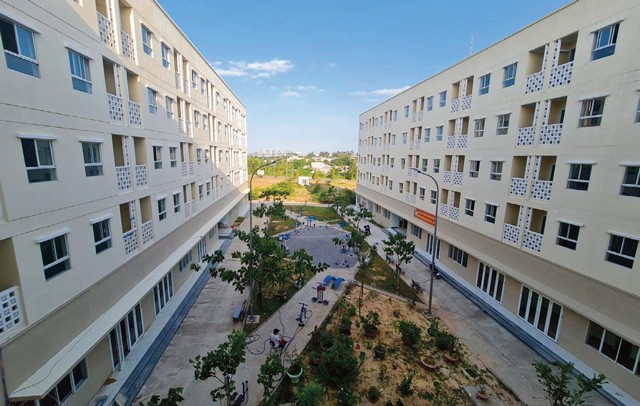
However, after three years of implementing the VND145 trillion ($5.58 billion) credit program for social housing development under Resolution No. 33, involving nine commercial banks, total disbursements had only reached about VND12.44 trillion ($478.5 million) as of May 2026, or less than 8.6 per cent of the allocated sum. Credit is effective only when it is accompanied by a viable project, streamlined procedures, and borrowers with the ability to repay.
By 2025, after two years of tight controls, real estate credit had been loosened. Outstanding credit in the sector grew faster than overall credit growth across the economy and became more concentrated in real estate business activities as the bond market remained subdued. Cheap money helped make the market more active, with numerous projects restarting, while preferential interest rates and extended principal grace periods boosted both demand and transaction volumes.
Today, as authorities closely monitor the market and “standards” and “discipline” become critical requirements, controlling speculation and steering the market back toward genuine demand through a range of measures, including credit policy, is considered key to enabling Vietnam’s real estate market to enter a more sustainable growth cycle. The State Bank of Vietnam (SBV) has asked credit institutions to continue tightly controlling real estate lending while proactively directing real estate credit toward segments aligned with the policies and priorities of the Party and the State.
The Vietnam Real Estate Market Research Institute at the Vietnam Association of Real Estate Brokers (VARS IRE) argues that the issue with real estate credit is not simply whether to “tighten” or “loosen” lending. More important is the effectiveness of capital allocation and the level of risk associated with it. In practice, real estate credit has a highly diverse structure, ranging from loans for housing needs, property purchases, and transfers to financing for project development, real estate businesses, and other investment and business activities. These credit categories differ in terms of the purpose of funds, cash flows, repayment capacity, and risk levels.
Therefore, rather than applying a uniform approach to all real estate credit, credit policy should gradually classify loans according to the nature of the asset, the purpose of the funding, borrower profiles, developer track records, and level of risk.
Credit should be prioritized for projects with sufficient legal approvals, a viable path to completion, the ability to increase housing supply, genuine demand, and significant spillover effects. Meanwhile, capital for speculative activities or for prolonging projects that are no longer viable should be appropriately controlled.
Targeted credit, controlled risk
Vietnam still has room to identify and prevent risks at an early stage. The legal framework governing land, housing, and real estate businesses is being developed in a more coordinated manner, while information systems and databases on housing and the real estate market are gradually being established.
However, data across banks, companies, projects, and homebuyers remains fragmented. The ability to identify a project at risk of becoming insolvent at an early stage is also not yet sufficiently clear. Without improvements in this area, a policy of “prioritizing credit” risks becoming an administrative capital-allocation mechanism rather than a data-driven risk-management tool.
The key change needed in the next phase, therefore, is a shift in the way credit is managed. Rather than treating real estate as a sector with a uniform level of risk and applying a common control mechanism, policy should move toward assessing risk based on the borrower, asset, purpose of funding, and repayment capacity.
First, projects should be classified to guide capital flows. The government could assign the Ministry of Construction, in coordination with the Ministry of Agriculture and Environment, local authorities, and the SBV, to study a mechanism for assessing and classifying projects based on their viability and recovery prospects. Under this approach, VARS IRE proposes considering three categories: projects with sufficient legal approvals, a viable path to completion, significant spillover effects, and that are primarily short of funding to continue development; projects that remain recoverable but require restructuring, such as additional equity, adjustments to their business plans, or restructuring of debt obligations; and projects that are no longer viable and need to be transferred, liquidated, or otherwise handled in accordance with regulations. The purpose of classification is to identify risk levels accurately and guide capital flows, while individual banks would retain responsibility and authority for lending decisions.
Second, the system should shift from sector-based controls toward assessments based on borrowers and assets. The SBV should gradually strengthen criteria such as the loan-to-value ratio of collateral, total debt obligations, and borrowers’ repayment capacity. First-time homebuyers, social housing buyers, affordable housing buyers, and income-generating assets should have more appropriate access to credit. Risk tiers should be based on actual data on borrowers and assets rather than primarily on product labels.
Third, the SBV should regularly conduct stress tests of banks against scenarios such as falling property prices, delayed project deliveries, maturing corporate bonds, or declining collateral values. The results should be linked to appropriate measures, such as higher provisioning, additional capital, or controls on credit growth for banks with high risk concentration. Debt restructuring should be a time-bound solution only for loans that remain recoverable, while loans that are no longer recoverable should be identified and handled in accordance with regulations.
Fourth, long-term funding sources for the real estate market should be gradually diversified. The Ministry of Finance and the SBV should study the development of funding sources beyond bank credit, including corporate bonds, real estate investment funds, and other appropriate financial products. However, expanding funding channels must go hand-in-hand with requirements for information transparency, independent valuation, and risk management. Policymakers should not create another fundraising channel if the risks ultimately return to the banking system or the State budget.
Fifth, all preferential credit policies should have clear criteria, time limits, and post-disbursement monitoring mechanisms. Policy effectiveness should be assessed not only by the amount of capital committed and disbursed, but also by the number of projects completed, homes delivered, people gaining access to funding, and the quality of credit after support is provided. In the near term, policymakers could focus on completing data systems and piloting project classification, with any expansion of new mechanisms based on actual results and the ability to control risks.
(*) Ms. Pham Thi Mien is the Deputy Director of the Vietnam Real Estate Market Research Institute at the Vietnam Association of Real Estate Brokers (VARS IRE)










 Google translate