


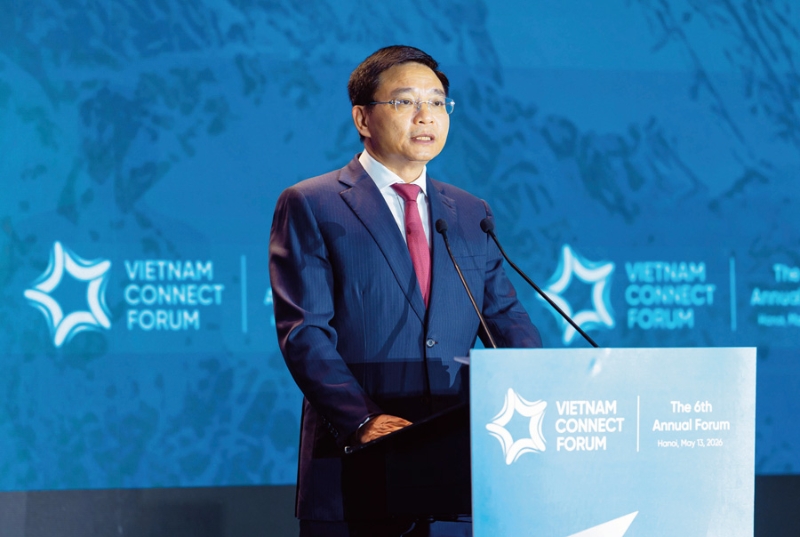
The Vietnam Connect Forum 2026, with the theme “Building Integrated Partnerships Between Foreign-Invested and Domestic Economic Sectors for Breakthrough Growth in the New Era”, is especially meaningful as Vietnam enters a new phase of development that requires faster, higher-quality, more sustainable, and more resilient growth in response to regional and global challenges.
On behalf of the government and the Prime Minister, I greatly appreciate the Vietnam Economic Association, the Institute for Policy and Strategy Studies, and Vietnam Economic Times / VnEconomy for jointly organizing this highly-practical and meaningful forum. I also sincerely thank the business community, investors, and domestic and international associations for their participation, partnership, and valuable contributions to Vietnam’s development over the years.
Bright spot amid rising competition
The world is entering a period of profound transformation marked by rapid, complex, and unpredictable changes. Strategic competition among major powers is intensifying, while supply chain restructuring, green transition, digital transformation, AI, semiconductors, data, and strategic technologies are fundamentally reshaping the way countries compete and cooperate economically.
Against this backdrop, competition for international investment has also changed significantly. Whereas low labor costs and investment incentives once served as the main advantages, investors today increasingly prioritize institutional quality, policy stability, strategic infrastructure, high-quality human resources, green energy, data infrastructure, innovation capacity, and the reliability and stability of the investment environment.
For Vietnam, this presents both challenges and major opportunities to reposition its role in regional and global value chains and renew growth drivers through science and technology, innovation, digital transformation, green transition, and private sector development.
In 2025 and the opening months of 2026, despite continued global volatility and uncertainty, Vietnam’s socio-economic performance achieved important and broad-based results. GDP growth reached approximately 8.02 per cent, with the economy valued at around $514 billion. Growth momentum continued in the first quarter of 2026, at an estimated 7.83 per cent. Macro-economic stability has largely been maintained, inflation kept under control, and major economic balances ensured, while budget revenues, trade, investment, and consumption continued to grow in a positive manner.
Notably, the foreign-invested sector has remained a major bright spot in the economy. To date, Vietnam has more than 46,500 active FDI projects with total registered capital exceeding $543 billion, while cumulative disbursed capital has reached approximately $357.6 billion. The FDI sector currently contributes more than 20 per cent of GDP, accounts for around 70 per cent of exports, and creates jobs for millions of workers.
At a time when global FDI flows have declined in many regions, Vietnam continues to rank among Asia’s leading FDI destinations. This reflects the confidence of the international business community in its development prospects, socio-political stability, and investment environment.
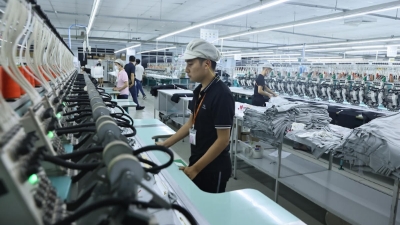
In recent years, Vietnam has also become a destination for major corporations expanding investments in electronics, semiconductors, high technology, energy, logistics, finance, innovation, and modern services, helping form new manufacturing ecosystems and supply chains in the country.
New phase of development
However, alongside these achievements, we must frankly acknowledge that the quality and effectiveness of links between the FDI sector and the domestic economy have yet to meet expectations. Many Vietnamese businesses remain concentrated in low value-added segments, localization rates in some industries are still limited, and the absorptive capacity of domestic enterprises has yet to keep pace with global supply chain requirements.
While Vietnam has achieved positive results in attracting investment capital, its new phase of development demands higher-quality cooperation, greater spillover effects, and stronger synergies between the FDI sector and the domestic economy. This is precisely the focus of today’s forum.
Vietnam’s consistent policy is to regard the foreign-invested sector as an indispensable and important part of the national economy, encouraged to develop in the long term on an equal basis and in healthy cooperation and competition with other economic sectors.
However, in this new phase of development, Vietnam is decisively shifting to “selective, high-quality, effective, and sustainable investment cooperation.”
We evaluate investors not only by how much capital they bring to Vietnam but more importantly by what technologies they bring, what added value they create, how they contribute to workforce development, how many Vietnamese enterprises they integrate into supply chains, and how they support green transition, digital transformation, and the strengthening of the economy’s internal capabilities.
New-generation FDI should not come to Vietnam merely for production or market access, but should partner with Vietnam to create new value, new capabilities, and a stronger position in global value chains.
Five major directions
With this spirit, the Vietnamese Government will focus on the following major priorities in the time to come.
First, continue institutional reforms and significantly improve the business and investment environment, shifting from a management mindset to one centered on development facilitation.
The government will continue making substantive reductions to administrative procedures and business conditions, deepen decentralization alongside stronger oversight, accelerate comprehensive digitalization, implement effective one-stop-shop mechanisms, and improve policy transparency, stability, and predictability.
Second, reform foreign investment attraction toward a more selective approach, prioritizing quality, technology, innovation, value addition, land-use efficiency, environmental protection, and links with domestic enterprises.
Vietnam will prioritize investment projects in semiconductors, electronics, AI, data, biotechnology, pharmaceuticals, clean energy, new materials, modern logistics, financial services, innovation, and other strategic technology industries.
Third, strongly develop domestic enterprises and support industries to enable Vietnamese companies to participate more deeply in global value chains.
We regard this as a long-term strategic mission. The State will continue supporting enterprises in improving governance, quality standards, technological innovation, digital transformation, access to financing, and connections with multinational corporations.
The objective is not only to increase the number of businesses participating in supply chains but also to gradually cultivate Vietnamese enterprises capable of becoming Tier 1 and Tier 2 suppliers in regional and global value chains.
Fourth, focus on developing strategic infrastructure and high-quality human resources to support new-generation FDI attraction.
The government is accelerating major transport infrastructure projects, logistics systems, energy and digital infrastructure, data infrastructure, and next-generation industrial parks, while also strengthening collaboration between the government, educational institutions, and investors to train talent for high-tech and strategic industries.
Fifth, improve the effectiveness of State management over the FDI sector, ensuring harmony between the interests of the State, investors, and citizens, while safeguarding economic independence, security, and sustainable development.
We are committed to creating the most favorable conditions for investors operating legally, efficiently, and sustainably in Vietnam. At the same time, we will firmly address transfer pricing, trade fraud, environmental violations, outdated technologies, and intellectual property infringements.
Vietnam is entering a new phase of development, with the aspiration of becoming a high-income developed country by 2045. To achieve this goal, it needs a new growth model based on innovation, technology, high-quality human resources, and effective synergies among economic sectors.
We hope the foreign business community and investors will continue to accompany Vietnam for the long term, viewing it not merely as an investment destination but as a strategic development partner in global value chains.
At the same time, we encourage Vietnamese enterprises to proactively innovate, strengthen their governance and technological capabilities, and deepen cooperation to participate more fully in international production networks and supply chains.
The Vietnamese Government remains committed to standing alongside, listening to, and acting with the business community, while continuing to build a transparent, stable, safe, and internationally-competitive investment environment.
I firmly believe that through cooperation and synergy between the foreign-invested sector and the domestic economy, Vietnam will create new momentum for rapid and sustainable growth in this new phase of development.




 Google translate