


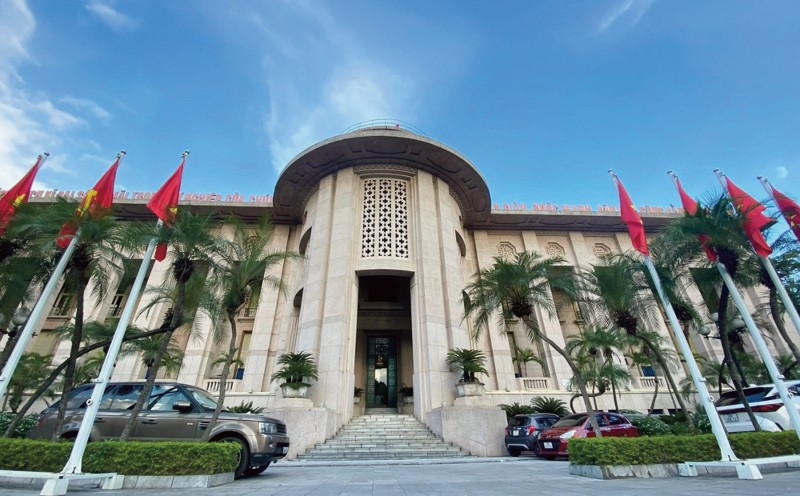
The recent decision by the State Bank of Vietnam (SBV) to introduce a special lending mechanism for 18 projects involving Vingroup, Sun Group, and Masterise has sparked intense debate. Supporting or rejecting the policy outright would, however, be an overly simplistic approach. A more balanced perspective is to endorse it with conditions, recognizing its potential to accelerate Vietnam’s development while remaining mindful of the risks it could create.
A substantial body of international research has found that infrastructure investment generally has a positive impact on economic growth, though the magnitude varies across nations and sectors. The benefits tend to be greater in developing economies than in advanced ones, while investments in energy and telecommunications often generate stronger returns than those in transportation. Studies also consistently show that the efficiency and quality of infrastructure are critical determinants of its broader economic impact.
Infrastructure as an engine of growth
Infrastructure development has long been recognized as a powerful catalyst for economic expansion. By supporting industrialization, accelerating urbanization, lowering logistics costs, improving market connectivity, and creating employment, infrastructure lays the foundation for sustained productivity gains.
One widely accepted economic mechanism is that government-led infrastructure investment initially creates new income streams for businesses. Those gains are then amplified through the consumption multiplier and crowding-in effects, whereby improved infrastructure encourages additional private sector investment, producing a much larger boost to the overall economy.
China provides perhaps the clearest illustration of this model. During its period of double-digit economic growth between 2003 and 2010, infrastructure investment played a central role in driving expansion. The country’s RMB4 trillion ($560 billion) stimulus package during 2008-2009 not only helped it weather the global financial crisis but also enabled it to maintain growth of nearly 10 per cent. By 2010, China had overtaken Japan to become the world’s second-largest economy.
More recently, some analysts have argued that China’s renewed emphasis on infrastructure-led growth reflects the limited effectiveness of recent consumption stimulus measures. This shift is evident in the country’s 15th Five-Year Plan, which outlines an ambitious blueprint for a modern national infrastructure system.
The strategy includes six nationwide infrastructure networks covering integrated transportation, energy, water resources, next-generation information and communications technology, a national computing network, and urban underground pipeline systems. Market estimates suggest total infrastructure investment could reach RMB40 trillion ($5.6 trillion) over the five-year period, with annual spending exceeding RMB7 trillion ($980 billion).
Credit the fuel
Infrastructure development requires massive amounts of long-term capital, making government leadership and policy support indispensable. Funding typically comes from a combination of State budgets, government bonds, public-private partnerships (PPPs), land-related revenues, and bank lending.
Many developing countries look to China’s experience as a model, though its financial system possesses unique characteristics. Bank credit serves as the primary financing source for infrastructure, supported by policy banks such as the China Development Bank alongside the country’s five major State-owned commercial banks. These institutions are able to provide large-scale financing rapidly, backed by liquidity support from the People’s Bank of China.
Another important pillar is China’s system of Local Government Financing Vehicles (LGFVs), which function as off-budget financing platforms. These entities borrow from banks and issue bonds to finance infrastructure projects, often using land as collateral, capital contributions, or by monetizing land-use rights.
Vietnam is likewise seeking stronger infrastructure investment to support its ambition of posting double-digit economic growth. Against that backdrop, the SBV’s decision to exclude new loans for 18 projects involving three major conglomerates from the banking system’s overall credit growth ceiling can be viewed as a form of targeted monetary easing. The move sends a clear signal that selected projects and private sector developers will receive priority access to financing. Priority, however, should not be mistaken for safety.
Risks that can’t be overlooked
The first concern is concentration risk. The combined financing requirement of more than VND752 trillion ($28.9 billion) is enormous relative to the size of Vietnam’s economy. Most of this debt is concentrated in a limited number of projects undertaken by just three corporate groups, many of them linked to infrastructure and real estate. Financial history has repeatedly demonstrated the dangers of concentrated lending. Delays, cost overruns, or weaker-than-expected economic conditions affecting only one or two major projects could place pressure not only on the lending banks but potentially on the broader financial system through interbank links.
The second concern is moral hazard. When authorities publicly grant preferential credit treatment to a specific group of companies, they may unintentionally reinforce the perception that these firms are “too big to fail.” Such expectations could encourage greater reliance on bank financing rather than equity funding or bond issuance. Over time, this risks fostering forms of crony capitalism that have created significant distortions elsewhere.
A third issue is maturity mismatch. Infrastructure and property developments typically require long-term financing, while Vietnam’s banking system continues to rely primarily on short-term deposits. Though the SBV has recently adjusted the loan-to-deposit ratio (LDR) framework, creating greater lending capacity by allowing more short-term funding to support longer-term loans, refinancing risk and the prospect of higher interest rates remain significant challenges for banking sector liquidity. Another equally-important question is where banks will obtain sufficient funding to support the scale of planned disbursements.
Finally, macro-economic risks should not be underestimated. Among the 18 priority projects are not only transport and infrastructure developments but also real estate and urban township projects. This raises concerns about the potential for localized property bubbles and inflationary pressures in affected areas.
Many major infrastructure components, meanwhile, require imported equipment and materials, increasing demand for foreign currency at a time when foreign exchange reserves are not unlimited.
Vietnam’s determination to pursue double-digit economic growth is undeniable, and stronger infrastructure investment will almost certainly be essential to achieving that objective. Nevertheless, prudence remains critical. Growth matters, but the quality and sustainability of that growth matter even more. Ultimately, the success of these projects will depend on how efficiently capital is allocated and utilized.
China’s experience offers a valuable cautionary tale. Without rigorous oversight, infrastructure-led growth can lead to excess construction, costly projects with limited practical value, real estate bubbles, and growing vulnerabilities within the financial system. For that reason, imposing clear conditions, stronger oversight and stricter accountability requirements on these projects, even if belatedly, remains an essential step.
(*) Dr. Vo Dinh Tri is a Lecturer at the University of Economics Ho Chi Minh City and the IPAG Business School (France), and a Member of AVSE Global.






 Google translate