


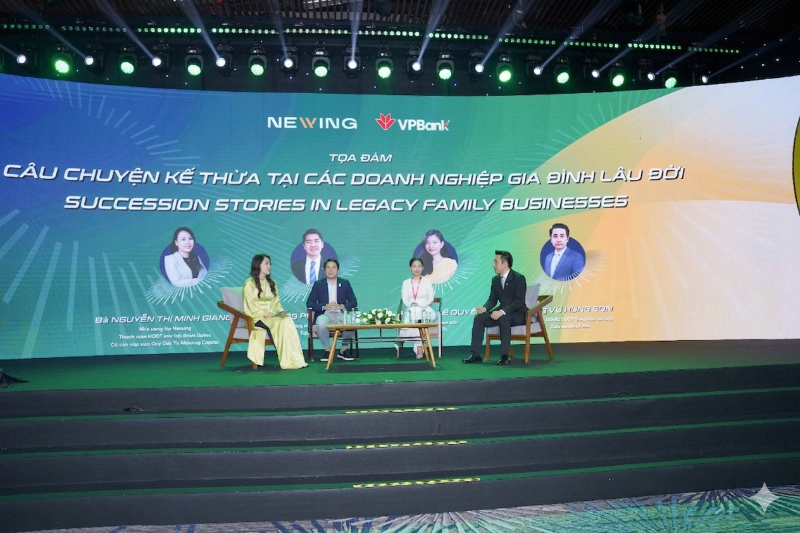
Succession and governance in family-owned enterprises took center stage at the session entitled “Succession Stories in Legacy Family Business” within the SME Forum 2026, held in Ho Chi Minh City on March 20 with the theme “New Momentum for the Big Game.”
Co-hosted by Newing and VPBank SME, the Forum drew strong interest from the domestic and foreign business community, particularly next-generation leaders.
The story of the “F2 and F3 generations” in family businesses shows that succession is not merely about the inheritance of assets or titles, as truly taking over and operating a legacy is a demanding journey.
Inheriting or truly succeeding
Sharing his first-hand experience, Mr. Vu Hong Son, Chairman of the Board of Directors at the Bao Tin Manh Hai Group, who transitioned from a public sector to a family business, pointed out that the biggest challenge lies in governance culture and the willingness of the previous generation to delegate authority.
Many family businesses still operate based on accumulated experience, internal trust, and longstanding habits, he continued, relying on informal, relationship-based decision-making, while lacking clear processes and approval systems. This makes it difficult for the next generation to exercise independent decision-making.
“The transfer must include not only ownership but also real authority,” he emphasized. “Even as CEO, if decisions are still influenced by family members behind the scenes, without sufficient space to exercise one’s mandate it becomes impossible to make independent decisions.”
From an organizational perspective, Ms. Vuu Le Quyen, CEO of Biti’s and a next-generation leader of the more than 44-year-old Vietnamese footwear brand, has opted to “restructure” the company through the development of a “happiness-driven culture.” She is also the architect behind the strategy to reach a new generation of consumers through the Biti’s Hunter product line, repositioning the brand toward Gen Z amid intensifying competition from international players in the domestic market.
According to Ms. Quyen, the challenge goes beyond product innovation to preserving the brand’s core identity. One of the biggest hurdles she has faced is transforming the long-established top-down management model that has been deeply embedded in the organization for more than three decades. Biti’s was founded in the post-war period, when discipline and command were the primary means of transitioning the workforce from agriculture to industrial production. The company’s founder, her father, built a culture that was highly disciplined and strongly masculine in nature and rigid yet effective in its time, but that now requires change to adapt to a new phase of development. Ms. Quyen noted that legacy in any business carries a dual nature. It provides a proven foundation, but can also hinder transformation if not continuously renewed.
From an international perspective, Mr. Pierre Pang, CEO of the MAMEE Group, described running a family business as one of the most complex leadership challenges, requiring a delicate balance between family dynamics and market pressures.
He raised a fundamental question for family shareholders: which matters more, the needs of the family or the needs of the business. In his view, without a well-performing company, the family’s long-term interests cannot be sustained. He also pointed out that legacy, often seen as an advantage, can in some cases slow down innovation and adaptation.
Solutions for cultural transformation
To address these challenges, speakers emphasized the importance of clear governance principles and organizational transformation.
According to Mr. Son, leaders must adhere to a core principle. All decisions should be based on clearly defined roles, responsibilities, and authority. Separating personal relationships from professional accountability is essential for building a more structured and professional organization.
At Biti’s, Ms. Vuu Le Quyen has taken a different approach, by focusing on internal transformation through building a happiness-driven culture. Following the success of Biti’s Hunter sneaker line in 2018, the company launched the Happy Biti’s initiative to reshape its organizational culture.
“Eight years ago, the idea of a happy company was often seen as unrealistic, as businesses were expected to focus solely on revenue and profit,” she said. However, she believes this new approach provides a foundation for sustainable change.
At the same time, the company remains committed to its core values while adapting its strategy to evolving consumer behavior, particularly among younger generations. “Strategy must change as customers change, but core values should not,” she stressed.
Meanwhile, Mr. Pang adopted a dual approach of preservation and transformation. He maintains four core values, integrity, involvement, intensity, and innovation, while proactively changing operational models to remain competitive.
He acknowledged that this transition is far from easy, especially when it involves shifting the mindset of a longstanding workforce. Nevertheless, it is a necessary step for family businesses to adapt to a rapidly-changing environment and sustain long-term growth.
The notion of “prosperity” was also reframed at the Forum through a broader lens, moving beyond short-term growth metrics. Ms. Nguyen Thi Minh Giang, Founder and CEO of Newing, argued that sustainable business success depends not only on strategy but also on execution.
She observed that while most companies today do not lack strategic direction, many fall short in disciplined execution and robust systems capable of supporting long-term growth. As a consulting and training firm focused on leadership development and organizational transformation, Newing aims to help businesses strengthen these foundations.
Ms. Giang added that as companies scale up, operational and governance weaknesses tend to become more visible. Therefore, prosperity should not be defined merely as growth, but as the ability to sustain consistent and resilient growth over time.
Sharing a similar view, Mr. Dao Gia Hung, Director of SME Banking at VP Bank, noted that capital is only a necessary condition for business development. The decisive factors lie in operational capability, governance, and the ability to adapt to industry-specific dynamics.
“Practical know-how and tailored financial solutions must go hand-in-hand to deliver tangible value for businesses,” he said, adding that such an approach enables companies not only to grow, but also to enhance resilience amid an increasingly volatile market environment.





 Google translate