


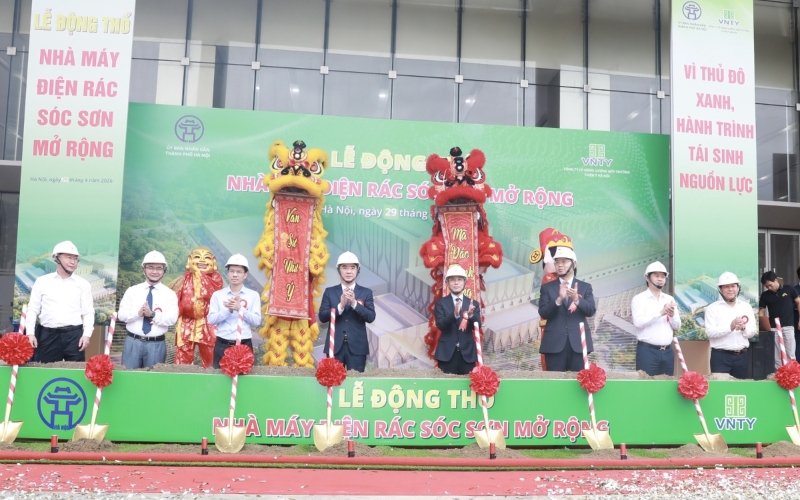
The Hanoi People's Committee held a groundbreaking ceremony on April 29 for the Soc Son Waste-to-Energy Plant expansion project, that is located at the Nam Son Solid Waste Treatment Complex in Trung Gia Commune.
According to Decision No 775/QD-UBND issued on February 13, 2026, by the Hanoi People's Committee, the Soc Son Waste-to-Energy project has been adjusted for two-phase investment.
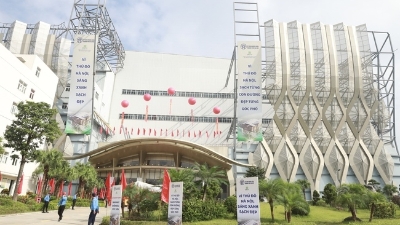
Phase 1 of the plant is already operational, with a receiving and processing capacity of approximately 5,000 tons of waste per day and a power generation capacity of 90MW.
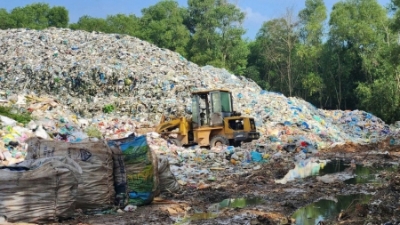
Phase 2 (the expansion) will focus on processing 1,600 tons of previously landfilled waste daily. This expansion will increase the plant’s total power generation capacity to 135MW, thus completing a synchronized technical infrastructure system, with the entire facility expected to be fully operational by the fourth quarter of 2027.
The project has a total investment of nearly VND13 trillion ($493 million), of which the expansion phase accounts for approximately $5.83 trillion (over $221 million).
Speaking at the ceremony, Vice Chairman of the City People's Committee Nguyen Xuan Luu noted that Hanoi is undergoing rapid urbanization and socio-economic development. This growth has brought significant environmental pressure, particularly regarding the challenge of municipal solid waste treatment.
He emphasized that transitioning from traditional landfilling methods to advanced waste-to-energy technology is an essential, strategic requirement for building a "Bright - Green - Clean - Beautiful - Civilized - Modern" capital.
However, given the pressures of population growth and increasing waste volume, he said that the city must continue to implement breakthrough solutions. This includes processing waste that has already been landfilled at the Nam Son Complex to gradually improve the environment, reclaim land for economic development and community use, and ultimately enhance the quality of life for local residents.
 Google translate