


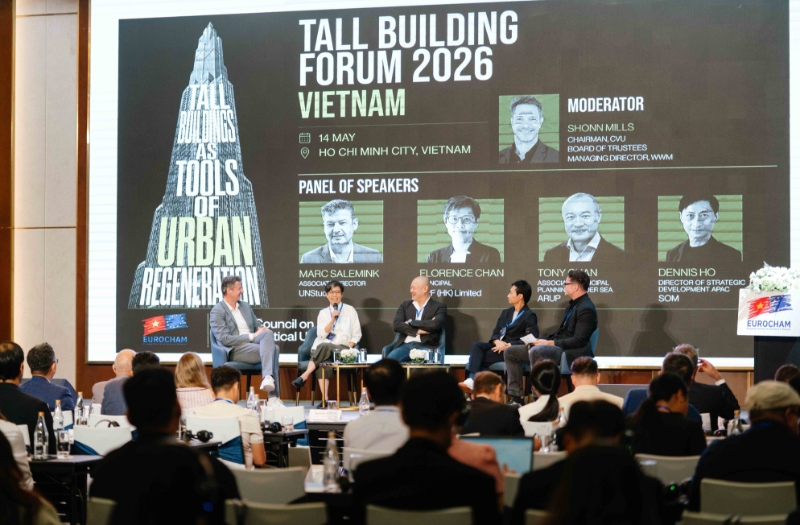
Against the backdrop of Vietnam as one of Asia’s fastest urban transformations, leaders from government agencies and the architecture, engineering, urban planning, finance, and real estate sectors gathered in Ho Chi Minh City on May 14 for the Tall Building Forum 2026 to discuss how the country can balance rapid urbanization with sustainability, resilience, and livability goals.
The forum was organized by EuroCham Vietnam’s Construction Sector Committee in partnership with the Council on Vertical Urbanism (CVU), as Vietnam’s major cities continue to experience accelerating urban growth.
As Hanoi and Ho Chi Minh City continue to absorb growing populations, speakers argued that high-rise developments should no longer be viewed merely as symbols of prestige. Instead, they are increasingly becoming strategic tools for land optimization, economic competitiveness, infrastructure integration, and long-term sustainability.
Speaking at the event, Mr. Jean-Jacques Bouflet, Vice Chairman of EuroCham Vietnam, said Vietnam has entered a decisive phase of urban evolution.
“Recent policy developments, including the implementation of the revised Law on Construction and ongoing institutional reforms, demonstrate Vietnam’s strong commitment to building a more modern, efficient, and sustainable urban environment,” he said.
He added that sustainability is becoming increasingly central to high-rise planning and development, with this year’s agenda focusing particularly on transit-oriented development (TOD), sustainable building design, and affordable housing.
Echoing similar views, Mr. Le Minh Long, Deputy Director of the Department of Science, Technology, Environment and Building Materials under the Ministry of Construction, said Vietnam’s urbanization model has become increasingly complex.
While high-rise construction has accelerated significantly over the past decade, challenges related to infrastructure integration, energy efficiency, climate resilience, and technical standards have become more apparent.
He stressed that sustainability should no longer be treated as an optional feature, but rather as a fundamental requirement. “Urban planning and management must stay ahead of development to ensure synchronization between high-rise projects and social infrastructure,” Mr. Long said.
According to leaders of EuroCham’s Construction Sector Committee, Vietnam now needs to develop its own approach to vertical urbanism rather than simply replicating international models. The goal, they said, is to strike a balance between rapid growth, sustainability, engineering excellence, and long-term quality of life.
Vietnam needs its own urban model
A recurring theme throughout the forum was that Vietnam should not merely replicate global skyline models, but instead adapt international experience to local cultural, social, and climate conditions.
Experts noted that global urban trends are shifting away from isolated skyscrapers toward integrated “vertical communities,” where residential, commercial, workplace, and public spaces coexist within walkable urban ecosystems.
Mr. Shonn Mills, Chairman of the Council on Vertical Urbanism, said mixed-use developments integrating residential, office, retail, and social functions have become a defining trend in global urban planning over the past decade.
“Tall buildings are no longer simply structures; they are becoming essential components of dense and vibrant urban environments,” Mr. Mills said.
Meanwhile, Mr. Marc Salemink, Associate Director and Senior Architect at UNStudio, said future towers should function as “cities within cities,” incorporating public and semi-public spaces that foster social interaction and community building.
Projects in Singapore and Thailand, including PARKROYAL on Pickering, Oasia Downtown, and One Bangkok, were highlighted as examples of integrating greenery, public transport connectivity, and climate-responsive design into high-density developments.
Ms. Florence Chan, Principal at Kohn Pedersen Fox (KPF), highlighted the transformation of Victoria Harbour in Hong Kong (China) as an example of how commercial waterfronts can evolve into vibrant public destinations that reconnect people with the city. Reflecting on the long-term sustainability of urban projects, she argued that Vietnam’s next generation of developments must move beyond short-term construction metrics toward broader lifecycle thinking. “We need to pivot from discussing construction costs to focusing on life-cycle costs,” Ms. Chan emphasised. “Investing in superior materials and integrated designs today pays dividends in the longevity and performance of the building over decades.”
TOD seen as key to future urban growth
Transit-oriented development (TOD) also emerged as one of the forum’s central themes, with experts arguing that Vietnam’s future urban expansion should revolve around integrated public transport systems rather than continued urban sprawl.
Participants also noted that the merger of the Ministry of Transport and the Ministry of Construction in 2025 could create more favorable conditions for coordinating infrastructure planning and urban development strategies.
According to experts, TOD models could help reduce traffic congestion, improve air quality, and create more walkable communities in Hanoi and Ho Chi Minh City. However, speakers emphasized that successful implementation would require long-term planning consistency, stronger governance, and more integrated urban data systems.
Alongside sustainability, climate adaptation and affordable housing also emerged as growing priorities for Vietnam’s urban future.
Mr. Tony Chan, Associate Principal Planning Leader SEA at ARUP, said recent extreme weather events in Central Vietnam highlighted the urgent need to integrate climate resilience into urban planning. “The value of a building should be measured by how it performs during extreme weather and how it serves the broader community,” Mr. Chan said.
Discussions also explored the role of updated technical standards, energy efficiency metrics, and data-driven planning in supporting smarter forms of vertical urbanism. At the same time, affordable housing was repeatedly identified as a critical issue, with experts arguing that stronger integration between transport systems, social infrastructure, and mixed-use planning could help lower living costs while improving access to jobs and public services.
Closing the forum, Mr. Bruno Jaspaert, Chairman of EuroCham, said that “Buildings are not easy, and they are rarely fast, but Vietnam’s development speed is unique." “We Europeans have a long history of architecture that makes a difference, and Vietnam needs those same landmarks to define its trajectory. EuroCham remains committed to showcasing how proper construction and technology can contribute to this fast-growing economy.”

 Google translate