


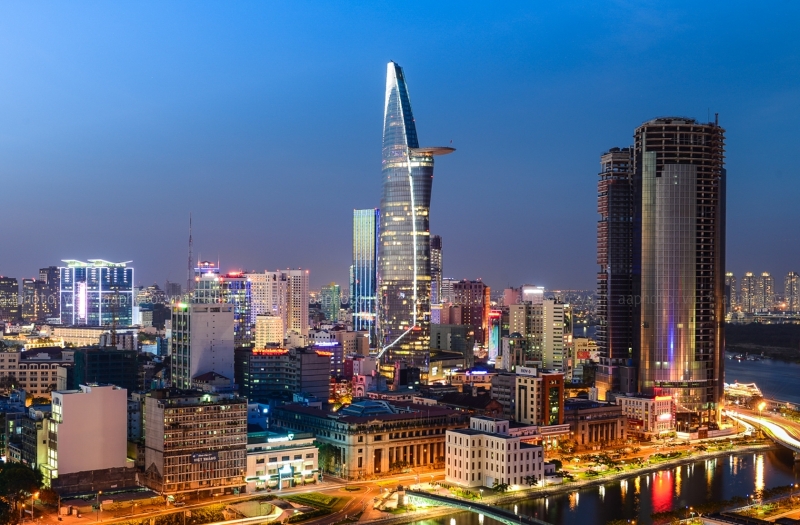
Under a decision recently issued by the Ho Chi Minh City People’s Committee, the Smart City Development Coordination Council of Ho Chi Minh City has been established.
According to the decision, the Council comprises 23 members and is chaired by the Chairman of the HCMC People’s Committee, Mr. Nguyen Van Duoc. Vice Chairman of the People’s Committee, Mr. Nguyen Manh Cuong, will serve as the Permanent Vice Chairman. The two other Vice Chairmen are Mr. Lam Dinh Thang, Director of the Department of Science and Technology, and Mr. Tran Quang Lam, Director of the Department of Construction.
The Council is tasked with leading and coordinating the implementation of the project "Building Ho Chi Minh City into a Smart City" for the 2026–2030 period, with a vision toward 2035.
Additionally, the Council's role involves directing and coordinating inter-disciplinary tasks related to the development, governance, and operation of a smart city.
The Council is also responsible for researching and proposing mechanisms, policies, and solutions to improve the efficiency of smart city development programs, ensuring they are synchronized, unified, and practical. It will monitor, urge, and inspect the progress of assigned tasks, while promptly identifying difficulties and proposing solutions to resolve bottlenecks during implementation.
Furthermore, the Council will advise the People’s Committee on assessing smart city maturity levels and certifying smart urban areas according to regulations. It will also review, update, and propose adjustments to smart city development schemes and plans to align with technological trends, the city’s developmental requirements, and the broader domestic and international context.
In the process of implementing the smart city development project, the city will focus on accelerating the application of Big Data, Artificial Intelligence (AI), and digital infrastructure to enhance urban management and governance.
The city has already built and put into operation a Smart City Operations Center (IOC), which is connected to a shared data warehouse and various digital platforms to support monitoring, analysis, forecasting, and decision-making. Moving forward, the city will continue to perfect its data ecosystem and expand the application of AI, GIS, and other digital technologies in urban governance, public services, and support for citizens and businesses.
Previously, the City People’s Committee issued a directive regarding the construction and development of smart cities across the area, with the ultimate goal of finalizing the master plan for the city to become a smart city by 2030, with a vision toward 2035.








 Google translate