


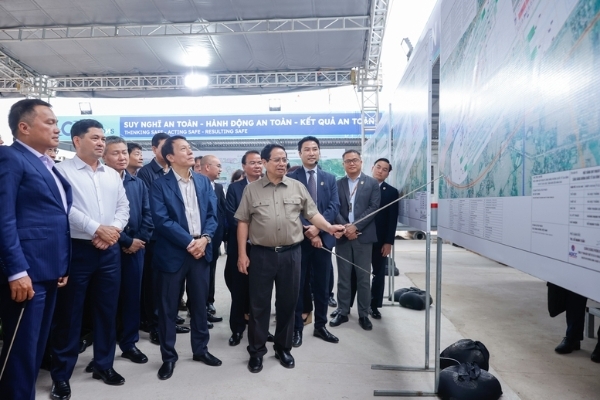
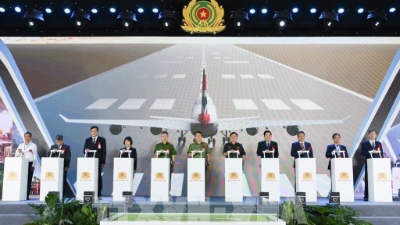
During a field inspection on March 7, Prime Minister Pham Minh Chinh directed stakeholders to accelerate the construction of Gia Binh International Airport while orienting the site as an "airport economic ecosystem" to unlock new development potential for the Capital Region.
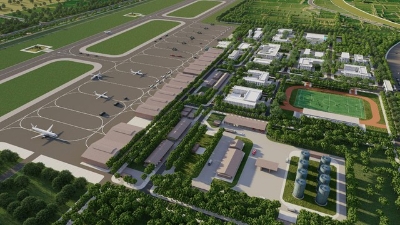
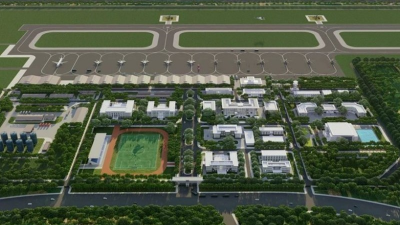
Gia Binh International Airport is being developed across the communes of Gia Binh, Luong Tai, Nhan Thang, and Lam Thao in northern Bac Ninh Province. The project spans approximately 1,885 ha with a total investment of over VND196.3 trillion (nearly $7.5 billion).
The PM emphasized that essential components must be completed between 2025 and 2027 to serve the 2027 APEC Economic Leaders' Week.
To date, site clearance has been completed for approximately 1,259 hectares, reaching 66.8% of the target. Construction is currently underway for several key items, including the VIP terminal, taxiways, air traffic control tower, and internal connection roads, all showing positive progress.
PM Chinh requested that investors and contractors fast-track construction while strictly ensuring project quality. He also instructed authorities to plan the surrounding areas to foster an aviation economy, including logistics hubs and specialized airport services.
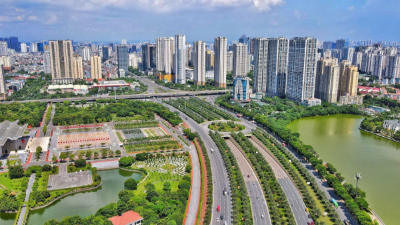
In addition to the main site, the PM inspected the resettlement areas for displaced residents. These zones are planned to integrate with the development of urban, industrial, and service sectors surrounding the airport, ensuring architectural and infrastructural harmony with the future urban planning of Gia Binh.
He demanded that the resettlement areas be modern, green, and clean, equipped with synchronous infrastructure—including transportation, electricity, water, telecommunications, healthcare, education, culture, and parks. He stressed that the ultimate goal is to create sustainable livelihoods and ensure that residents enjoy a higher quality of life in their new homes than in their previous locations.
On the same day, the PM inspected a 41.3-kilometer road project connecting Gia Binh International Airport with Hanoi, with a total investment of approximately VND83 trillion ($3.165 billion). It is designed to link directly with major transport arteries, including the Hanoi–Lang Son and Hanoi–Thai Nguyen expressways, as well as Ring Road 3 of the capital city.
During a working session with ministries, sectors, and local authorities following the inspection, the PM emphasized that Gia Binh International Airport must be developed as a "dual-use" facility. This strategy aims to harmonize socio-economic development with national security and defense, while establishing a modern, internationally integrated aviation economic zone.
The Prime Minister noted that investing in Gia Binh Airport and its surrounding ecosystem will unlock new development potential for Bac Ninh and Hanoi. Furthermore, it will strengthen regional connectivity with Hai Phong, Quang Ninh, and the Red River Delta, while enhancing economic ties with Southwest China and international markets via maritime routes.
He requested that Bac Ninh Province and Hanoi coordinate closely with relevant ministries to review and update planning with a long-term vision. The PM stressed the need for synchronized implementation of connecting infrastructure and the airport ecosystem to ensure the entire hub is fully operational upon opening, specifically to serve the 2027 APEC Economic Leaders' Week.
 Google translate