


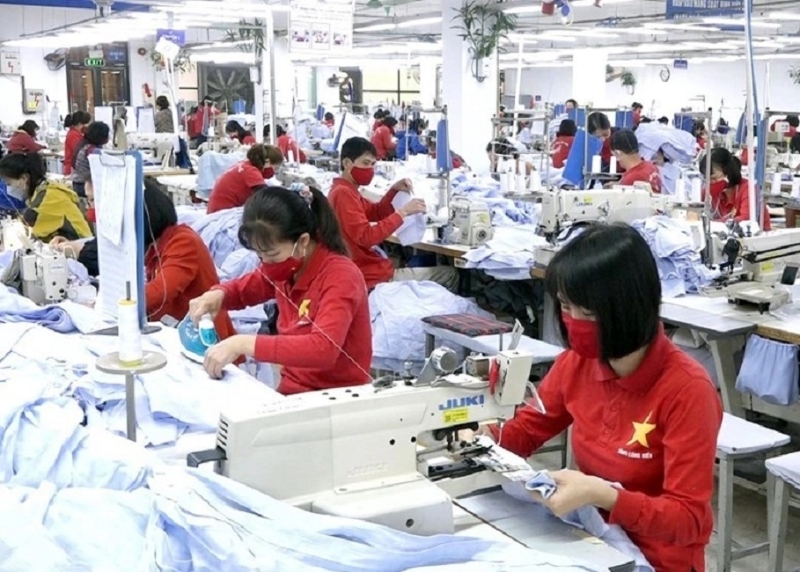
Vietnam’s textile and garment industry’s export target of $49-49.5 billion this year is achievable in spite of facing mounting challenges from global disruptions triggered by the Middle East conflict, according to a 2026 industry report by the Vietnam Textile and Apparel Association (VITAS).
The blockade of the Red Sea has forced cargo ships to reroute via the Cape of Good Hope, extending delivery times by 14–20 days—dealing a heavy blow to fast fashion, which relies on short production cycles. Freight costs have surged, with container rates to the US and EU rising two to threefold, while shipments to the US East Coast face additional war risk surcharges of $2,000–4,000 per container. Meanwhile, ports in Vietnam such as Cat Lai and Hai Phong are also grappling with shortages of empty containers.
The sector, which depends on imported materials for over 70% of its inputs, is further strained by rising oil prices, pushing up costs of synthetic fibres and dyes, while a stronger US dollar makes imports more expensive.
Exporters are also at risk of order delays or cancellations in the Middle East market.
The crisis is reshaping buyer strategies in the US and EU, with fast fashion orders shifting away from Vietnam due to longer shipping times. Instead, importers are prioritising higher-margin products and demanding faster production to offset logistics delays.
Despite these pressures, VITAS said the 2026 export target of $49–49.5 billion remains achievable if firms pursue market, product and customer diversification, while restructuring logistics, boosting domestic sourcing, and accelerating digital transformation and ESG compliance.





 Google translate