



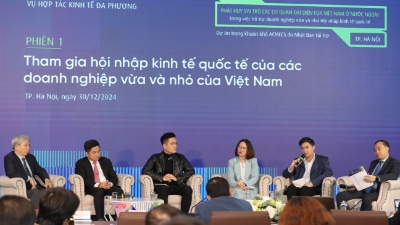
During a working session between the Vietnam Chamber of Commerce and Industry (VCCI) and the Standing Board of the National Assembly’s Committee for Economic and Financial Affairs, Mr. Dau Anh Tuan, Deputy Secretary-General of VCCI, presented an in-depth analysis and a comprehensive system of solutions aimed at refining the Draft Law on Support for Small and Medium Enterprises (amended).
Mr. Tuan outlined 11 quantifiable recommendations to ensure the law provides practical and effective support for small and medium enterprises (SMEs).
VCCI argued that the current universal threshold of fewer than 300 employees and revenue below VND400 billion ($15 million) is restrictive for material-intensive industries like electronics (where material costs account for 85-90% of production costs). This causes businesses to lose support "before they have a chance to grow." VCCI proposed raising the revenue ceiling to VND1 trillion ($38 million) for specific sectors and allowing a three-year transition period once the threshold is exceeded.
The proposal suggests extending Corporate Income Tax (CIT) incentives to medium-sized enterprises in manufacturing and supporting industries. It also calls for additional incentives for expansion investment and technological innovation for existing units.
VCCI recommended that the Government establish a valuation framework for intangible assets, intellectual property rights, and purchase orders. Furthermore, they proposed shortening appraisal times and setting a minimum interest rate subsidy of 2% per annum to ensure parity with green projects under Article 21.
The recommendation seeks to allow direct deductions from land rent instead of reimbursements through infrastructure developers. It also proposes a 30% rent reduction for seven years for both direct lessees and existing supporting industries, ensuring synchronization with the 2024 Land Law and Resolution 198/2025/QH15 of the National Assembly.
VCCI proposed expanding the scope of deductible R&D expenses and simplifying procedures for the Science and Technology Development Fund in accordance with Resolution 57-NQ/TW of the Politburo.
The proposal aims to quantify support at a minimum of 50% of costs (with a cap), explicitly naming technologies such as ERP, MES, AI, and IoT, while allowing for the accelerated depreciation of software assets.
VCCI recommended increasing the interest rate subsidy to 3% per annum and expanding eligibility to standard manufacturing blocks with green projects. They also proposed funding at least 50% of the costs for certifications and greenhouse gas inventories, providing support for CBAM (Carbon Border Adjustment Mechanism) compliance, and allowing 150% of ESG consulting costs to be treated as deductible expenses.
VCCI suggested applying simplified accounting for small enterprises, implementing "one-time declaration" data linkage, and stipulating that support is only excluded when there is a legally effective judgment in order to respect the "presumption of innocence" principle, according to Resolution 68-NQ/TW of the Politburo on private sector development.
VCCI proposed legalizing the spirit of "guidance before penalties" as a core principle for the entire SME sector, to be included in Chapter I or Article 5.
The recommendation calls for strict monitoring mechanisms to ensure a minimum 20% of public procurement funding is allocated to SMEs, with priority given to domestic products and supporting industries.
Finally, VCCI proposed new regulations regarding support for fire safety compliance; funding for technology transfer within industrial clusters (Article 22); a dedicated chapter to directly amend specialized laws; a "Sandbox" pilot mechanism to exempt liability for objective risks during innovation; and clarifying the scope of "Support Vouchers."



 Google translate