


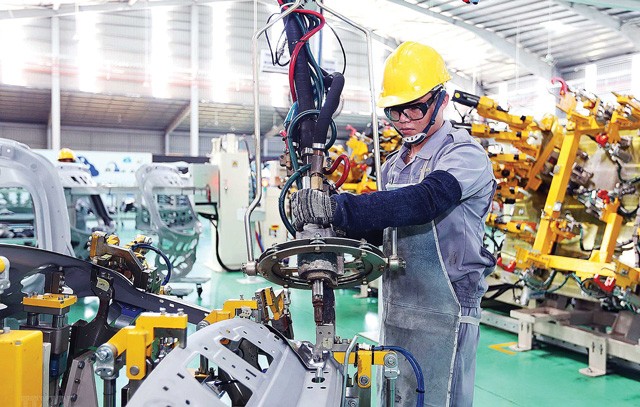
Vietnam’s manufacturing sector is entering another stage of development as global trade patterns change, supply chains are reconfigured, and companies reassess their production footprints. “Vietnam’s Next Manufacturing Frontier 2026,” a strategic market analysis by Acclime Vietnam with expert insights and material analysis from Avison Young Vietnam, BW Industrial, and FVSource, describes a manufacturing economy that has expanded well beyond a low-cost production base.
Vietnam recorded $38.4 billion in registered FDI and $27.6 billion in disbursed FDI in 2025; the highest result in the latter for five years. In the first half of 2026, registered FDI totaled $34.65 billion, up 61 per cent against the same period of 2025, with $13 billion already disbursed. Manufacturing and processing absorbed roughly 70-80 per cent of the inflows.
The report identified geopolitical fragmentation, supply chain reconfiguration, trade policy changes, and technological development as factors reshaping global manufacturing. Within that environment, Vietnam’s geographic position, free trade agreements (FTAs), operating costs, and developing industrial ecosystem have supported its role in regional and global production networks.
Changing global trade map
Vietnam’s manufacturing expansion is taking place alongside a shift toward a more multipolar global trading system. The report describes the emergence of “connector” economies around China, including Vietnam, as companies and supply chains become more geographically distributed.
Vietnam benefits from a land border with China, allowing components to move overland, while its coastline and deep-water ports provide access to international shipping routes. The country has also signed 18 FTAs, including the Comprehensive and Progressive Agreement for Trans-Pacific Partnership (CPTPP), the EU-Vietnam FTA (EVFTA), and the Regional Comprehensive Economic Partnership (RCEP), providing exporters with preferential or duty-free access to major consumer markets.
“Trade patterns have shifted in ways we have not seen before,” said Mr. Vlad Savin, Director, Markets & Growth - ASEAN, at Acclime. ‘Traditional trade models based on cost efficiency, linear supply chains, and predictable market access are being disrupted by a more complex global environment. Trade is increasingly shaped by strategic alliances, bilateral arrangements, and regional agreements, with companies needing to navigate not only commercial considerations but also policy direction, geopolitical alignment, and regulatory change. As a result, the global trading system is becoming denser, more fragmented, and more multipolar, with China at its core and a ring of connector economies around it.”
He added that Vietnam is well positioned within this structure, while companies operating in the country will need to remain flexible as global policy and market conditions change.
The regulatory environment is also evolving. The report highlighted changes to the Law on Investment, the Law on High-Tech, and the corporate income tax framework, as well as support for R&D and high-tech activities. Export processing enterprises (EPEs) can receive import duty and VAT exemptions on raw materials and equipment, subject to licensing, customs, and operational requirements.
For foreign manufacturers, the sequencing of investment decisions can be important. According to Ms. Thao Nguyen, Senior Manager - Licensing and Corporate Secretarial, at Acclime Vietnam, the most expensive mistakes are not regulatory, but sequencing. “Investors who treat licensing as paperwork to be handled after the site and structure are chosen end up rebuilding both,” she said. “The ones who succeed decide three things before they file anything: where the factory sits, whether it is an EPE or a non-EPE, and how origin will be documented for every product line.”
Environmental requirements are another part of the investment process. Manufacturing projects are classified according to environmental risk, with higher-risk projects requiring environmental permits before construction or operation. Projects outside the highest-risk groups may still be subject to environmental registration, while factories using hazardous chemicals or generating wastewater, exhaust, or solid waste may require early environmental assessment.
Origin requirements are similarly relevant to export manufacturers. Under major agreements such as the CPTPP, the EVFTA, and the RCEP, simple repackaging, relabeling, basic assembly, quality inspection, and simple cutting do not establish Vietnamese origin. The report noted that customs authorities have become more stringent in enforcing rules against tariff circumvention.
Mr. Lance Li, CEO of BW Industrial, described the direction of the manufacturing market in terms of the capabilities companies are seeking. “We see Vietnam gradually moving up the global value chain, evolving from an alternative production base into a strategic manufacturing hub in Asia,” he said. “Manufacturers today are looking beyond labor costs. They increasingly value speed, reliability, supply chain resilience, and long-term operating certainty. Vietnam is responding in kind: not only by upgrading its transport infrastructure but also by building out industrial ecosystems, strengthening power reliability, and developing institutional-grade industrial facilities.”
Uneven sectoral growth
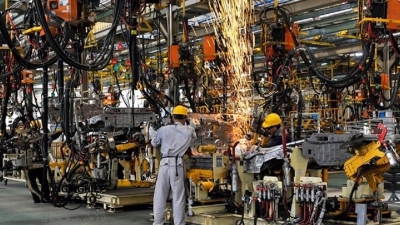
Electronics and semiconductors are among the most developed areas of Vietnam’s manufacturing economy, with the country being a manufacturing base for companies such as Samsung, Intel, LG, Foxconn, Amkor Technology, and Hana Micron. While assembly, testing, and packaging remain important, recent investment has expanded into integrated circuit (IC) design, advanced packaging, and wafer fabrication.
Exports of computers, electronic products, and components reached approximately $107.7 billion in 2025, accounting for nearly 22.7 per cent of national exports. Including telephones and related components, total electronics exports exceeded $164.4 billion. During the first half of 2026, electronics exports totaled $102.85 billion.
Vietnam’s semiconductor strategy includes targets for at least 30 packaging and testing facilities, 300 semiconductor design companies, three semiconductor fabrication plants, and 50,000 semiconductor engineers by 2030. In 2025, it approved its first commercial wafer fabrication project, worth approximately $500 million.
“Vietnam’s electronics sector has developed significantly, especially in assembly, printed circuit board assembly (PCBA), consumer electronics, lighting, smart devices, cables, wiring, and certain industrial electronics,” said Mr. Pietro Karjalainen, Co-Founder and CSO of FVSource. “There are factories in Vietnam that can meet international standards, work with export customers, and manage technical documentation.”
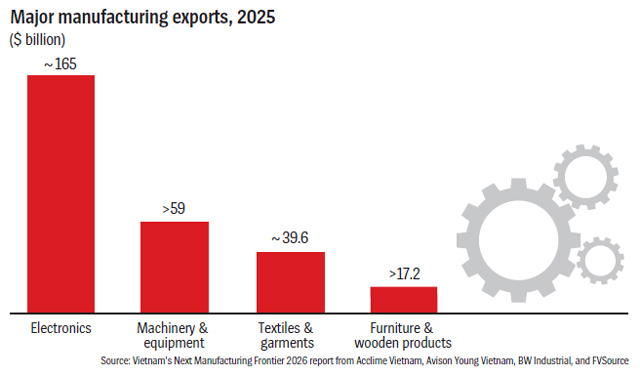
Furniture and wooden products represent another established export sector. Vietnam ranked second globally last year for furniture exports, behind China, and shipped finished goods to 166 countries and territories. Wood and wooden product exports exceeded $17.2 billion, up 5.7 per cent from 2024, while the industry is targeting $19 billion this year.
The sector’s development has been supported by accumulated capabilities in export compliance, quality control, and large-scale production. Vietnamese suppliers now serve global retailers such as IKEA, Walmart, and Ashley Furniture, while leading manufacturers are adopting smart-factory processes, Internet of Things (IoT)-enabled production lines, and enterprise resource planning (ERP) systems.
Compliance requirements are also extensive. Vietnam’s Timber Legality Assurance System requires chain-of-custody documentation across the wood supply chain. US-bound furniture must comply with the Lacey Act and applicable formaldehyde standards, while EU requirements include rules covering green claims and deforestation-related due diligence.
Textiles and garments have likewise established a large export base. The sector generated $39 billion in export revenue in 2025, up 7 per cent year-on-year, while Vietnam accounted for 20.6 per cent of US apparel imports during January-July 2025. The country now accounts for nearly 6 per cent of global textile and apparel exports.
However, the industry’s production structure remains concentrated at the garment stage. Of approximately 3,800 textile factories, 70 per cent are garment producers, compared with 6 per cent for yarn, 17 per cent for fabric, and 4 per cent for dyeing. As of January 2026, domestic production met only around 25 per cent of fabric demand.
Vietnamese factories are strongest in apparel, particularly knitwear, woven shirts, trousers, denim, uniforms, sportswear, and light outerwear. Home textiles are a solid secondary segment, while technical textiles and performance fabrics remain smaller, more mill-dependent niches.
Machinery and equipment show another side of the manufacturing economy. Vietnam imported $61.02 billion in machinery, instruments, and accessories in 2025, making machinery the country’s second-largest import category with 13 per cent of total import turnover. At the same time, machinery and instrument exports exceeded $59 billion, including $24.1 billion to the US, $7.1 billion to the EU, and $5.5 billion to China.
More than 70 per cent of machinery and equipment used in Vietnamese industry is still imported, primarily from China, Japan, and South Korea. Domestic capabilities have expanded through a network of metalworking small and medium-sized enterprises (SMEs) providing stamping, forging, casting, machining, cutting, and welding, while software-integrated systems, advanced automation programming, and original equipment design remain less developed.
Industrial geography shifts
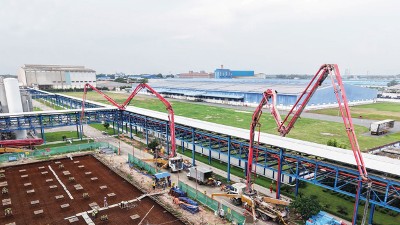
Vietnam’s industrial property network has expanded alongside manufacturing. The country now has 478 established industrial parks (IPs), including 421 outside economic zones, 49 within coastal economic zones, and eight within border economic zones. Of these, 324 are operational.
Northern Vietnam is developing through several industrial tiers. Hanoi, Bac Ninh, and Hai Phong form the core for high-tech manufacturing, specialized logistics, and maritime activity. Hung Yen, Quang Ninh, and Ninh Binh form a surrounding group of growth poles, while Thai Nguyen, Phu Tho, and Lang Son are developing as a cross-border corridor linked with southern China. Together, these localities account for 38,185 ha of planned industrial land, including 26,314 ha of net leasable area, with occupancy at around 75 per cent and average lease prices at 129 per sq m per term.
Southern Vietnam has 16,113 ha of ready-for-lease industrial land, with average asking rents of $188 per sq m per term. Ho Chi Minh City is focused increasingly on high-tech industries and R&D, Binh Duong remains the main manufacturing base, and Vung Tau serves as a maritime logistics gateway.
Central Vietnam is also developing its industrial base. Da Nang recorded technical occupancy of 87 per cent, with asking rents of $95-145 per sq m per term, while Quang Nam accounted for 57 per cent of regional supply.
Describing the development of IPs, Mr. David Jackson, Principal and CEO of Avison Young in Vietnam and Cambodia, believes that next-generation IPs are transitioning from a land-leasing model to integrated industrial ecosystems, incorporating energy infrastructure, technology,
Ready-built factories are also becoming part of manufacturers’ location options. The report compared greenfield, brownfield, and ready-built facilities, noting that greenfield development can involve 12-36 months of development, long-term land commitments, and substantial upfront capital. Ready-built factories can be operational in three to seven months, with rents at around $5 per sq m per month and flexible lease terms.
Technology and manufacturing readiness
Technology adoption is progressing, though unevenly across Vietnam’s manufacturing base. Larger export-oriented factories have adopted automation, ERP systems, production tracking, barcoding, and digital quality records, particularly in electronics, packaging, automotive components, furniture, and textiles.
AI adoption, however, remains at an early stage. Some manufacturers are piloting AI for production planning, demand forecasting, quality inspection, and document management, while many small and mid-sized factories continue to rely on manual workflows, spreadsheets, and paper-based records.
Cost remains part of the manufacturing equation. Business electricity prices in Vietnam were approximately $0.079 per kWh in September 2025, compared with $0.117 in China, $0.123 in Thailand, $0.139 in Malaysia, $0.212 in Singapore, and $0.235 in Mexico, according to Global Petrol Prices data cited in the report.
“Vietnam remains one of Asia’s most compelling manufacturing destinations, but long-term success depends on looking beyond the initial cost advantage,” Mr. Jackson said. “Manufacturers should carefully assess infrastructure connectivity, labor depth, power reliability, supply chain access, regulatory requirements, and whether the selected location can support future expansion. The right industrial location should not only work for Day 1 operations but also provide room to scale as production, logistics, and workforce requirements grow.”
The report’s closing assessment is that Vietnam’s manufacturing competitiveness increasingly combines manufacturing scale, execution speed, policy stability, and global connectivity. Electronics and semiconductors are moving toward advanced packaging, testing, and product design, while textile and furniture manufacturers are developing capabilities around quality, sustainability, traceability, and brand value.
Mr. Savin described the operating environment that manufacturers now face. “The challenge for manufacturers today is building a business that can respond confidently to constant change,” he said. “Customer demand shifts faster, trade policies evolve, and geopolitical disruptions have become a recurring feature of the global business environment. In this context, resilience and adaptability are a source of competitive advantage and a growth pillar, rather than a protection mechanism.”
The report identified a manufacturing landscape in which sector capabilities, industrial locations, logistics, technology, workforce, and regulatory requirements are increasingly interconnected. The next stage of development will therefore involve not only continued investment in production capacity but also further development of the industrial and supply chain infrastructure surrounding it.





 Google translate