



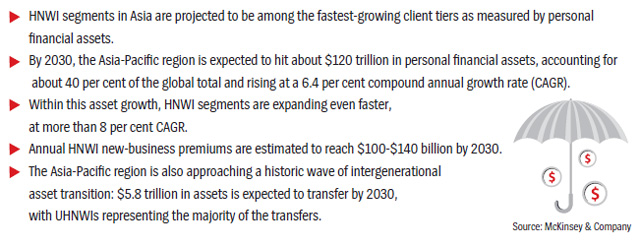
The assets of Asia’s high-net-worth individuals (HNWIs) are growing quickly, especially in wealth hubs such as the Hong Kong (China) and Singapore, according to a recent McKinsey & Company report. At the same time, the requirements and expectations of HNWI clients in Asia are evolving. They are seeking liquidity when it matters (family support and business continuity), protection across uncertainty (longevity risk and health), and control of wealth transfer to the next generation. The multi-jurisdictional family structures, cross-border wealth, and increased expectations of control are challenging traditional wealth solutions in the Asian HNWI market.
Market evolution
The evolution of this market offers a big opportunity and challenge for insurers in Asia. McKinsey & Company estimates annual HNWI new-business premiums in Asia will reach $100-$140 billion by 2030. As part of a holistic wealth strategy, insurance can offer guaranteed liquidity, payout certainty, and risk protection in a single integrated solution. At the same time, it can complement trust structures, which provide governance and control over asset distribution. Well-structured insurance solutions also offer accessible cash value and flexibility in allocating assets across beneficiaries as well as support efficient wealth transfer and estate planning.
Despite rapid wealth creation across Asia, the HNWI insurance market remains structurally underpenetrated, creating a window of opportunity for insurers. Only 15-20 per cent of HNWIs in the region have integrated life insurance into their wealth planning, according to industry estimates and McKinsey & Company’s interviews with insurance CEOs and other experts.
Some insurers are pursuing this market with their existing retail playbook: more advisors and more life insurance policies wrapped around an investment portfolio. McKinsey & Company believes that approach is ill-adapted to the HNWI segment. Insurance in Asia is less about selling individual products than developing new capabilities that enable underwriting authority, cross-border operating muscle, and a service model that signals status and certainty. To that end, this market requires a dedicated business with its own operating model within the insurer.
In addition, brokers remain the gatekeeper in HNWI insurance, often controlling access to clients and influencing product selection and pricing conversations. At the same time, a parallel opportunity is emerging for insurers to partner with fast-growing mid-tier private banks, financial advisors, and external asset managers looking to strengthen their wealth offerings and increasingly open to embedding insurance into holistic client solutions. To succeed, insurers can position themselves as the default risk-and-legacy partner for multi-jurisdiction families.
Asian marketplace splitting into two groups
Retail-first insurers and HNWI specialists designed for complexity now define the HNWI competitive landscape.
Retail-first insurers moving upmarket. This group is extending the proven affluent market client model into the HNWI segment. These insurers’ approach is based on scale with broader distribution access (financial advisors, insurance agents, bancassurance, and brokers), targeting entry-level HNWI and younger emerging wealthy segments, relatively smaller case sizes, a domestic market focus, and a higher degree of reinsurance cession to manage risk.
This model can potentially be effective in capturing growth at the lower end of the HNWI spectrum and in building early relationships with future HNWI clients. Some insurers are adding pockets of underwriting expertise or selective offshore access to push further upmarket.
HNWI specialists designed for complexity. These insurers (existing players and new units of incumbents) are designed from the ground up to serve HNWI and ultra-high-net-worth-individual (UHNWI) clients across jurisdictions. Their models typically combine multi-booking centers (for example, Bermuda, Hong Kong (China), and Singapore). The distribution is more curated, often broker-led or employing banking partnerships. These insurers have greater risk-retention tolerance with higher-sum assured underwriting supported by strong reinsurer access, and they are competing on capability depth. Beyond bringing innovative products to market quickly, their proposition features rapid execution.
Retail-first insurers can continue to scale in the emerging HNWI segment. But as client needs get more complex and case sizes increase, the bar shifts from distribution reach to underwriting depth, from product innovation to execution reliability, and from onshore engagement to offshore orchestration.
One example is the variation in auto binding limits (the maximum sum assured an insurer can issue under its delegated underwriting and reinsurance authority without requiring facultative approval). These limits can vary significantly across insurers. Specialist HNWI carriers may operate with auto binding limits of $50-$75 million or more, while retail-first insurers often have limits closer to $2-$10 million. This difference can materially affect speed, certainty, and the ability to compete for large and complex cases.
Six building blocks
Some retail insurers might treat the HNWI opportunity as a segment expansion needing limited investment. According to McKinsey & Company, success in this segment requires building a dedicated unit with its own capabilities, operating model, and talent, and leveraging any synergies with the wider group. This means underwriting authority for complex risks, cross-border reach, a service model built around the client’s lifecycle stages, and specialist talent that can engage directly with the HNWI client and across the HNWI ecosystem of brokers, private banks, and family offices.
The following offers a path forward for building a winning position in the Asian HNWI market: build a clear view of your target HNWI customer; drive solution engineering; build underwriting authority as a strategic asset; re-anchor distribution around the true control points; engineer a cross-border operating spine; and design a premium service model that suits the focus segment.
The six capabilities are not a checklist to complete before the HNWI business launch. The objective is to establish the right to compete quickly, deliver early commercial results, and strengthen the capabilities as the business scales.
Mr. Vishal Kaushik, Expert Associate Partner, and Bernhard Kotanko, Senior Partner at McKinsey & Company, tell Vietnam Economic Times / VnEconomy about the report’s findings at the Asia level and their potential relevance for Vietnam’s insurance market.
McKinsey projects $100-$140 billion in annual new-business premiums from Asia’s HNWI segment by 2030, yet only 15-20 per cent of HNWIs in the region have integrated the insurance into their wealth planning. What does this opportunity specifically mean for Vietnam’s insurance market?
The research was conducted at the Asia level, so we would not translate the regional opportunity of $100-$140 billion directly into a Vietnam-specific market estimate.
What may be relevant for Vietnam, as for other markets, is that as wealth grows, insurance can play a broader role in a family’s overall wealth architecture. Rather than providing mortality protection alone, insurance can also help address liquidity, business continuity and succession, and intergenerational wealth transfer. These themes could be particularly relevant to wealthy families in Vietnam.
How do the needs of HNWI clients in Vietnam differ from those of the mass market, particularly in areas such as legacy planning, liquidity, business continuity, and family protection? What does this imply for how insurers should design products and advisory services?
The distinction highlighted in our research is less about geography and more about complexity. As wealth increases, client needs tend to move beyond individual protection products towards what we describe as “life-stage architecture.” This encompasses liquidity planning, legacy transfer, business succession, health, retirement, and wealth structuring.
For insurers, the implication is not simply to take a mass-market product and increase the sum assured. HNWI clients require greater customization, more sophisticated underwriting, stronger service, and greater coordination with the wider ecosystem around the family.
More standardized high-value solutions may be appropriate for emerging HNWIs. High-net-worth-plus clients, however, are more likely to require bespoke solutions and institutional-grade expertise.
What will it take for insurers and advisers in Vietnam to move beyond traditional product-led distribution toward more integrated wealth-protection propositions that combine insurance with legal, tax, and investment advice?
Our industry findings should be viewed as a framework for asking the right questions in Vietnam, rather than as a prescribed model for the Vietnamese market.
Serving HNWIs effectively requires a shift from selling individual insurance products to addressing broader client needs. This does not mean that an insurer needs to become a tax adviser, lawyer, investment manager, and insurer simultaneously. Rather, it points toward an ecosystem model in which insurers work effectively with the firms and individuals already advising wealthy families, including private banks, brokers, financial advisers, family offices, and relevant legal and tax specialists.
A few capabilities will be particularly important:
- Advisers who can understand a client’s broader wealth and family objectives rather than leading with a product.
- An operating model that can coordinate effectively across different specialists and intermediaries.
- Underwriting and service capabilities that can handle larger and more complex cases with speed and certainty.







 Google translate