



The total operating income (TOI) of Vietnam’s 28 listed banks in the first half of 2026 stood at VND410.9 trillion ($15.8 billion), an increase of 16.8 per cent. Net interest income (NII) rose 17.1 per cent year-on-year, accounting for 78.4 per cent of the increase in TOI. Net fee income rose 57.6 per cent and contributed 30.5 per cent, while foreign exchange and securities trading reduced TOI growth by about 15.2 per cent.
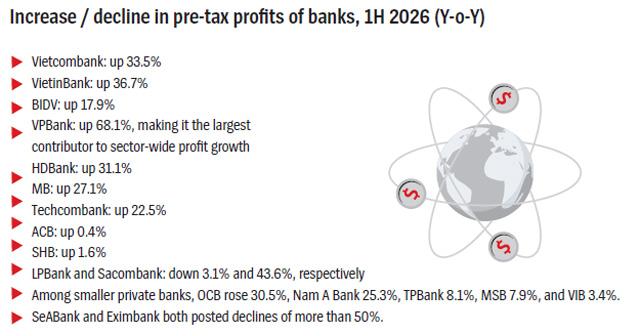
Pre-tax profit at the 28 listed banks reached VND206.195 trillion ($7.9 billion) in the period, up 19.6 per cent year-on-year. In the second quarter alone, profit reached VND111.255 trillion ($4.3 billion), up 24.5 per cent year-on-year and 17.2 per cent from the previous quarter. However, stronger earnings have come alongside funding pressures, a declining net interest margin (NIM), and rising Stage 2 loan risks, pointing to increasingly divergent prospects for the second half of the year.
Funding structure under pressure
By the end of the second quarter, outstanding credit at the 28 banks totaled VND15,838 trillion ($609.1 billion), increases of 18.2 per cent year-on-year, 9.2 per cent since the beginning of the year, and 5.5 per cent quarter-on-quarter. All 28 banks recorded positive year-on-year credit growth.
Most of the absolute increase remained concentrated among larger banks. BIDV, Vietcombank, and VietinBank accounted for about 29.3 per cent of the year-on-year increase, while large private banks contributed nearly 55 per cent.
State-owned banks grew more slowly but remained dominant in scale, with credit rising 14.7 per cent at BIDV, 12.8 per cent at Vietcombank, and 10.1 per cent at VietinBank. Among large private banks, VPBank, MB, HDBank, and Techcombank posted growth of 40.6 per cent, 37.8 per cent, 32.7 per cent, and 25.1 per cent, respectively.
The divergence reflects differences in credit limits, capital capacity, and funding conditions. ACB’s credit rose 17.9 per cent year-on-year, compared with just 9.8 per cent at Sacombank.
Banks also expanded their corporate bond holdings. Combined portfolios reached VND257.204 trillion ($9.9 billion), up 39.9 per cent year-on-year and 41 per cent quarter-on-quarter, though they accounted for only 1.6 per cent of total credit.
Credit remained concentrated in capital-intensive sectors with longer loan tenors, including real estate and construction. Such lending can improve asset yields but also increases exposure to project legal risks, repayment capacity, and the property cycle.
The funding side remains a concern, as credit growth outpaced customer deposits. Core funding at the 28 banks reached VND19,500 trillion ($750 billion), up 18.4 per cent year-on-year. Customer deposits increased only 11.9 per cent, compared with 45.4 per cent growth in deposits and borrowings from other credit institutions and 23.5 per cent growth in valuable papers.
Customer deposits accounted for around 75-80 per cent of core funding at Vietcombank, BIDV, and VietinBank, compared with 59 per cent at VPBank, 64 per cent at Techcombank, 62 per cent at ACB, and 65 per cent at MB. OCB, Nam A Bank, SeABank, MSB, and TPBank had ratios of around 51-59 per cent.
Banks expanding credit faster than deposits must rely more heavily on higher-cost or shorter-term funding, putting further pressure on funding costs and NIM.
The sector’s trailing 12-month NIM fell to 2.95 per cent; four basis points below 2025. While yields on interest-earning assets recovered around 35 basis points, funding costs increased nearly 42 basis points.
This means faster credit growth has not translated proportionately into interest income, particularly for banks relying on long-term deposits, valuable papers, or interbank funding.
State-owned banks maintained NIMs of around 2.1-2.7 per cent, reflecting their stable deposit bases as well as customer concentration among large corporates and their role in maintaining supportive interest rates.
Warning signs from Stage 2 loans
The non-performing loan (NPL) ratio remained broadly stable, but NPL balances continued to rise. NPLs at the 28 banks reached VND314.3 trillion ($12.1 billion), up 17.2 per cent from the beginning of the year. The NPL ratio stood at 2.02 per cent, increasing just 14 basis points as credit expanded.
Sacombank, VietinBank, BIDV, and HDBank accounted for almost all of the net increase in NPLs in the second quarter, indicating that deterioration was concentrated among several banks rather than uniform across the system.
Stage 2 loans increased faster, reaching VND213.2 trillion ($8.2 billion), up 28.3 per cent from the beginning of the year. Their ratio rose 20.8 basis points to 1.37 per cent, bringing the combined Stage 2-5 ratio to 3.39 per cent. In the second quarter, 15 of the 28 banks recorded an increase in their Stage 2 ratio, potentially signaling credit risks before they are fully reflected in NPLs.
Risk levels varied widely. Sacombank’s NPL ratio reached 7.54 per cent, while its Stage 2 ratio stood at 2.65 per cent and total problem loans exceeded 10 per cent. HDBank had an NPL ratio of 2.79 per cent and Stage 2 loans of around 4.7 per cent, while VPBank recorded 3.28 per cent and 3.17 per cent, respectively, with a Loan Loss Reserve (LLR) of 56 per cent. OCB and VIB had combined Stage 2-5 ratios of around 5.5-5.9 per cent.
By contrast, Vietcombank had an NPL ratio of 0.61 per cent and an LLR of 279 per cent. Techcombank and ACB had NPL ratios of around 1-1.1 per cent and LLRs above 100 per cent, while VietinBank maintained an NPL ratio of around 1.2 per cent and an LLR of 134 per cent.
Provisioning expenses reached VND83 trillion ($3.2 billion) in the first half of the year, up 20 per cent year-on-year. Excluding Sacombank, the increase was 11.4 per cent. Sacombank accounted for 43.5 per cent of the increase, while the five largest banks accounted for almost all of the sector’s net increase. First-half provisions were already equivalent to around 1.11-times the full-year 2025 figure.
Provisioning trends also diverged. Vietcombank’s provisions rose 91.8 per cent year-on-year, VietinBank’s 17.3 per cent and BIDV’s 6 per cent. Among large private banks, Sacombank’s provisions surged 542.7 per cent, LPBank’s 134.9 per cent, ACB’s 60.3 per cent, and VPBank’s 23.7 per cent. HDBank and Techcombank recorded declines of 30 per cent and 24.6 per cent, respectively, while MB was nearly unchanged.
Test in the final quarter
Credit growth is expected to remain strong in the second half of 2026 as economic growth supports demand for capital. Circular No. 25/2026/TT-NHNN raises the cap on short-term funds used for medium- and long-term lending from 30 per cent to 40 per cent, creating additional lending capacity for housing, real estate, and infrastructure. Decision No. 1743/QD-NHNN and Official Letter No. 5386/NHNN-TD also expand credit capacity for key projects. However, growth will vary depending on credit limits, project financing capacity, and funding conditions.
The NIM is unlikely to recover evenly while interest rates remain elevated. Faster credit growth than deposit growth will continue to pressure funding costs, particularly at banks with high loan-to-deposit ratios or greater reliance on interbank funding. Banks with high CASA (Current Account and Savings Account) ratios and deposit growth closer to credit growth will have more room to maintain margins.
Against this backdrop, banking-sector profits in the second half of 2026 will remain differentiated. Performance will depend mainly on TOI growth, operating-cost control through CIR, and developments in Stage 2 loans and credit provisions.
Law No. 96/2025/QH15 and Decree No. 304/2025/ND-CP strengthen lenders’ rights to handle collateral, which is particularly relevant for banks with large NPLs and retail and real estate portfolios. However, the impact on profitability will still depend on each bank’s asset quality, provisioning buffer, and funding structure.








 Google translate